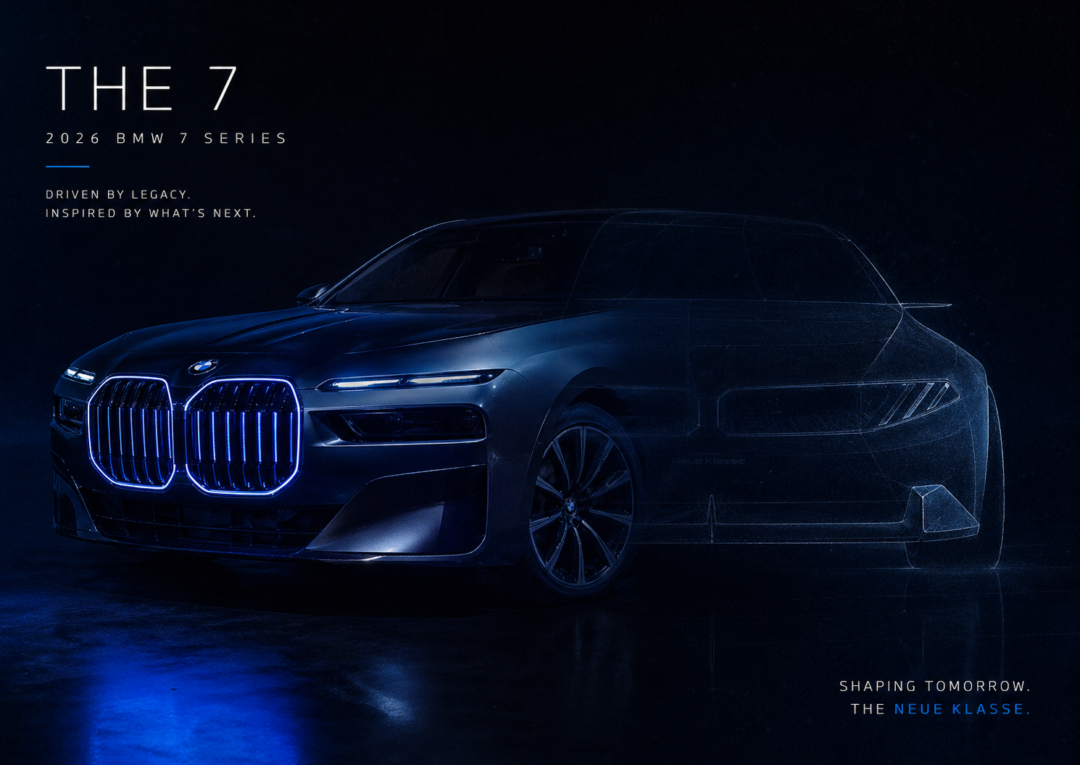
⚙️ Automotive Deep Dive | 2026 Model Year
The 2026 BMW
7 Series:
Where Neue Klasse
Meets Now.
Here’s a question worth sitting with for a second: what do you do when your most important car is already excellent — and you still need to make it feel like the future?
That’s the challenge BMW faced with the 2026 7 Series. The G70 generation, launched in 2023, was already a bold step. Massive. Tech-heavy. Polarising by design. But with the Life Cycle Impulse — BMW’s term for a mid-cycle update — arriving for the 2026 model year, the company went further than most people expected. This isn’t a facelift. It’s a deliberate architectural shift, one that plants the 7 Series squarely in line with the Neue Klasse philosophy BMW has been building toward since the iX1 and i5 era.
If you work in automotive, follow EV market trends, or are simply in the market for a flagship luxury sedan, the 2026 7 Series deserves a proper read-through. Let’s give it one.
What Even Is Neue Klasse — And Why Does It Matter Here?
Before we get into spec sheets and powertrain tables, it helps to understand the context. Neue Klasse — German for “new class” — is BMW’s overarching next-generation platform strategy. It’s not just an EV architecture. It’s a complete rethink of how a BMW is designed, built, experienced, and updated over its lifetime.
The philosophy has three pillars. First, a sixth-generation circular cell battery technology that improves energy density by roughly 20% while reducing costs. Second, a brand-new E/E architecture that allows over-the-air software updates at a level that legacy platforms simply can’t match. And third — the one most visible in the 2026 7 Series — a design language that strips away visual noise and finds confidence in restraint.
The upcoming Neue Klasse electric vehicles — the next 3 Series EV, the iX3 successor — will be fully native to this platform. But BMW isn’t waiting. The 2026 7 Series LCI translates several of these principles into its existing G70 architecture. Think of it as the bridge version: built before the platform switch, but designed to speak the same visual and technical language.
The Design Language Shift — Subtle, Intentional, Debated
Look — the 7 Series G70 was always going to be a conversation starter. The split-headlight design. The kidney grille that takes up what feels like 40% of the front face. It divided opinion the moment it launched. BMW knew this going in.
For the 2026 LCI, the company made some deliberate refinements without backing down from the original statement. The split-light signature is tightened. The lower front bumper treatment is cleaner, borrowing surfacing cues from the Neue Klasse concept cars. The rear gets a more integrated diffuser element and a slightly revised light bar treatment that links the taillamps more cohesively.
These aren’t drastic changes. But they tell you something important about BMW’s thinking: they still believe in the original design direction — they’re just making it sharper. The visual identity of the 7 Series is now meant to feel like a preview of what Neue Klasse production cars will look like, not a departure from them.
New Exterior Colour and Trim Pairings
The 2026 model year introduces three new Individual exterior colours — including a deep Frozen Tanzanite Blue Metallic that’s already getting significant attention in configurator screenshots — alongside new Merino leather interior options in the Exclusive Lounge Rear compartment. If you’re ordering for a client who cares about individuality, the BMW Individual programme for this generation is now wider than it’s ever been.
Every Powertrain Option, Explained Plainly
One of the things that genuinely makes the 7 Series interesting from an industry perspective is its breadth. BMW isn’t betting on one drivetrain answer — they’re offering combustion, plug-in hybrid, and full electric in a single body style. Let’s walk through what’s available.
2026 BMW 7 Series — Full Powertrain Lineup
3.0L inline-six, 375 hp, rear-wheel or all-wheel drive. The entry point. Still genuinely quick and the purist’s pick.
Plug-in hybrid. 3.0L six + electric motor. 490 hp combined. Up to ~50 miles electric-only range. The practical choice for buyers who want optionality.
4.4L twin-turbo V8, 536 hp. The combustion flagship. 0–60 in under 4.0 seconds. For those who simply aren’t ready to let go of the V8 note.
Dual-motor electric. 483 hp. Estimated 320+ miles EPA range with 2026 battery revision. The volume EV variant globally.
High-performance electric. 544 hp. 0–60 in 3.7 seconds. The performance flagship of the entire 7 Series range — and the one that competes directly with the Mercedes EQS 580 and Lucid Air Grand Touring.
The fact that BMW offers all five in a single vehicle family — including a full performance EV — is genuinely unusual at this price and size segment. It’s a hedging strategy, yes. But it’s also a real advantage for markets where EV infrastructure is patchy and buyers need flexibility.
The AI Cabin — iDrive 9 and What’s Actually New
If there’s one area where the 2026 LCI update genuinely moves the needle, it’s the interior technology stack. The 7 Series was already ahead of most competitors in cabin tech. The 2026 update makes it feel like a properly next-generation environment.
iDrive 9 — BMW’s current infotainment generation — gets meaningful AI refinements in this cycle. The system now learns driver preferences across seven distinct categories: climate, audio, route selection, display brightness, seat positioning, ambient lighting, and suspension mode. Over time — and BMW means actual weeks of driving, not a one-time prompt — the system builds a behavioural profile that begins anticipating adjustments before you make them.
This isn’t quite the conversational AI layer that some startup EV brands are experimenting with. But BMW’s approach is more measured and, arguably, more useful in day-to-day driving. The AI doesn’t interrupt. It learns quietly and surfaces its learnings through suggestions rather than commands.
The Theatre Screen — Still the Most Impressive Rear Seat Tech in Its Class
The optional 31.3-inch 8K rear entertainment screen remains exclusive to the 7 Series at this price point. For 2026, it gains Amazon Fire TV integration (replacing the previous Android TV-based system) and a new hands-free gesture control layer that works with the optional Privacy Glass partition. The front-to-rear communication system — think of it as an intercom with driver-facing camera — is also improved, with lower latency and a better microphone array for conference call use.
This is relevant if you’re buying this car as a rear-seat car. And at this price point, a meaningful percentage of buyers are.
The 2026 system learns across seven behavioural dimensions. Climate, audio, routing, brightness, seat, lighting, and suspension. No setup required — it observes and adapts over weeks of real driving.
Amazon Fire TV integration replaces the previous platform. Gesture control added for hands-free use. Improved privacy glass partition system. Still the largest and most capable rear screen in the segment.
The optional 1,965-watt, 36-speaker Bowers & Wilkins Diamond Surround Sound system returns, now with improved room-acoustic modelling that adjusts the soundstage based on occupancy and seat position.
The Extended Wheelbase (L) variant’s rear Executive Lounge seats now include a heated and ventilated footrest ottoman and a new Merino leather headrest pillow option — details that are hard to photograph but impossible to ignore once you’ve experienced them.
The 7 Series’ new E/E architecture enables full over-the-air updates including powertrain software, suspension calibration, and iDrive logic — without a dealer visit. A capability BMW is building toward on all future Neue Klasse platforms.
Personal Pilot L3 — BMW’s conditional autonomous driving system — receives an expanded operational speed range for 2026 and improved lane-change initiation logic. Still geofenced, but expanding market availability.
Where the 2026 7 Sits in the Market Right Now
Let’s talk competitive positioning, because this is where the 7 Series story gets interesting from an analyst’s perspective.
The full-size luxury sedan segment has quietly been going through a transformation. Traditional combustion-only flagships — the Mercedes S-Class, Audi A8, Lexus LS — are all managing the transition to electrification at different speeds. Mercedes-Benz has doubled down with the EQS as a separate EV product. Audi has been slower. Lexus is methodical.
BMW’s approach — multiple powertrains in a single 7 Series body — is the most vertically integrated play in the segment. It means a single car on the floor serves the fossil fuel loyalist and the EV-first buyer. For dealers, that’s significant. For the brand, it maintains 7 Series as a unified family rather than splitting attention between a combustion flagship and an EV flagship.
“BMW isn’t building two flagships. They’re building one — that happens to run on whatever you want.”
Automotive Product Strategy, 2026 Segment Overview
Key Competitive Pressure Points
- Mercedes EQS vs. i7: The EQS has range credibility and a longer track record in the pure EV space. The i7 counters with a more driver-focused chassis, stronger brand recognition in key markets, and the option to buy a combustion or hybrid sibling from the same dealership visit.
- Lucid Air Grand Touring: The technology benchmark for electric range in this price bracket. But Lucid lacks the dealer network, service infrastructure, and brand history that matters to a significant cohort of luxury buyers.
- Genesis G90: Surprising value at this tier and increasingly credible. The G90 threatens the 7 Series in markets where BMW’s pricing is at a premium, particularly with buyers who prioritise rear-seat comfort over brand cachet.
- Rolls-Royce Ghost: Not a direct competitor, but increasingly relevant as 7 Series L buyers drift toward Ghost territory in their thinking. BMW Group owns Rolls-Royce — so internally, this is a nuanced conversation about where one ends and the other begins.
The Road That Got Here — A Brief Lineage
Understanding the 2026 LCI requires understanding what BMW was doing before it. The 7 Series has always been the test bed for BMW’s most ambitious technology — and the G70 generation is the most ambitious yet.
Who Actually Buys This Car?
Let’s be real for a second — because the “who is this for” question is actually useful in understanding what the 2026 update is trying to accomplish.
The 7 Series G70 buyer profile is more diverse than it’s ever been, and the LCI reflects that. You have the traditional 7 Series loyalist — typically a senior professional, likely male, late 40s to 60s, who has owned multiple 5 and 7 Series cars and cares deeply about the combustion driving experience. For them, the 760i xDrive with the V8 and optional M Sport Package is the answer.
Then you have the new-money EV buyer — someone who wants the most technologically impressive car at the price point, has a home charger, and isn’t sentimentally attached to an engine note. The i7 xDrive60 or i7 M70 serves them. And BMW’s dealer network — with proper EV consultation and home charging setup support — is increasingly geared to convert this buyer.
And then there’s the rear-seat buyer — the chauffeur-driven executive, the family that has a driver, the long-haul traveller who wants a business-class cabin on the road. For them, the Extended Wheelbase 7 Series L, with the Executive Lounge rear seats, the Theatre Screen, and the Bowers & Wilkins sound system, is essentially a rolling luxury suite. This is the variant that competes with the Lexus LS 500h L and the Genesis G90 LWB most directly.
- The V8 loyalist → BMW 760i xDrive, M Sport Package, Frozen Individual colour, full ADAS suite.
- The EV-first executive → i7 xDrive60, Exclusive Lounge rear, charge at home, Theatre Screen optional.
- The performance EV buyer → i7 M70 xDrive, M Sport Package, 21″ wheels, maximum output spec.
- The chauffeur-driven buyer → 7 Series L Extended Wheelbase, 750e or i7, Executive Lounge Rear, B&W Diamond sound.
- The hybrid pragmatist → 750e xDrive. Gets the electric range for urban commutes, the combustion engine for long trips. No range anxiety. No compromise.
What to Watch After This LCI
The 2026 LCI keeps the G70 generation relevant for at least two more model years. But the story that’s more interesting — from a product strategy standpoint — is what comes after it.
The next-generation 7 Series, presumably arriving around 2028–2029, will be fully Neue Klasse architecture. That means native EV-first platform design, the sixth-generation circular cell battery, dramatically different interior proportions (no combustion transmission tunnel), and a full AI-native software environment from day one rather than retrofitted in updates.
The 2026 LCI, in that context, is the last gasp of the bridge era. It’s the G70 at its most refined, carrying Neue Klasse DNA in its software and design without being fully native to the platform. It’s a genuinely impressive car in its own right — but it’s also a preview of something much more fundamental coming down the road.
For the industry, the 7 Series LCI tells you that BMW isn’t panicking about the transition. They’re pacing it. Using the 7 Series as a field laboratory for Neue Klasse software, AI logic, and customer feedback before committing to the full architectural switch. It’s methodical. It’s expensive. And if the strategy plays out, it’s probably the right call.
Final Word:
The 7 Series Has Never Been This Thoughtful
The 2026 BMW 7 Series LCI doesn’t reinvent a car that was already very good. It sharpens it. It makes the design speak the Neue Klasse language more fluently. It makes the cabin smarter without making it more complicated. It extends the i7’s range meaningfully and refines the combustion variants for a buyer who still wants the V8 experience done right.
Is it perfect? No. The exterior design will still divide people. The starting price puts it in a rarefied bracket that many buyers will only ever configure, not purchase. And the full Neue Klasse promise is still a few years and a full platform switch away.
But as a showcase of how a legacy luxury automaker manages a technology transition without losing its identity — the 2026 7 Series is genuinely worth studying. Not just as a car. As a strategy.
Full LCI · 2026 Model Year

[…] If you’re expecting this comparison to declare a winner, that would be missing the point BMW t… […]