💼 Tech Leadership | April 2026
The End of
an Era:
Tim Cook’s Legacy
Let’s be honest. When Steve Jobs passed in 2011, a lot of people thought Apple was done. “Without Jobs, Apple is nothing.” That was the headline. That was the hot take. Analysts said it. Tech journalists said it. Half the internet said it.
They were wrong. Spectacularly, historically wrong. Because the man who stepped in — Tim Cook — didn’t just keep Apple alive. He turned it into the most valuable company in the history of human commerce. A three-trillion-dollar juggernaut. A brand that lives in your pocket, on your wrist, in your ears, and increasingly, in your home.
Now Tim Cook’s own era is closing. And the man many believe will step into the top role is John Ternus — Apple’s current head of hardware engineering. So let’s talk about what Tim Cook actually built, why it matters more than people give him credit for, and what this leadership transition could mean for the company, its investors, and the future of tech.
What Tim Cook Actually Built
People love to credit Steve Jobs for everything Apple is. And Jobs absolutely deserves that credit. He was a once-in-a-generation product visionary. But here’s the thing — what Tim Cook did after 2011 is arguably just as impressive, just in a completely different way.
Jobs built the products. Cook built the empire around them.
When Cook took over, Apple had a market cap of roughly $350 billion. By the time his tenure wound down, that number had crossed three trillion dollars. That’s not luck. That’s not momentum. That’s deliberate, patient, strategic execution over more than a decade.
The Numbers That Tell the Real Story
Here’s what the Cook era looks like in cold, hard data — and why every investor paying attention was watching carefully:
- Apple’s stock rose over 800% under Tim Cook’s leadership — far outpacing the S&P 500 and most tech peers over the same period.
- Services revenue grew from near-zero to $85+ billion annually — making Apple’s software business alone one of the most profitable divisions in all of tech.
- Over 2 billion active Apple devices are in use globally — the stickiest hardware-software ecosystem ever built.
- Apple became the first company to cross $1 trillion, then $2 trillion, then $3 trillion in market capitalisation. A hat-trick no other company has pulled off.
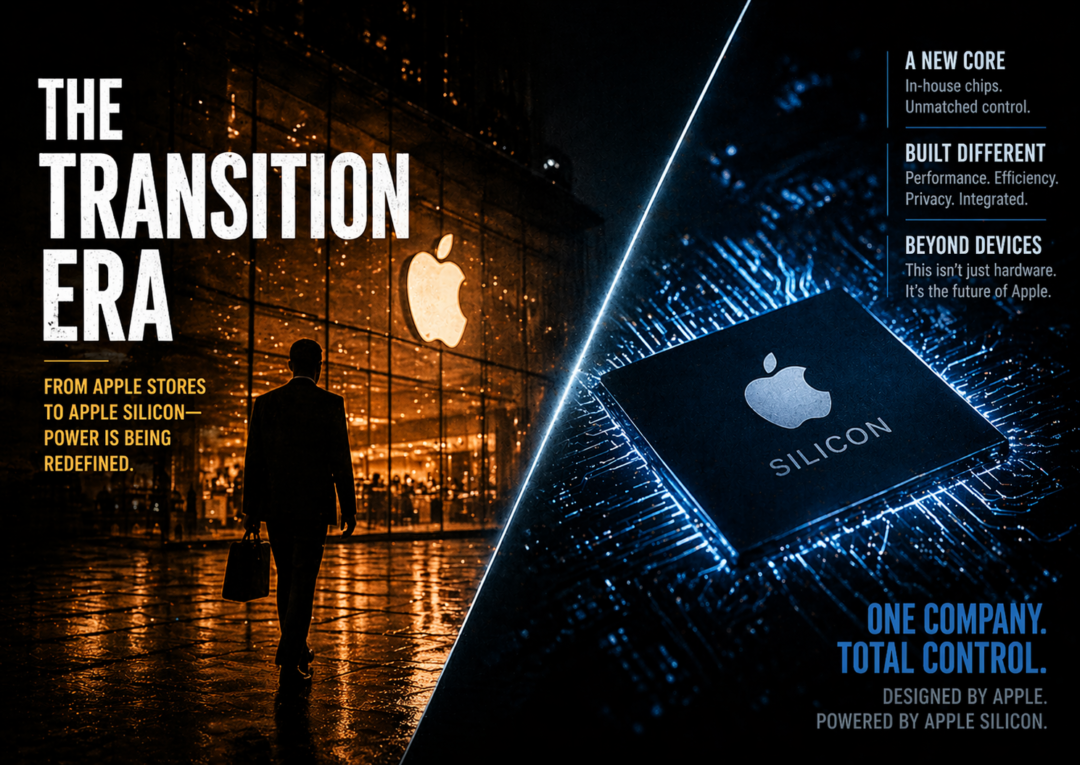
- The Apple Silicon transition — moving the entire Mac lineup from Intel chips to proprietary M-series silicon — was one of the most audacious technical migrations in consumer electronics history. Cook greenlit it and delivered it flawlessly.
If someone else had run Apple since 2011, we’d be living in a very different world. That’s not hyperbole. That’s just the math.
The Cook Era — A Timeline
Who Is John Ternus — Really?
Most people outside the Apple orbit haven’t heard of John Ternus. That’s by design. Apple is an extraordinarily private company, and its executives — with the exception of whoever holds the top seat — tend to stay out of the press cycle.
But inside Apple? Ternus is a big deal. A very big deal.
He joined Apple in 2001, has spent over two decades rising through the hardware engineering ranks, and became Senior Vice President of Hardware Engineering in 2021. That role puts him in charge of every physical Apple product — iPhone, Mac, iPad, Apple Watch, AirPods. All of it.
🔧
📐
🤫
🎓
“John Ternus doesn’t talk about changing the world. He just quietly builds the hardware that does it.”
The quiet force behind Apple’s biggest bets
What Changes — and What Stays the Same
Every leadership transition at a major tech company triggers the same question: “Will the culture change?” It’s a valid concern. Culture is the invisible operating system of any organisation — and Apple’s culture is one of the most distinctive in the industry.
Here’s the honest assessment of what a Ternus-led Apple might look like.
Under Cook, Services became the growth story. Under Ternus, expect hardware to reclaim centre stage — especially as Apple Vision Pro matures, M-series chips continue to leap forward, and whatever comes after the iPhone takes shape behind closed doors.
The M-series chips are already the best consumer silicon on earth. Ternus knows this roadmap intimately. Under his leadership, expect Apple to push further into custom silicon for AI workloads, XR headsets, and automotive applications. This is the next hardware frontier.
Apple Vision Pro is the most ambitious hardware bet Apple has made since the original iPhone. Its commercial success — or failure — will define the early years of the Ternus era. And since he helped engineer the device, he has the deepest possible context for how to evolve it.
Apple’s approach to AI has been more reserved than Google or Microsoft. That may shift. With Ternus’s hardware-first mindset, expect Apple’s AI strategy to be tightly integrated with on-device silicon — private, fast, and deeply embedded in iOS and macOS rather than bolted on.
Cook’s greatest non-product achievement was building Apple’s supply chain into a competitive weapon. This infrastructure doesn’t disappear with a leadership change. Whoever runs Apple inherits the most sophisticated hardware supply chain in consumer electronics history.
Apple’s Services division is structurally embedded in billions of people’s lives. iCloud storage, Apple Music subscriptions, App Store commissions — this money keeps coming in regardless of who sits in the CEO chair. That’s the beauty of the flywheel Cook spent 14 years building.
What This Means for Investors
Leadership transitions at mega-cap companies almost always create short-term volatility. It’s not rational, but markets are not always rational — especially when it comes to iconic brands with iconic leaders. So let’s separate signal from noise.
📌 Key Points for Investors Watching Apple
- Apple’s moat isn’t in its CEO — it’s in its ecosystem. 2 billion active devices, one of the world’s most loyal customer bases, and a hardware-software-services loop that took two decades to construct. That doesn’t disappear overnight.
- Leadership transitions at Apple have historically been buying opportunities. The market sold off when Jobs handed over to Cook. That was a mistake in hindsight — an enormous one.
- Services revenue is the long-term stability story. High-margin, recurring, growing. Even in a hardware downturn cycle, Services provides ballast. This won’t change under Ternus.
- The AI and XR bets are the wild cards. Apple Vision Pro’s trajectory, Apple Intelligence’s integration into the OS layer, and whatever next-generation device categories Ternus prioritises — these are the unknowns that investors should watch most closely.
- Tim Cook will likely remain on the board. Historical precedent at Apple suggests a gradual, structured transition rather than a hard departure. The institutional knowledge doesn’t vanish.
The Leadership Lesson Everyone Is Missing
Business schools will study the Cook-to-Ternus transition for years. And the thing most of them will probably miss is this: Tim Cook’s greatest achievement wasn’t a product. It was building an organisation that didn’t need Tim Cook.
That sounds paradoxical. But it’s actually the highest form of leadership. Great leaders build systems, cultures, and pipelines that outlast them. They design for succession. They develop the people around them. They build institutions, not empires that collapse when the emperor leaves.
Compare that to the alternative. How many brilliant founders have you seen who couldn’t let go? Who kept the company so personalised around their own genius that nobody else could step in? Apple under Steve Jobs was in danger of that trap. Apple under Tim Cook was deliberately built to escape it.
🔑 What Future Leaders Can Learn From This Transition
- Operational excellence IS a form of vision. Cook proved that being the best executor in the world is just as valuable as being the next big product visionary. Don’t underestimate the builder who optimises, scales, and systematises.
- Develop your successor from within. John Ternus has been at Apple for over 20 years. That’s a leadership pipeline, not an accident. Organisations that promote from within during major transitions carry institutional knowledge that outside hires simply cannot replicate.
- The quiet leaders often build the most durable things. Ternus is not a showman. He will never give a keynote that makes you cry. But he understands deeply how Apple makes things — and that understanding is worth more than a thousand polished press appearances.
- Culture travels, but it needs stewardship. Apple’s obsession with product quality, detail, and secrecy didn’t come from a memo. It came from years of consistent behaviour modelled by leadership. Ternus’s job is to protect that culture while also evolving it for the next decade of challenges.
“Tim Cook didn’t just run Apple. He built the Apple that could survive without him.”
The quiet genius of the Cook era
What to Watch Next
If you’re a tech professional, investor, or student of business leadership, here’s where to focus your attention over the next 18 to 36 months as this transition plays out:
- Apple Vision Pro’s second and third hardware revisions — this is Ternus’s product in the deepest sense. How it evolves under his direct leadership will be the clearest signal of his product philosophy.
- Apple Intelligence and on-device AI — watch for how deeply AI gets embedded into the M-series chip architecture. The hardware-software integration story will define Apple’s AI positioning.
- Any move into automotive or health — Apple has circled both categories for years. Under hardware-focused leadership, one or both could finally crystallise into actual products.
- Tim Cook’s board role — whether he stays active or gradually steps back will tell you a lot about the pace and nature of the transition. His continued presence would be a stabilising signal for markets.
- Apple’s communication style — Ternus is less of a public figure than Cook. Watch for how Apple’s external messaging adapts. Leadership personality always shapes company communication, even at the level of product announcements and press events.
The Apple Story Isn’t Over —
It’s Just Starting Again
Every great company eventually faces the same moment: the person who defined the last chapter has to hand the pen to someone new. Apple has been through it before. It came out the other side not just intact, but transformed.
Tim Cook built something that genuinely didn’t need to depend on any single human being to keep running. That’s not luck. That’s leadership at its highest level. And if the early signals around John Ternus are accurate — a deeply technical, hardware-obsessed, culture-aligned leader who has spent two decades in the building — then Apple’s next chapter could be just as compelling as anything that came before it.
The era is changing. But the mission — building the world’s best technology in ways that feel genuinely human — that doesn’t change. That’s what Apple is. That’s what it will remain.
Watch this space. Because the next decade of Apple is going to be genuinely fascinating to watch unfold.
Analysis • April 2026 Leadership Transition