🎬 True Crime | Streaming | Prime Video 2025
Raakh Season 1:
India’s Most
Disturbing Real
Crime — Retold.
Some crimes don’t just shock you. They stay with you. They become part of a city’s collective memory, shape how an entire generation thinks about safety, trust, and justice.
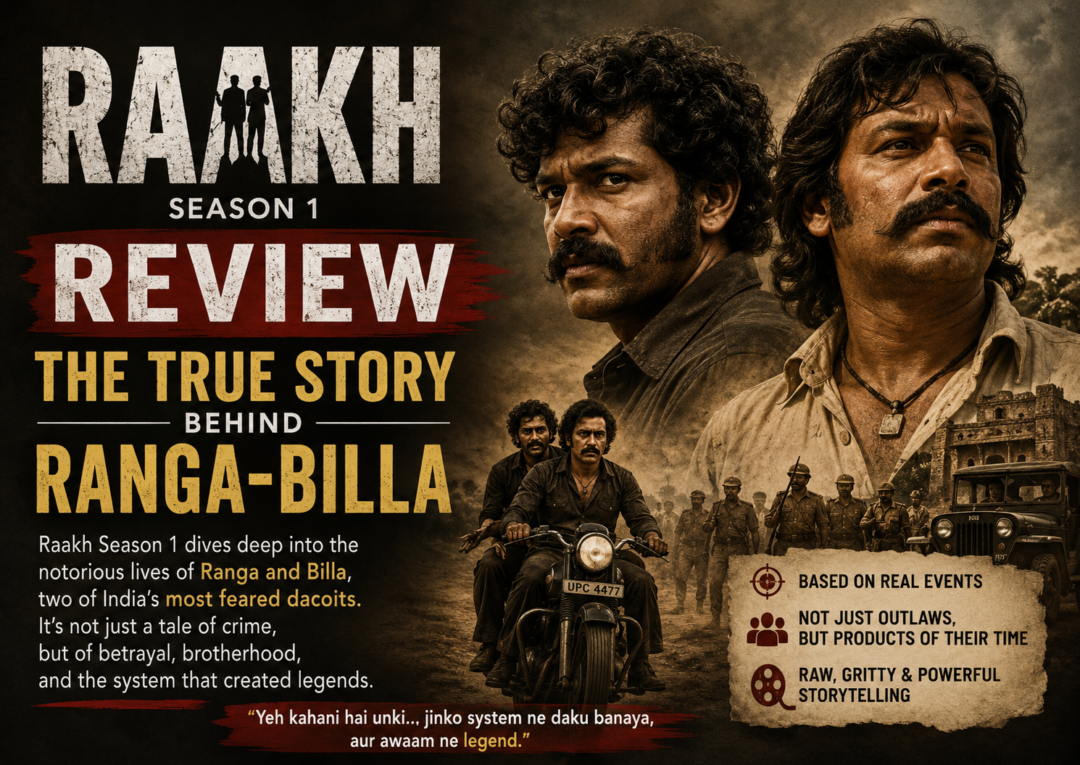
The Ranga-Billa case of 1978 Delhi is exactly that kind of crime. And Raakh — Amazon Prime Video’s new Indian crime thriller — has the courage to go there. Not just as a retelling, but as a raw, uncomfortable examination of how monsters are made, how systems fail, and how two ordinary men became the most hated names in Indian criminal history.
If you’ve been putting this one off in your watchlist, this is your sign to move it to tonight. Here’s everything you need to know — the real story, what the show does with it, and why it’s already one of the most talked-about Indian series of the year.
The Real Story That Raakh Is Based On
Before we get into the show — you need to know what actually happened. Because without that context, you won’t fully understand the weight of what the creators are working with here.
August 26, 1978. Delhi was a different city back then — slower, more trusting. A teenage boy named Sanjay Chopra and his younger sister Geeta Chopra were kidnapped. They were the children of a Navy officer. A routine evening turned into something no family should ever have to live through.
The two men responsible — Kuljeet Singh (Ranga) and Jasbir Singh (Billa) — were career criminals. Both had prior records. What they did to that brother and sister horrified the entire country when the details came out in trial. Delhi was shaken in a way it hadn’t been before.
The case never really went away. It resurfaced in books, in documentaries, in late-night conversations between people who grew up in Delhi. Raakh brings it back — but in a format that reaches the generation that only knows it as a headline.
Why “Raakh” as a Title?
“Raakh” means ash in Hindi. And that word carries more weight than it looks like on paper.
Ash is what’s left after something burns completely. It’s the aftermath — not the fire. And that’s exactly what this show is about. Not just the crime, but the ash it left behind: on a family, on a city, on a justice system, on the two men who were eventually hanged for it. The title is doing real work here, and that’s a good sign.
What the Show Actually Does With the Story
A lot of Indian true-crime adaptations play it safe. They reconstruct events, add some tense background music, and call it a thriller. Raakh doesn’t do that.
The show takes the real events as a spine and builds out from there — into the psychology of the perpetrators, the investigation machinery, the courtroom drama, and most importantly, the human cost on every side. It’s less interested in shock value and more interested in the “how did we get here” question.
The casting is the show’s biggest strength. The actors playing Ranga and Billa walk a difficult line — they can’t be cartoonish villains, but they also can’t generate sympathy. The result is something more unsettling: two men who feel frustratingly, disturbingly human. That’s harder to watch than a monster would be.
The police procedural elements are period-accurate and tightly written. Pre-digital Delhi, word-of-mouth investigation, physical evidence trails. There’s no tech shortcut here. Watching how the pieces came together — slowly, messily — adds an authenticity that a lot of modern crime shows lack.
If there’s one section that elevates Raakh beyond a standard crime drama, it’s the courtroom. The debate around the death penalty — whether it delivers justice or just revenge — is handled with genuine nuance. The show doesn’t give you an easy answer, which is exactly right.
Too many true-crime shows forget that real people are at the centre of every case. Raakh gives the Chopra family portrayal real weight. You feel the before and after — what was lost, what grief looks like when it has no resolution, what it means to carry a case for years waiting for justice.
The production design is quietly exceptional. This isn’t a glossy recreation — it’s a dirty, textured, warm-lit Delhi that feels lived-in. The cityscape itself becomes a character: a city learning, too slowly, that it needed to change how it thought about safety and crime.
The music doesn’t oversell the drama. It sits underneath scenes rather than leading them — which is exactly the right call for a story this serious. When the score does swell, it earns it. The restraint here is a real creative choice, and it pays off.
“Raakh isn’t trying to scare you. It’s trying to make you understand. That’s a much harder thing to do — and a much more uncomfortable one.”
IndiaThreads Series Analysis — 2025
The Real Timeline — Case to Court to Execution
For context — here’s how the actual Ranga-Billa story unfolded. Knowing this makes the show land differently.
What Raakh Gets Right That Other Shows Don’t
Indian true-crime content has exploded on streaming platforms. Most of it follows a formula: recreate the crime, build suspense, resolve with arrest. Done. Raakh is trying to do something more serious than that.
🔑 Where Raakh Earns Its Reputation
- It doesn’t glorify: There’s no cool aesthetic around the criminals. No slow-motion stylisation of violence. The show understands that how you frame a true crime story is itself a moral choice — and it makes the right one.
- It’s historically grounded: The period details are well-researched. The law enforcement culture, the courtroom procedure, the social atmosphere of late-70s Delhi — all of it feels earned, not approximate.
- It takes the victims seriously: Sanjay and Geeta Chopra aren’t just plot devices. The show consistently reminds you that these were real people with real lives, not just the starting point of a crime narrative.
- It raises real questions: Does the death penalty deliver justice? Does it give closure? What happens to families who spend years waiting for a verdict? Raakh doesn’t answer these for you. It sits in the discomfort.
- Pacing is earned, not rushed: This isn’t a show trying to stuff everything into 45 minutes for algorithm retention. It takes time — and that time creates genuine weight. You feel the duration of the investigation, the wait of the trial, the slow grind of justice.
- The writing trusts the audience: No hand-holding, no over-explanation. If you’re paying attention, the subtext rewards you. This is the kind of show that respects you enough to let you feel what it’s saying rather than telling you how to feel.
Should You Watch It? The Honest Take
Look — not every show is for everyone. Raakh is heavy. It’s not background viewing. If you’re looking for something light or fast-paced, this isn’t it.
But if you want a show that actually means something — that takes a real story and handles it with the seriousness it deserves — Raakh is genuinely one of the best Indian crime series in recent years.
Watch It If You Like
- Delhi Crime — the original seasons: Same kind of grounded, character-led procedural energy. Less flash, more weight.
- Scam 1992 / The Disciple-style storytelling: Indian stories told with patience and period authenticity rather than trying to imitate international formats.
- True crime that makes you think: Making a Murderer, The People v. O.J. Simpson — shows where the crime is the starting point, not the whole story.
- Courtroom drama: If the trial sequences in any legal thriller get your attention, the courtroom work here is some of the best you’ll find in Indian streaming.
Be Prepared For
- Heavy subject matter: The crime involves children. The show handles it with restraint, but it doesn’t sanitise the reality of what happened. This is not comfortable viewing.
- A slower pace: Raakh earns its moments. Viewers used to quick cuts and rapid plot development may need to adjust. Stick with it.
- Moral complexity without resolution: The show won’t tell you how to feel about capital punishment, about the criminal justice system, about justice itself. That ambiguity is the point — but it can be frustrating if you want neat answers.
The Bigger Picture: Why This Story Matters Now
Here’s the thing about the Ranga-Billa case that Raakh understands — it was never just about two criminals. It was about a city that woke up to something it hadn’t been prepared for. And the questions it raised are still questions we’re asking.
How does a society punish unforgivable acts? Does execution provide closure, or does it just close a chapter while the grief stays open? What does justice actually feel like for the people who need it most — and is “justice” even the right word for what the Chopra family was owed?
These aren’t abstract legal questions. They’re deeply human ones. And a show that brings them to a new generation through a story that actually happened — that’s doing something genuinely valuable.
“Every era has a case that defines its relationship with crime, justice, and fear. For Delhi, for a generation, Ranga-Billa was that case. Raakh is its reckoning.”
IndiaThreads — True Crime Series Review
Final Verdict:
The Ash Doesn’t Lie.
The Ranga-Billa case shaped a generation’s relationship with crime in India. And now, almost five decades later, Raakh gives a new audience the chance to understand not just what happened in August 1978 — but what it meant. For two families. For Delhi. For a justice system trying to figure out what it owed the dead.
Stream it this weekend. Turn off the notifications. Let it breathe. Some stories deserve that kind of attention — and this is one of them.
Series Review — 2025