🚀 Space Intelligence | June 2026
Artemis III:
Back to
the Moon —
For Good.
The last time a human stood on the Moon, it was December 1972. Gene Cernan climbed back into the lunar module, looked one last time at the desolate grey landscape, and said — without knowing it would be five decades — “We shall return.”
He wasn’t wrong. He was just off on the timeline. NASA’s Artemis III mission, currently targeting a 2027 launch window, is the closest humanity has come to making that promise real. And if it works — when it works — it won’t just be a landing. It’ll be the opening chapter of permanent human presence beyond Earth.
This isn’t your grandfather’s moonshot. The technology is different. The destination is different. The stakes — for science, for geopolitics, for the entire future of space exploration — are orders of magnitude higher. And yet, the mission has faced delays, budget pressures, and technical hurdles that remind you just how hard this actually is.
Here’s everything a serious space enthusiast needs to understand about Artemis III — the mission, the hardware, the science, and what happens after.
Why the South Pole? The Answer Will Surprise You
Every Apollo mission landed near the lunar equator. Nice flat terrain, good sunlight, easy communication with Earth. Safe choices for a programme that was mostly about proving it could be done.
Artemis III is going somewhere completely different — the lunar south pole region. And the reason isn’t just to be bold. It’s because that’s where the real prize is buried.
Multiple missions — including India’s Chandrayaan-3 in 2023, which made history as the first successful south pole landing — have confirmed water ice signatures in this region. NASA’s own LCROSS mission punched a hole into a shadowed crater in 2009 and found water in the debris cloud. The data has been building for years. Artemis III goes to collect the ground truth.
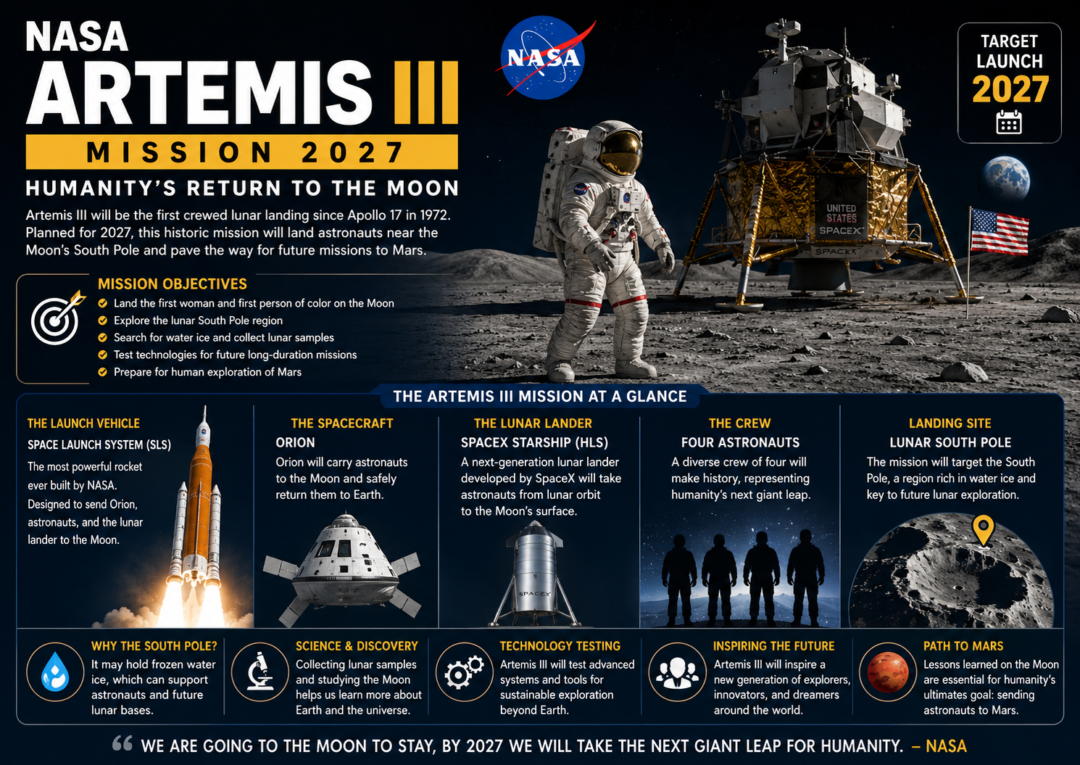
The specific landing zone candidates are all within 6 degrees of the south pole. They’re chosen for a combination of scientific value (proximity to shadowed crater regions), communication viability, and terrain that a Starship-derived lander can actually touch down on without turning into a very expensive crater itself.
The Hardware: Three Machines That Have to Work Together
The thing about Artemis III that doesn’t get enough attention is how genuinely complicated the architecture is. This isn’t one rocket and a capsule. It’s three separate spacecraft from two different organisations, doing a carefully choreographed dance around the Moon. All three have to work. There’s no margin for partial credit.
The Space Launch System is the biggest rocket NASA has built since Saturn V. For Artemis III, the upgraded Block 1B variant provides the raw power to throw the Orion capsule and its crew toward the Moon. It burns for about 8 minutes and then it’s done — its only job is to get everything pointed in the right direction at the right speed.
Orion carries the four-person crew through the 3-day transit to lunar orbit, serves as their home while they wait, and brings them back to Earth. It’s the evolved descendant of Apollo’s command module — more capable, better radiation shielding, deeper life support. Two crew members transfer to Starship HLS for the actual landing; two stay aboard Orion in orbit.
This is the genuinely new piece. SpaceX’s Human Landing System is a modified version of Starship — a stainless steel tower nearly 50 metres tall — that pre-positions itself in lunar orbit before the crew arrives. The two surface crew transfer to it via spacewalk, ride it down to the surface, live and work there for roughly 6.5 days, and then it launches them back to Orion. No separate ascent stage. One vehicle does it all.
NASA has not yet publicly announced the Artemis III crew as of early 2026. What is confirmed: four astronauts will fly, two will land. Artemis III will include the first woman and the first person of colour to walk on the Moon — a deliberate and long-overdue milestone. The selection criteria weight lunar-specific training, EVA experience, and Starship HLS proficiency.
The original plan included docking with the Lunar Gateway — a small space station in lunar orbit — but Gateway has been descoped from the Artemis III mission due to development timelines. The architecture now goes SLS-Orion direct to lunar orbit, where Starship HLS is waiting. Gateway comes later, for subsequent Artemis missions.
Artemis isn’t just an American programme. Over 40 countries have signed the Artemis Accords — a framework for space exploration principles. ESA, JAXA, CSA (Canada), and others are contributing hardware, crew candidates, and science instruments. Canada, notably, is guaranteed a crew slot on a future Artemis mission as part of their Gateway module contribution.
“We’re not going to the Moon to plant a flag and leave. We’re going to stay.”
NASA Artemis Programme — Strategic Vision
The Road Here — What’s Already Happened
Artemis III didn’t appear from nowhere. The programme has been building for years — through delays, successes, and some genuinely spectacular moments. Here’s the road that leads to 2027.
The Science Mission — What They’re Actually Going to Do
The landing itself is the headline. But what happens during those 6.5 days on the surface is where the scientific value lives. NASA and its partners have planned a remarkably dense programme of fieldwork for the two surface crew members.
🔬 Primary Science Objectives — Artemis III Surface Mission
- Water Ice Characterisation: Direct sampling of regolith from regions with confirmed water ice signatures. The goal is understanding the form, depth, distribution, and origin of lunar water — information that’s critical for any future in-situ resource utilisation (ISRU) programme. Ground truth that no orbital instrument can provide.
- Geological Fieldwork: The south pole terrain is geologically ancient and complex. Astronaut geologists will collect carefully documented samples from multiple contexts — something rovers, however capable, fundamentally cannot replicate. The diversity and quality of Apollo samples transformed planetary science; Artemis III samples from a completely different geological province will do it again.
- PRIME-1 Follow-Up: NASA’s PRIME-1 robotic precursor mission drilled into shadowed regolith ahead of Artemis III. The crew will conduct follow-up investigation at compatible sites, linking robotic and human data for the first time at a single lunar location.
- EVA Suit Testing: The new xEMU suit (or its current successor design) will be stress-tested under real lunar south pole conditions — extreme temperature gradients, rough terrain, reduced visibility near crater rims. This operational data feeds directly into future permanent habitat design.
- Biological Exposure Experiments: Understanding radiation and micrometeorite exposure at the south pole surface is critical for crew safety on longer future missions. Passive and active dosimetry experiments will run throughout the surface stay.
- Seismic Network Deployment: Small seismometers will be emplaced near the landing site, extending the lunar seismic network and allowing scientists to study the Moon’s interior structure — still only partially mapped — from a new geographic vantage point.
The Real Challenges Nobody Talks About Enough
Artemis III is arguably the most technically complex human mission ever attempted. Not the most dangerous — Apollo had its own terrifying margins — but the architecture involves more moving pieces than any previous human spaceflight programme. Here’s where the real risk lives.
The Propellant Transfer Problem
Starship HLS needs to be refuelled in orbit by other Starship tanker vehicles before the crew arrives. This is the single most technically demanding requirement in the entire mission. Cryogenic propellant transfer in the vacuum of space, at scale, has never been done before. SpaceX has been demonstrating the technology in stages, but it remains the highest-risk element of the architecture.
The Terrain Uncertainty
The south pole surface is terrain that no human-rated lander has ever touched. The slopes near crater rims, the behaviour of the fine regolith under Starship’s engine plume, the exact topography of candidate landing zones — these are known imperfectly. NASA and SpaceX are doing significant advance characterisation work, but there’s irreducible uncertainty until a vehicle actually lands.
Budget and Schedule Reality
Artemis has been delayed before. The 2024 target slipped to 2025, then to 2027. Congressional budget pressures, the SLS’s high per-flight cost, and the technical complexity of Starship HLS development have all contributed. The 2027 timeline is credible — but the history of the programme says to hold that date with appropriate humility.
What Comes After Artemis III — The Bigger Picture
Here’s the thing that sets Artemis III apart from Apollo 11 in terms of historical significance: it’s not designed to be the last mission. It’s designed to be the first of many. The architecture and ambition extend well beyond 2027.
- Artemis IV and beyond — Gateway activation: Subsequent missions will construct and crew the Lunar Gateway, a small space station in Near-Rectilinear Halo Orbit. Gateway serves as a staging post for increasingly complex south pole surface missions — and eventually, for deep space missions to Mars.
- Lunar Base Camp — the 2030s horizon: NASA’s stated goal is sustainable human presence on the Moon by the early 2030s. That means semi-permanent surface habitats, ISRU water extraction operations, and crew rotations measured in weeks rather than days. Artemis III is the proof-of-concept that makes this viable.
- Commercial expansion: The Artemis architecture is deliberately designed to enable commercial activity. Commercial lunar payload services (CLPS) are already delivering science and technology experiments to the surface. Within a decade, NASA expects to be one customer among several in a functioning lunar economy — not the only player.
- The Mars pathway: Everything Artemis proves at the Moon — long-duration surface operations, ISRU, radiation management, deep space communication — directly reduces the risk of eventual crewed Mars missions. The Moon is the proving ground. Artemis III is where that proof starts being written in human footprints.
Final Read:
The Footprints Are Coming.
It will have delays. There will be nervous press conferences and anxious engineers watching propellant transfer tests at 3am. That’s what doing hard things looks like. Apollo had the same texture — moments of brilliance surrounded by grinding, painstaking problem-solving.
But here’s what’s different now: the programme is designed to be sustainable. The commercial ecosystem is maturing. International partners are invested — financially and institutionally. The political will, for once, spans administrations. Artemis III isn’t a one-off. It’s a door being opened.
When those first footprints appear in the lunar south pole regolith in 2027, they won’t be a flag-planting moment for a single nation. They’ll be the first page of a much longer story — one our species has been circling for fifty years, finally ready to write.
Space Analysis — June 2026