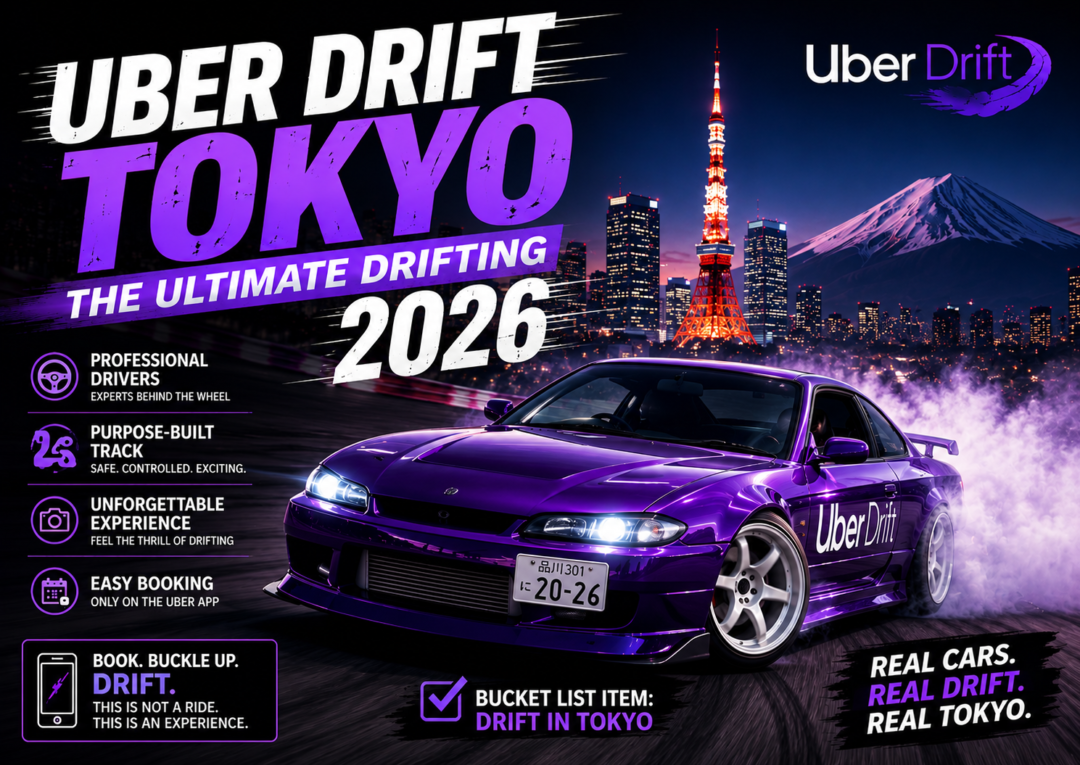
🏎️ Drift Culture | Tokyo 2026
Uber Drift:
Tokyo’s
Ultimate
Experience.
There’s a moment — right after you commit to the corner, rear tyres screaming against cold tarmac, the nose pointing somewhere it probably shouldn’t — where everything gets very quiet. Not the track. The track is deafening. Your mind. That’s the moment every serious drifter lives for.
Uber Drift in Tokyo is built around exactly that moment. It’s not a theme park ride. It’s not a YouTube-friendly stunt show. It’s a full-contact, no-excuses drifting experience in one of the world’s most iconic car cultures — and it’s changing what people think a drift event can actually be.
Whether you’re a seasoned pro looking for a new benchmark, or a serious enthusiast who’s spent years watching D1 Grand Prix clips at 3am — this guide tells you everything. What it is, how it works, what makes Tokyo different, and how to actually get the most out of it.
What Is Uber Drift — And Why Tokyo?
Let’s start with the obvious question. Why Tokyo? Because this city didn’t just watch drifting happen — it invented the rulebook. The touge mountain passes, the Wangan expressway, the Odaiba waterfront car meets — these aren’t backdrops. They’re the founding mythology of an entire global subculture.
Uber Drift is an immersive, professionally organised drifting experience that puts you — as a driver, passenger, or both — inside that mythology. It isn’t a drift taxi where someone else does the sliding while you grip the door handle. This is a structured programme where you’re behind the wheel on a real circuit layout, working with instructors who’ve actually competed at a professional level. The experience scales from properly coached introductory runs all the way to advanced tandem sessions for drivers who already know what they’re doing.
The Tokyo setting isn’t cosmetic, either. The machines available — RB26-powered Skylines, SR20-swapped S-chassis cars, 2JZ builds that sound like the earth cracking open — these are the JDM icons that defined drifting. Driving one of them, on tarmac in Japan, coached by someone who learned on these same streets — that’s a completely different experience from driving a Mustang on a car park in Birmingham on a Tuesday.
Why This Isn’t Just Another Drift Day
Most drift experience days follow a formula: brief safety briefing, a few instructed runs at low speed, maybe a passenger lap with a local semi-pro who does this on weekends. That’s fine. That’s not what this is.
The Uber Drift format is built around real progression. Your runs are assessed. Your technique is coached between sessions. If you’re already intermediate, you skip the basics. If you’re advanced, you get paired with drivers who’ll push your angle, your speed, and your precision — not babysit you. The gap between a standard drift experience and this is the same gap between a go-kart and an actual race seat. They share a category. They don’t share an experience.
Inside the Circuit — What You’re Actually Driving
Not all drift layouts are equal. Some are ovals with one radius. Some are figure-eights that punish the same entry angle for twenty minutes. The Uber Drift circuit in Tokyo is neither.
The layout is designed specifically to demand variety. You’ll encounter long sweepers where angle and speed have to be managed simultaneously, tight hairpin entries that require sharp initiation and a fast transition, and linked sections where the car barely straightens between corners. Every element is there to teach something — and to expose where your technique is actually at, versus where you think it is.
Nissan S13, S14, S15 platforms. Skyline GT-Rs. Toyota Chasers and Marks. These are the actual cars that built drift culture — not replicas, not modern substitutes. Modified to competition spec, maintained by people who understand what that means. The difference between a stock and a built machine is something you feel in the first corner.
Hydraulic handbrakes, tuned suspension geometry, sticky-to-loose tyre configurations depending on your session type. Instructors set up the car to match your ability level — not some generic default. A beginner gets more grip. An advanced driver gets something that punishes late corrections.
Actual competitive drifters. Not weekend drivers who do this on the side. People who have qualified for D1GP, who’ve run at Ebisu and Fuji, who can tell from thirty metres whether your entry speed is right before you’ve even turned in. The coaching quality here is the single biggest differentiator from every other drift day on the market.
Multi-corner linked sections. Not a single-corner oval. The layout forces you to manage transitions — the moment when one drift ends and the next begins — which is where intermediate drivers either level up or stall. Getting that transition clean is one of the hardest things in drifting. This circuit makes you do it repeatedly.
On-board and trackside cameras. Not a phone propped against a wheel arch — actual multi-angle footage reviewed with your instructor during debrief. Watching your own inputs — throttle, steering, brake — on video is the fastest feedback loop in driver development. Most people are genuinely surprised by what they see.
Night sessions available. The Tokyo skyline, the sound of a tuned SR20 under a Japanese sky — this isn’t just technical. The cultural layer makes it something you remember differently from any other driving experience you’ve had. It sits in a separate category in your memory.
“You don’t just drive Tokyo. You feel what this city did to car culture — in real time, at full angle.”
Drift Instructor — Uber Drift Tokyo Programme
What Pro Drifters Actually Work On Here
If you already know how to initiate, maintain, and link — this section is for you. Because Uber Drift isn’t just for people learning the basics. The advanced programme exists specifically for drivers who want to push past whatever ceiling they’ve hit in their home country.
Tokyo has a specific teaching philosophy around drifting that’s different from what you get in Europe or North America. The focus isn’t just on angle — it’s on control quality. A big, sloppy angle with constant micro-corrections is not the goal. Smooth, sustained, deliberate angle with clean inputs is. That distinction drives everything about how the advanced sessions are coached here.
🔑 Technical Focus Areas — Advanced Programme
- Entry Precision: Getting the rear to step out at exactly the right point in the corner — not a metre early, not a metre late. This is about reading corner geometry and matching your initiation to it. Tokyo instructors are specifically brutal about this. If your entry is sloppy, they’ll make you feel it before they explain it.
- Throttle Modulation: The difference between holding a drift and fighting one is almost entirely throttle discipline. Too much — you spin. Too little — you snap straight. The advanced programme isolates this specifically, often working with partially wet surface sections to compress the feedback loop.
- Tandem Technique: Following a lead car at competition proximity. Not fifty metres back — actual tandem proximity where you can see the lead driver’s helmet movement. The judgement required — matching their rhythm, anticipating their speed changes, holding position through linked corners — is what separates competitive drifters from skilled solo drivers.
- Transition Speed: The moment between corners. This is where most intermediate drivers lose time and angle. Tokyo’s circuit is specifically designed with back-to-back corners that demand fast, clean transitions. Getting this right under coaching is genuinely transformational for drivers who’ve plateaued.
- Line Variation: Running the same corner on multiple lines — inside, outside, clipping late — while maintaining consistent angle. This isn’t creativity for its own sake. It’s building the spatial awareness to compete, where lead drivers will vary their lines and chase drivers have to match them.
The Drift Culture Timeline — Why Tokyo Owns This
How to Actually Prepare — Before You Land in Tokyo
The best sessions at Uber Drift aren’t the ones where you show up cold and hope for the best. They’re the ones where someone arrived with a clear idea of what they wanted to work on, realistic expectations of their current level, and at least some base preparation behind them. Here’s what that preparation actually looks like.
For First-Timers
- Sim time is real time: Assetto Corsa with a wheel and pedal set, running rear-wheel drive cars on appropriate tracks, teaches throttle and counter-steer inputs in a feedback loop that directly translates. It won’t make you Tsuchiya. It’ll mean your first session isn’t entirely spent on basic muscle memory.
- Study the circuit: If layout preview material is available before your session — use it. Walk it if you can. Understanding corner geometry before you’re sitting in a moving car with smoke pouring from the rear tyres compresses the learning curve significantly.
- Wear the right gear and bring the right attitude: Comfortable, close-fitting clothing. No loose sleeves or dangling accessories. And mentally — come ready to be corrected repeatedly. Pride is the single biggest enemy of progression in a driving school environment.
For Intermediate and Advanced Drivers
- Film your current driving before you go: On-board footage of your best recent runs. Watch it critically before the trip. Identify your weakest area — entry, maintenance, transition, or tandem. Go into the advanced sessions with a specific thing you want to fix, not just a general desire to go fast sideways.
- Research the machines available: If you’ve spent five years driving a BRZ with a modest power build, stepping into a 500hp SR20-swapped S14 requires a mental recalibration. The power delivery, the weight distribution, the grip level — it all changes. Knowing what you’re climbing into means you’re not wasting the first session on orientation.
- Be honest about tandem readiness: If you want the tandem sessions — genuinely assess whether you’ve ever held proximity in a tandem run in a competitive context. The proximity required in the advanced programme isn’t social media proximity. It’s actual competition distance. Respect that before you request it.
The Complete Experience — Beyond the Circuit
Uber Drift in Tokyo isn’t a standalone hour on a track and then back to the airport. The culture around it — if you engage with it properly — makes the whole trip something different. Here’s what that looks like when you do it right.
- Odaiba Car Meets: The Odaiba waterfront has a long history as a gathering point for Tokyo’s car community. Modified JDM machinery, proper enthusiasts, the kind of informal technical conversation that doesn’t happen at staged events. Worth an evening before or after your circuit sessions.
- Ebisu Circuit Pilgrimage: Three hours north of Tokyo. Multiple drift circuits on the same complex, active every weekend. Watching club-level Japanese drivers on their home circuits — the proximity and precision they run at — recalibrates what you think is possible. Budget a full day if you can.
- Parts and Build Culture: Akihabara and Osaka’s car part shops are genuinely different from anywhere else. The depth of JDM parts availability, specialist knowledge of specific builds, and the workshop culture around these cars is part of understanding why Tokyo produces the driving talent it does. If you build your own car — this is a research trip as much as a driving trip.
- D1 Grand Prix or Formula Drift Japan Events: If your dates align — go. Watching professional tandem drift at full competition speed, from the stands, is a completely different experience from watching video. The sound, the smoke volume, the proximity — it changes how you understand what the top level actually looks like.
Final Read:
This Is What It Was Always About.
Uber Drift is the legitimate evolution of that culture into something accessible — but not diluted. It keeps the machines real, the instruction honest, and the standard high. It doesn’t pretend you’ll become a competition driver in a weekend. What it does is put you inside the actual thing, not a facsimile of it.
For car enthusiasts who’ve watched the clips, read the builds, and wondered what it would feel like — Tokyo is the answer. Not hypothetically. Actually. Rear tyres howling, counter-steer loaded up, the circuit stretching out ahead. The moment your mind goes quiet and your hands just know.
That moment exists. It’s in Tokyo. And Uber Drift is currently one of the best ways to get there.
Drift Culture Guide — 2026