📊 Policy & Real Estate | June 2026
Delhi’s “O Zone”
Order:
Builders,
Beware.
If you’re tracking Delhi real estate, this one’s going to matter — a lot. The Delhi High Court has stepped into one of the city’s oldest unresolved fights: encroachment in the floodplain zones along the Yamuna, officially classified as “O Zone” under the Master Plan for Delhi.
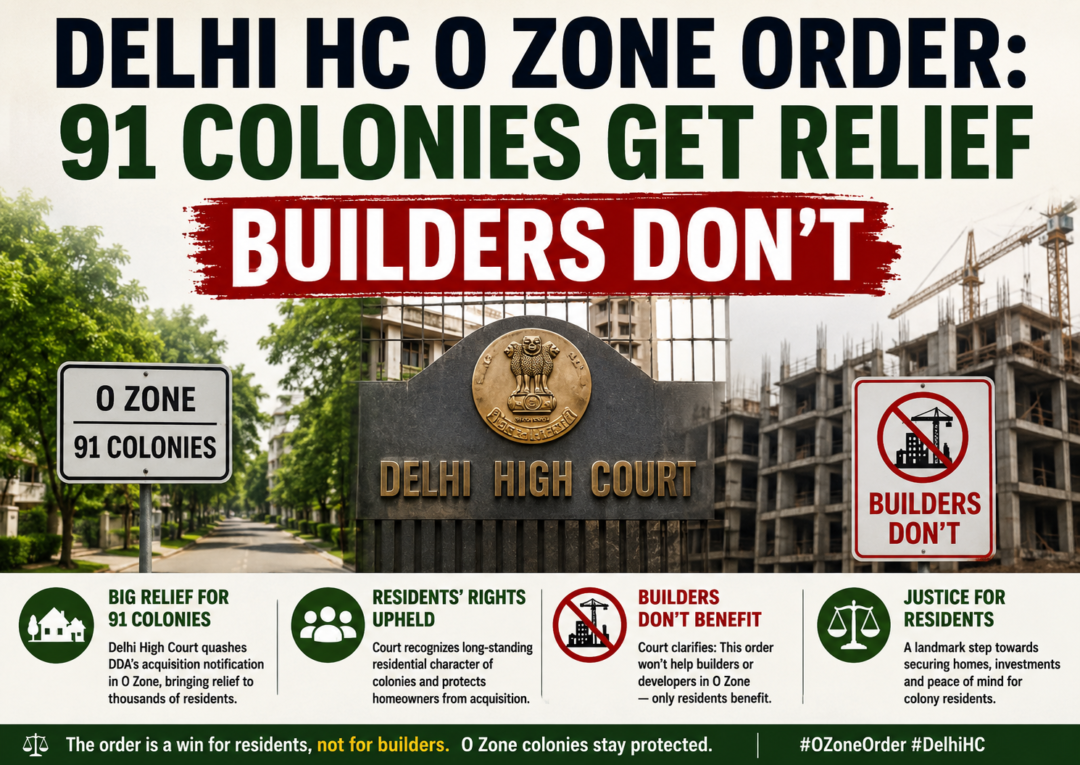
The order draws a sharper line than Delhi has seen in years — tightening the noose on fresh, unauthorised construction in O Zone areas, while at the same time carving out a measure of protection for 91 existing unauthorised colonies that have grown up over decades. For builders, landowners, and political stakeholders alike, that’s a combination worth sitting with.
This isn’t a small zoning footnote. It touches property values, ongoing construction projects, regularisation hopes for lakhs of residents, and the long, uneasy relationship between Delhi’s civic agencies and its floodplain. Here’s what’s actually going on — and what it means going forward.
What the “O Zone” Actually Is
Before getting into the order itself, it helps to understand what “O Zone” even means in Delhi’s planning language — because this term is going to come up a lot in property conversations from here on.
Under the Master Plan for Delhi, land use zones are split into categories — residential, commercial, industrial, and so on. “O” stands for the open/recreational and riverbed zone, and it primarily covers the Yamuna floodplain. This land is meant to act as a natural drainage and flood-absorption buffer for the river — not a construction zone.
For decades, however, the reality on the ground has drifted far from the plan on paper. Informal colonies, farmhouses, warehouses, and even some larger commercial structures have come up across stretches of this floodplain — some dating back 30-40 years, others far more recent.
Why the Court Got Involved Now
Floodplain encroachment isn’t a new topic for Delhi courts — petitions on Yamuna pollution, riverbed construction, and flood management have been around for years, particularly gaining urgency after the 2023 Delhi floods, when water levels breached danger marks and large parts of low-lying Delhi went underwater.
That flood event became something of a turning point. It exposed, in very visible terms, how much encroachment had eaten into the river’s natural buffer — and how unprepared the city’s drainage and embankment systems were for a high-water scenario. Petitions seeking stricter enforcement against O Zone construction picked up momentum in the aftermath.
What the Order Actually Does
Here’s where it gets interesting — because the order isn’t a blanket “demolish everything” or “regularise everything” instruction. It’s more nuanced, and that nuance is exactly what professionals need to understand.
The order signals a firm clampdown on any fresh or ongoing unauthorised construction within O Zone limits. Civic agencies — DDA, MCD, and the Irrigation & Flood Control Department — are expected to act against new structures with far less tolerance than before. For anyone with a project near the floodplain, this changes the risk calculus immediately.
A list of 91 unauthorised colonies — many falling under the broader regularisation framework that Delhi has worked through over the years — gets a degree of protection from the immediate enforcement sweep. These are largely existing, long-settled residential areas where lakhs of people live, not fresh encroachments.
DDA, MCD, DUSIB (Delhi Urban Shelter Improvement Board), and the Flood Control Department are all named stakeholders. The order effectively asks them to coordinate — something that’s historically been Delhi’s biggest enforcement gap. Overlapping jurisdiction has been the excuse for inaction for years.
A recurring theme in floodplain litigation is the lack of a clear, updated demarcation of where O Zone boundaries actually fall on the ground today versus on old maps. Expect renewed push for satellite-based surveys and updated boundary marking — which itself will become a flashpoint, since boundary lines determine who’s “in” the zone and who isn’t.
Unlike residential colonies, larger commercial complexes, banquet halls, and farmhouses built on floodplain land don’t get the same political or humanitarian cover. These structures are more likely to face direct action, and several have already been subjects of separate demolition orders in past years.
Unauthorised colonies have been a recurring electoral issue in Delhi for over two decades, with regularisation promises featuring in multiple election cycles. Any order that touches these colonies — even protectively — gets read through a political lens by every party involved.
“Protection for residents isn’t the same as a green light for builders.”
Delhi Real Estate Watch — June 2026 Perspective
The Strategic Reading for Professionals
If you’re a developer, broker, lawyer, or policy-watcher, here’s the part that actually matters — not the headline, but what it changes practically for people operating in or near these zones.
🔑 Core Takeaways — Delhi O Zone Order, June 2026
- “Protected” Does Not Mean “Approved for Expansion”: The 91 colonies getting protection from immediate enforcement action does not translate into a green signal for fresh construction, additional floors, or commercial conversion within those colonies. Existing structures get breathing room — new activity within O Zone limits remains a different conversation entirely.
- Due Diligence on Land Near the Yamuna Just Got Heavier: Any transaction involving land in or near floodplain-adjacent areas — Yamuna Khadar, parts of East Delhi, certain stretches near ITO, Mayur Vihar, and similar belts — now carries an additional layer of legal risk that buyers’ lawyers will need to flag explicitly.
- Regularisation Lists Become More Valuable — and More Contested: Being on the list of 91 protected colonies could become a meaningful differentiator for property values in those specific pockets compared to similar-looking settlements that aren’t on the list. Expect disputes over inclusion/exclusion to follow.
- Civic Agency Coordination Is the Real Test: Orders asking multiple agencies to “act in coordination” have a patchy history of actual implementation in Delhi. The professional read isn’t just “what does the order say” — it’s “will DDA, MCD, and the Irrigation Department actually move in sync, or will this become another enforcement gap story in 12 months.”
- Monsoon Timing Adds Pressure: With this order landing ahead of the monsoon season, there’s an operational urgency baked in. Flood-readiness narratives tend to accelerate enforcement action in the short term — even if follow-through fades once the immediate flood risk passes.
- Precedent Value Beyond Delhi: Floodplain encroachment is not a Delhi-only issue — Mumbai, Chennai, Bengaluru, and other cities have their own versions of this fight. A strongly-worded Delhi HC order on enforcement vs. protection often gets cited in similar litigation elsewhere.
The Background — How We Got Here
Context matters for understanding why this order lands the way it does. Here’s the broader sequence that’s shaped Delhi’s floodplain enforcement story.
What Different Stakeholders Should Do Now
Generic “watch this space” advice doesn’t help anyone here. Here’s specific, practical thinking for the people actually affected.
For Developers & Builders
- Audit any project near the floodplain immediately: If a project site sits within or near O Zone boundaries — even partially — get fresh legal opinion on zoning status before continuing any further construction activity. The cost of pausing is far lower than the cost of a demolition order mid-project.
- Don’t rely on old survey maps: Given the renewed push for updated demarcation, boundary lines that seemed settled a few years ago may be revisited. Independent verification against current records is worth the expense.
- Re-price floodplain-adjacent land in deal models: Land near but not strictly within O Zone may still carry reputational and procedural friction simply by association. Build that into valuation and timeline assumptions for any active deals.
For Brokers & Property Lawyers
- Add O Zone status to standard due diligence checklists: For any property in East Delhi, Yamuna Khadar belt, or similar stretches, zoning classification under the Master Plan should now be a default check — not a special-case one.
- Track the list of 91 colonies closely: Buyers and sellers in these specific colonies will want clarity on what “protection” actually means for resale value, loan eligibility, and future regularisation prospects — questions that will keep coming up.
- Flag commercial and farmhouse transactions separately: These structure types are explicitly more exposed under the order’s framing, and deals involving them deserve a more cautious legal opinion than residential colony transactions.
For Political & Policy Watchers
- Expect cross-party messaging on the 91 colonies: Regularisation and protection of unauthorised colonies has been a vote-bank issue in Delhi for years — every party will frame this order in a way that serves their narrative with affected residents.
- Watch for agency coordination follow-through: The real test of this order isn’t the text — it’s whether DDA, MCD, DUSIB, and the Irrigation Department actually act in sync over the coming months, particularly through the monsoon period.
- Monitor for appeals or modification petitions: Orders touching both enforcement and protection tend to draw challenges from both directions — those who feel enforcement should go further, and those who feel protection should extend wider.
The Scenarios Worth Tracking
Anyone professionally exposed to this — whether through property, policy, or politics — should be watching for how this plays out across a few possible paths.
- Steady Implementation (Most Likely): Civic agencies move on new/unauthorised construction in O Zone with visible but gradual enforcement, the 91-colony list holds with minor adjustments, and the order becomes a reference point for future floodplain litigation — without dramatic, large-scale demolition drives.
- Enforcement Stalls Post-Monsoon: Initial action picks up ahead of monsoon season for optics and flood-readiness, then slows once immediate flood risk passes — repeating a pattern Delhi has seen with similar orders before. The court may need to revisit compliance later.
- Escalated Action & Wider Litigation: If a major flood event or high-profile collapse occurs near floodplain construction, expect accelerated enforcement, expanded demarcation surveys, and possibly an expanded or contested list of protected/non-protected colonies — with significant political pushback either way.
Final Read:
Lines Are Being Redrawn — Carefully.
For the 91 unauthorised colonies named, this brings a measure of relief — but not a final answer on regularisation, expansion, or long-term status. For builders and developers with any exposure near the Yamuna floodplain, it’s a clear signal that scrutiny is rising, and that “it’s always been like this” is no longer a workable assumption.
The political dimension won’t fade quickly either. Unauthorised colonies have been part of Delhi’s electoral conversation for decades, and an order that touches 91 of them — even protectively — will be read, quoted, and contested by multiple sides.
The professionals who navigate this well will be the ones tracking implementation, not just the order itself — watching whether civic agencies actually coordinate, whether the monsoon brings renewed urgency or renewed excuses, and whether the line drawn here holds up under the next real test.
News Analysis — June 2026