🇮🇳 India Economy | May 2026
Is India
Heading Toward
an Economic
Reset?
Something feels different. If you’ve been following Indian politics and economics lately, you might have noticed a shift — not just in policy announcements but in the tone of the conversation coming from the top.
Prime Minister Modi’s economic messaging in 2025–26 has moved into new territory. There’s more talk of consumption, welfare, and bridging the gap between India’s GDP story and the lived reality of its middle class. And that gap, honestly, has been the elephant in the room for a while now.
This is the story of what that shift means — whether it’s a genuine course correction or a political recalibration before elections, and what it could actually mean for you, your job, your savings, and India’s next chapter.
First, Let’s Be Honest About the Disconnect
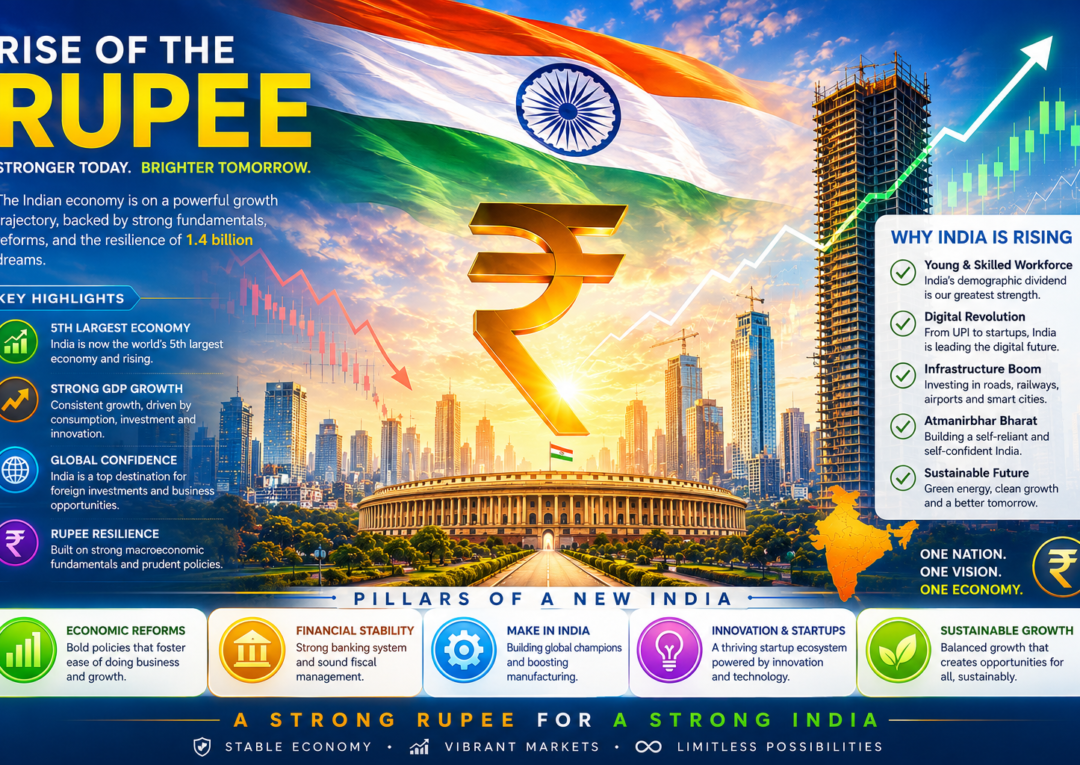
India’s headline numbers look great on paper. We’re the fifth-largest economy in the world. GDP growth has been among the highest of any major economy. Infrastructure projects are visible — highways, metros, airports. The government points to these proudly, and fairly so.
But here’s the thing that doesn’t quite add up for most people living in urban India: if the economy is growing at 6–7%, why does it feel like it isn’t? Why are jobs still hard to find? Why are household savings under pressure? Why does every salary hike feel like it barely covers the cost of inflation?
This isn’t a pessimistic take — it’s what the data broadly suggests. And more importantly, it’s what Modi’s own government appears to be acknowledging, at least implicitly, in the way economic conversations have evolved through 2025 and into 2026.
Why the Messaging Has Changed
After the 2024 general election — where the BJP lost its outright majority and had to rely on coalition partners — something shifted. The political read was clear: India’s aspiring middle class wasn’t feeling the growth. The infrastructure story wasn’t translating into household income security for enough people.
The 2025–26 Union Budget was the first visible response. For the first time in several years, personal income tax slabs were meaningfully revised upward, giving direct relief to the ₹7–15 lakh income bracket. It was a signal — not massive, but unmistakable — that the government was aware of the middle-class squeeze and was beginning to respond.
What “Reset” Actually Looks Like in Practice
So what exactly is changing — or being attempted? Let’s break it down honestly, because there’s a difference between what’s being signalled and what’s being delivered.
The FY26 budget expanded the zero-tax threshold to ₹12 lakh (with standard deductions). This was politically bold and economically meaningful — it puts more money in the hands of the salaried middle class rather than routing it through subsidies. Direct purchasing power boost, even if modest.
The Production Linked Incentive scheme is being expanded and refined. The original sectors — mobiles, pharma, EVs — showed mixed results. The revised push is more focused on labour-intensive manufacturing: textiles, footwear, food processing. These are the sectors that create broad-based employment, not just headline FDI numbers.
With urban consumption growing unevenly, the government is leaning harder on rural demand — MGNREGA spending, PM Kisan transfers, and rural housing. This isn’t a new playbook, but the emphasis has increased. Rural India consumes differently from urban India — it drives FMCG, two-wheeler sales, and local services, all of which feed into broader GDP.
Capex at ₹11.11 lakh crore is a record. The logic hasn’t changed: build roads, ports, rail, and logistics infrastructure, lower the cost of doing business, attract private investment, create jobs in the medium term. The debate is about timing — the jobs created by infra projects are often not the white-collar jobs the urban middle class is looking for.
India’s economic reset isn’t just domestic. The government is actively positioning India as a China+1 manufacturing destination, a services hub for the Global South, and a critical partner in Western supply chain diversification. The geopolitical window is real — but executing on it requires regulatory reform, infrastructure, and skills that are still works in progress.
UPI, ONDC, DigiLocker, DPDP Act — India’s digital infrastructure is genuinely world-class and increasingly being exported. The digital economy is creating new categories of jobs and businesses that didn’t exist five years ago. But it’s also creating a two-speed economy: those who can access digital opportunity, and the majority who are still on the outside of it.
“India’s growth story is real. The question is who it’s growing for — and whether that answer is changing.”
India Economic Desk — May 2026 Perspective
The Turning Points That Shaped This Moment
To understand where India is heading, it helps to trace how we got here. The reset — if that’s what it is — didn’t happen overnight.
The Hard Questions Nobody’s Answering Cleanly
Let’s be direct. The reset narrative has some real substance — but it also has some significant gaps. And if you’re a thinking urban professional, you deserve an honest read on both.
🔑 What’s Working vs. What’s Still Unclear
- Working: Direct tax relief. The income tax restructuring is genuine. For someone earning ₹10–15 lakh, the effective saving runs into thousands per year. It’s not transformational but it’s real and immediate — the kind of thing that actually shows up in monthly take-home.
- Working: Infrastructure quality is improving. Whatever one thinks of the political management, the physical infrastructure transformation — highways, airports, metro connectivity — is visible and measurable. It’s reducing logistics costs for businesses even if the job creation takes time to materialize.
- Unclear: Manufacturing job creation. PLI schemes have attracted investment. But the quality and quantity of jobs created remains below expectation. The gap between “units produced in India” and “good jobs created in India” is real and not yet resolved.
- Unclear: Education-to-employment pipeline. India produces millions of graduates annually. The mismatch between what they’re trained for and what the economy needs is a structural problem that no single budget can fix. Until this changes, urban youth unemployment will remain a political and economic fault line.
- Unclear: Private investment cycle. Government capex is substituting for — not catalysing — private investment to the degree hoped. Until private corporate capex meaningfully recovers, the job creation math doesn’t work at scale for the middle class.
- Unclear: Real wage growth sustainability. Nominal wages are rising in some sectors. But when adjusted for inflation — particularly food and rent inflation in metros — real purchasing power for the broad middle hasn’t grown meaningfully. This is the number that actually determines household quality of life.
What This Means For You — Practically
Okay, enough macro. Let’s bring this home to what the middle-class professional in India should actually be thinking about — because the economic reset, real or partial, does have direct implications for how you plan your career and finances.
For Salaried Professionals
- Tax savings are real — deploy them wisely: The income tax relief isn’t just symbolic. If your effective outgo drops by ₹20,000–50,000 annually, that’s a meaningful investment corpus compounded over five to ten years. Don’t spend it into lifestyle inflation — deploy it into equity SIPs or index funds while markets are still in a reasonable range.
- Skill up for the sectors that are getting government tailwind: Manufacturing, defence, logistics, digital infrastructure, green energy — these are the sectors getting sustained policy and budgetary support. Positioning your career toward these domains over the next three to five years is a better bet than waiting for your current sector to recover.
- Don’t confuse growth with security: India growing at 6.5% doesn’t mean your job is secure. In fact, AI adoption, global hiring slowdowns, and sector-specific stress (IT services, BFSI) mean job risk is very real even in a growing economy. Build six months of expense buffer — boring advice, but the data on urban household savings is genuinely concerning.
For Business Owners and Entrepreneurs
- Rural consumption is recovering — size your opportunity: FMCG, two-wheelers, affordable housing, agri-inputs — rural India is where the consumption revival is most visible right now. Businesses that can serve this market at the right price point are sitting on real tailwind.
- Digital public infrastructure is free to use and worth building on: ONDC, Account Aggregator, DPDP-compliant data sharing — India’s digital infra stack is legitimately world-class and largely free to build on. If your business isn’t incorporating these, you’re leaving a competitive advantage on the table.
- Watch PLI eligibility carefully: If you’re in manufacturing and your sector is PLI-eligible, the incentive structures are designed to reward volume and incremental production. The application process is bureaucratic but the upside is real for businesses that can navigate it.
Three Scenarios Worth Thinking Through
No one knows exactly where India’s economy goes from here. But it’s worth mapping out the realistic range of outcomes rather than anchoring on any single view.
- Accelerated Reset (Optimistic — ~30% probability): Tax relief + infrastructure + manufacturing PLI start compounding together. Private investment cycle turns. Real wages begin growing meaningfully for the broad middle class by FY28. India starts its next leg of growth with more inclusive foundations. This is the government’s stated goal — and it’s plausible, not certain.
- Muddling Through (Base Case — ~50% probability): GDP stays in the 6–7% range. Infrastructure keeps improving. But structural gaps in jobs and wages persist. Middle class continues to feel pressure. Political pressure for consumption-oriented policies increases. Growth continues, but the “reset” remains partial and uneven across income levels and geographies.
- External Shock Scenario (~20% probability): West Asia tensions, oil above $100+, global recession, or a domestic monsoon failure disrupts the recovery trajectory. India’s significant oil import dependency becomes a macro headache. RBI has limited room. Fiscal consolidation hits. The reset narrative pauses — at considerable cost to household economics.
Final Read:
The Reset Is Real. But It Needs Time.
But a reset is not automatic. The shift in Modi’s messaging reflects a real political and economic acknowledgement that growth without broad-based income improvement is not sustainable — politically or economically. Whether that acknowledgement becomes sustained policy execution is the question that will define India’s next five years.
For the urban middle class, the honest read is this: the conditions for a better decade are being assembled. Your job is to position yourself to benefit from them — not to wait passively for policy to fix your household balance sheet.
The reset, if it comes, will reward the prepared. And preparation, as always, starts before the headlines confirm it.
India Analysis — May 2026