📷 Smartphone Review | May 2026The Vivo X300 Ultra
Is Here —
And It’s Not
Playing Around 2026.
Every year there’s one phone that makes you stop scrolling and go — “Wait, they actually did that?” In 2026, that phone is the Vivo X300 Ultra.
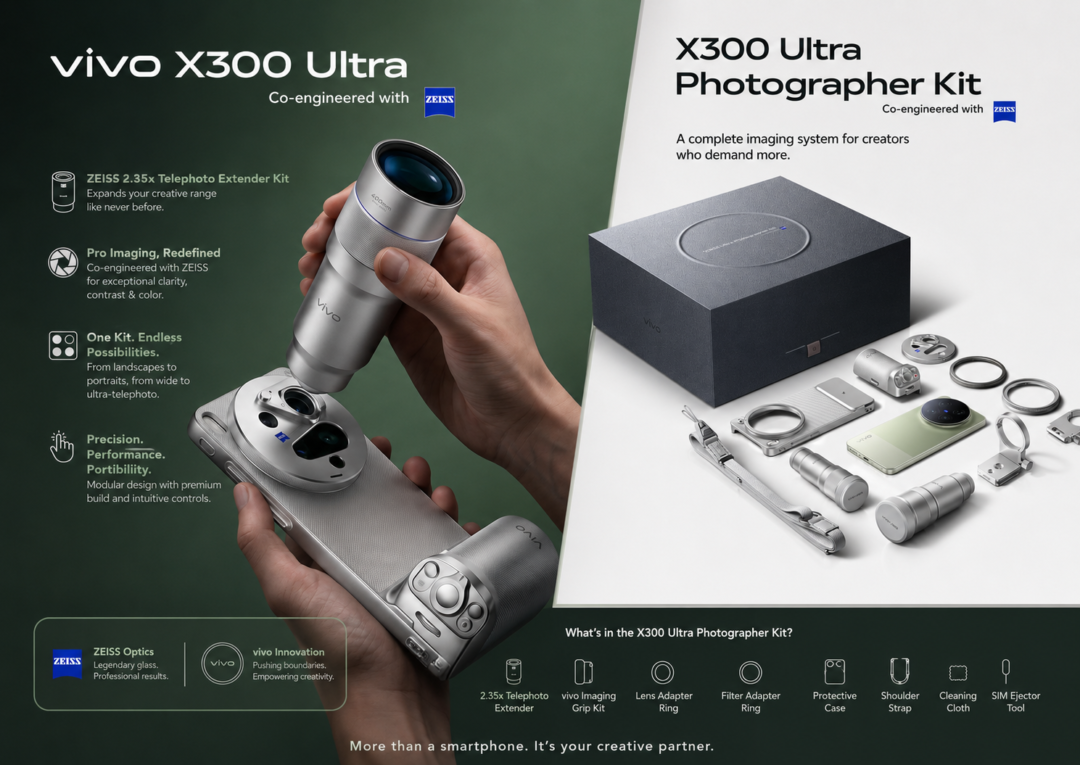
This isn’t just another flagship with a big number slapped on the camera spec sheet. Vivo went deep — dual 200MP Zeiss sensors, a mechanical zoom extender that physically clips on like a real lens, a 35mm documentary lens chosen the way an actual photographer would choose it, and the fastest Android chip ever benchmarked. Oh, and it’s the first ever Vivo “Ultra” to get a proper global launch.
If you follow smartphone launches, the X300 Ultra is the story of 2026. Here’s everything you need to know.
The Launch Story — How We Got Here
For years, Vivo’s Ultra lineup was essentially a China-only secret. Reviewers who imported them were blown away — but if you lived outside mainland China, getting one officially was near impossible.
That changed completely with the X300 Ultra. It launched in China on March 30, 2026, and became the first Vivo Ultra model to get a proper global release — going on sale in Europe, South and Southeast Asia, the Middle East, and Brazil from April 24. India got its official launch on May 6, 2026.
The hype started at MWC 2026, months before the launch. When reviews finally dropped, they confirmed what people suspected — this is genuinely different.
Full Specs — No Fluff
Before the storytelling, let’s put the numbers on the table. Because some of these are genuinely wild.
The headline stat: two 200MP cameras — one on the main sensor, one on the periscope telephoto. No flagship has done this before at this level.
The Camera System — Where the Magic Is
Most flagship phones treat cameras like this: one great main, one decent ultrawide, one telephoto that just exists. Vivo did something completely different.
Why 35mm — Not the Usual 24mm?
Vivo chose 35mm specifically to appeal to street photographers and photojournalists who prefer a slightly tighter, more natural-looking perspective. It’s a creative decision, not a spec-sheet decision. And that’s exactly what separates this phone from everything else in 2026.
The Physical Lens Extender — 400mm on a Phone
Vivo introduced two physical Telephoto Extenders, including a Gen 2 Ultra model that pushes focal length to a 400mm equivalent. Wildlife photography. Concerts without front row. A level of zoom no software trick replicates cleanly — because this is actual glass, not a crop.
Video That Competes With Mirrorless Cameras
4K 120fps Dolby Vision HDR. 8K at 30fps. 1.5-degree gimbal-level stabilisation. Blueprint Imaging Chip V3+. This phone starts to compete with entry-level mirrorless cameras for run-and-gun video work. That’s not hyperbole — that’s what the reviewers found.
“Vivo didn’t just make a camera phone. They made a camera — that happens to be a phone.”
Android Central — Best Phone of 2026
Performance & Display — The Supporting Cast
Snapdragon 8 Elite Gen 5
Built on 3nm with an AnTuTu score of 4,010,000 — one of the fastest Android chips ever tested. For context, most 2024 flagships scored around 2.2–2.5 million. The jump is very real.
One honest caveat: the chip throttles by about 40% under sustained load — matters for extended gaming or long video recording sessions. Android Central still named it the best phone of 2026 overall despite that trade-off. For camera-first users, you won’t feel it.
The Display
6.83-inch WQHD+ AMOLED. 144Hz. 1800 nits peak brightness. 8,000,000:1 contrast ratio. 90.1% screen-to-body ratio. The photos you take with those cameras look genuinely stunning on this panel.
Battery
6600mAh with 100W fast charging means full charge in under 40 minutes. 40W wireless charging included. Expect 6–8 hours of screen-on time under regular use.
How It Compares — The 2026 Competition
You can’t talk about the X300 Ultra without the field. It’s a brutally competitive space right now — let’s be specific about where Vivo wins and where it doesn’t.
Samsung wins on software ecosystem, trade-in programs, and brand recognition in India. But the X300 Ultra’s dual 200MP system and physical Zeiss extender give it a clear photography edge for serious shooters. The spec gap is real.
Apple’s video colour science and computational photography remain best-in-class. But in raw sensor resolution and zoom reach, Vivo leads. For still photographers working across focal lengths — the X300 Ultra wins the argument.
OnePlus has come far with Hasselblad tuning, but sensor sizes here are in another league. The 1/1.12-inch main sensor alone dwarfs most competitors. In low-light photography, the gap shows immediately.
Pixel nails consistent colour and skin tones through AI processing. The X300 Ultra gives more creative control — manual focal lengths, physical extenders, photographer-first philosophy. Different approaches for different users.
The closest real competitor. Both Zeiss-partnered, both launched early 2026, both with large sensors. The Find X9 Ultra is slightly smaller. But the dual 200MP setup and physical extender kit give Vivo the headline advantage.
The India Angle — What It Means for You
For Indian smartphone enthusiasts, the X300 Ultra’s arrival signals something bigger than just specs. This is the first time a Vivo Ultra sits in the same global conversation as Samsung’s Ultra lineup and Apple’s Pro Max — not just on spec sheets, but in reviews from the world’s biggest tech publications.
🎯 Who Should Buy It in India
- Content creators and street photographers — The 35mm documentary lens and Zeiss tuning produce images worth printing, not just posting to Stories.
- Travel videographers — 4K 120fps Dolby Vision plus gimbal-level stabilisation. No external rig or gimbal needed.
- Tech enthusiasts tired of the same two brands — The most credible alternative to Samsung and Apple in 2026, by a wide margin.
- Power users who want longevity — Android 16 on day one. 3+ years of software support expected.
Who Should Wait or Look Elsewhere
- Budget-conscious buyers — The Vivo X300 or X300 Pro offer most of this experience at meaningfully lower price points.
- Heavy gamers — Thermal throttling under sustained load is a genuine concern. Consider something with more aggressive cooling.
- One-handed users — At 232–237g with a large camera hump, this is a two-handed phone. The cheap multiple isn’t deserved here — it’s genuinely heavy.
Final Read:
This One Earns the Hype.
Two 200MP sensors. A physical lens extender that clips on like a real camera accessory. A 35mm main lens chosen because it sees the world the way photographers do. These aren’t gimmicks. They’re genuine decisions made by people who love photography.
It’s expensive. It’s heavy. It throttles under gaming load. But as a camera-first flagship for 2026, it’s the most ambitious smartphone Vivo has ever shipped — and arguably the most interesting camera phone of the year.
Smartphone Review — May 2026