💻 Tech Intelligence | May 2026
Your Next Laptop
Thinks
For Itself.
Think about the last time your laptop actually surprised you. Not just opened fast — but felt like it was working with you instead of just waiting for your next click. For most people, that moment hasn’t happened yet. But it’s about to.
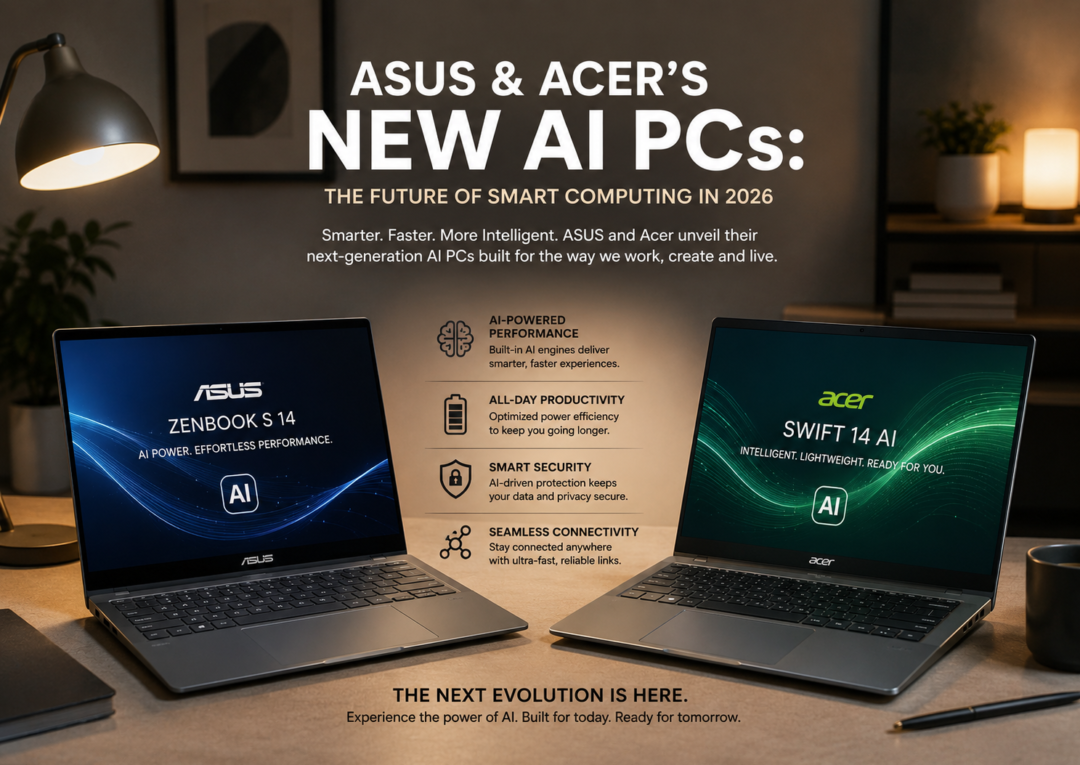
Asus and Acer have launched a new generation of AI PCs in 2026 that are fundamentally different from anything that came before. These aren’t just faster machines with a shiny new label slapped on. They have a dedicated AI chip — called an NPU (Neural Processing Unit) — built right into the hardware. That chip does one thing: run AI tasks locally, without needing the internet, without draining your battery, and without slowing down anything else you’re doing.
Whether you’re a freelancer editing videos, a business owner running back-to-back meetings, or someone who just wants their PC to stop being annoying — the AI PC shift is the most meaningful computing upgrade in a decade. And Asus and Acer are leading it.
What Is an AI PC — Really?
The term “AI PC” gets thrown around a lot right now. So let’s be clear about what it actually means — because it’s not just marketing.
A traditional laptop runs AI features — like voice assistants or smart photo editing — by sending your data to a remote server, waiting for it to process, and getting a result back. That takes time, uses data, and has privacy trade-offs you might not love.
An AI PC is different. It has a dedicated Neural Processing Unit (NPU) — a chip specifically designed to handle AI calculations locally on your device. No round-trip to the cloud. Everything happens on your machine, in real time.
Old laptop: You type a command → data goes to server → server processes → result comes back. Slow. Data leaves your device.
AI PC: You type a command → on-device NPU processes instantly → result appears. Fast. Your data never leaves.
Microsoft’s Copilot+ PC certification — which both Asus and Acer’s new lineups carry — requires at least 40 TOPS (Trillion Operations Per Second) of NPU performance. That’s the minimum bar for AI features like live captions, real-time translation, intelligent noise cancellation, and Recall (the AI memory feature that lets your PC remember everything you’ve done on it).
In short: AI PC = your computer actually understands what you’re doing and helps you do it faster — without you having to ask twice.
Asus 2026 AI PC Lineup — What’s New
Asus has never been shy about going all in on new technology. Their 2026 lineup proves it. The new ZenBook, ProArt, and Vivobook AI series all come packed with Qualcomm Snapdragon X Elite or Intel Core Ultra 200V processors — both built with serious NPU muscle.
Asus ZenBook S 16 (2026)
This is the one that surprised even the tech press. It weighs under 1.2 kg — lighter than most premium notebooks — but packs an NPU that delivers 50+ TOPS. The OLED display is stunning, the build is magnesium alloy, and it charges to 60% in about 30 minutes. For professionals who travel constantly, this is the machine.
Asus ProArt PX13
Designed for creators. The ProArt series in 2026 leans hard into AI-assisted creative workflows. It auto-adjusts colour calibration for your working environment, runs AI upscaling for video editing in real time, and integrates natively with Adobe’s AI tools. The dual-screen variant lets you use a secondary display as a drawing tablet. It’s genuinely impressive.
Asus Vivobook 16 AI
This is the one for budget-conscious professionals and students. Sub-₹80,000 price point (in India), still carries the Copilot+ certification, and gives you real AI features without asking you to spend like a tech executive. Battery holds up across a full workday. Not flashy — but exactly what most people actually need.
Acer’s 2026 Push — Quietly Impressive
Acer doesn’t always get the headlines Asus does. But their 2026 AI PC lineup deserves serious attention — especially if you’re buying for a business or team.
The new Acer Swift 14 AI and Aspire AI series have been built from the ground up with enterprise AI workflows in mind. Acer has partnered directly with Microsoft to deeply integrate Copilot+ features into their hardware — meaning features like Windows Recall, AI-powered search, and live captioning are genuinely smooth on these machines, not just technically supported.
Acer Swift 14 AI
The standout spec here is the battery. Real-world 18–20 hours on a charge. That’s not a marketing number — reviewers are consistently hitting 16+ hours on mixed workloads. The Intel Core Ultra 7 200V chip inside is efficient without being slow. If you’re the type who forgets to carry a charger, this is your laptop.
Acer TravelMate P6 AI (Business Series)
This one’s built for corporate users who need reliability over flash. Military-grade durability certification, dedicated AI security features (on-device facial recognition that doesn’t send biometrics anywhere), and a 3-year business warranty. IT departments love it because the AI features don’t require special cloud permissions or data agreements.
Acer Aspire AI 15
The affordable one that holds its own. A 15.6-inch display, decent NPU performance, and Copilot+ certification at a price point that makes sense for small businesses outfitting a team. Not a powerhouse, but reliable and genuinely smart.
What AI Features Actually Work in 2026
Here’s the honest part. Not every AI feature in these machines is game-changing yet. Some are genuinely useful. Some are still finding their footing. Let’s break it down so you know what you’re actually getting.
Real-time captions for any audio playing on your device — YouTube, meetings, podcasts. And live translation into 40+ languages on supported apps. This is one of the features that works brilliantly and is immediately useful for anyone in international business.
This has been on laptops for a few years, but the 2026 NPU-powered version is on another level. It isolates your voice so precisely that people on calls can barely tell if you’re in a coffee shop or a quiet office. Asus’s implementation is especially strong here.
This is the controversial one. Recall takes regular snapshots of your screen and lets you search your history with natural language — “find that PDF about the Q4 report.” Useful, but privacy-sensitive. It’s opt-in, stored locally, and encrypted. Still evolving, but genuinely impressive when it works.
On-device upscaling and enhancement for photos and videos. Useful for creators and content teams. Adobe’s Firefly features run noticeably faster on AI PCs because the NPU handles the heavy lifting. Not a replacement for a dedicated GPU workstation — but fast enough for most professional workflows.
Both Asus and Acer’s business-focused models have on-device facial recognition and presence detection — the PC locks automatically when you walk away and unlocks when you return. Biometrics never leave the device. For enterprise users, this is a genuine security upgrade, not just a convenience feature.
The AI watches what you’re doing and adjusts CPU/GPU/NPU allocation dynamically. Light document work? It parks power to extend battery. Video export? It ramps everything up instantly. The battery life gains from this are real — typically 20–30% better than a non-AI equivalent machine doing similar work.
“The best AI PC feature isn’t one big thing. It’s a hundred small things that stop being annoying.”
Tech Desk — IndiaThreads Computing Analysis, May 2026
Who Should Actually Buy One — And Which One
Not everyone needs to run out and upgrade immediately. Here’s honest guidance based on who you are and what you actually do.
For Working Professionals & Executives
- Asus ZenBook S 16 — best in class for portability + performance. If you’re on flights and in back-to-back calls, this is the one.
- Acer Swift 14 AI — if battery life is your top priority and you’re in long days without a charger.
- AI noise cancellation and live translation will meaningfully improve your daily meeting experience — not slightly, noticeably.
- The on-device privacy features are worth it if you handle sensitive data. No cloud AI = no data risk.
For Small Businesses Buying in Volume
- Acer TravelMate P6 AI or Acer Aspire AI 15 — better warranty support, easier to manage across teams, better after-sales in India.
- The AI PC premium over a regular laptop is roughly ₹8,000–₹18,000 right now. For most business use cases, that pays back in productivity within months.
- If your team does a lot of video calls, document work, or multilingual communication — the AI features are immediately practical, not theoretical.
For Creators & Freelancers
- Asus ProArt PX13 — built for this use case. If you’re in video, photography, or design, the on-device AI enhancement tools are genuinely faster and better than cloud-dependent alternatives.
- Adobe integration on NPU-equipped machines is noticeably smoother in 2026 — Firefly AI features run locally without the lag.
For Students & First-Time Buyers
- Asus Vivobook 16 AI or Acer Aspire AI 15 — Copilot+ certified, affordable, and future-proof for the next 4–5 years of software development.
- Don’t buy a non-AI PC right now if you’re buying new. The price gap has narrowed enough that future-proofing is worth it.
The Bigger Picture — Where This Is Heading
Asus and Acer aren’t just updating their product lines. They’re betting on a fundamental shift in how personal computing works — and the industry data backs that bet.
According to projections from Canalys and IDC, AI PCs will account for over 40% of all PC shipments in 2026, up from under 5% in 2024. That’s not a gradual curve — it’s a cliff. The transition is happening fast.
And here’s why it won’t slow down: software is catching up to hardware. Right now, most users are only using maybe 20% of what their AI PC can actually do. As Microsoft, Adobe, and third-party developers ship more NPU-aware applications — which they’re doing aggressively — the gap between what an AI PC can do and what a regular laptop can do will widen every single month.
📅 What’s Coming Next in AI PC Development
- Real-time meeting summarisation: Not just transcription. The PC will follow your meeting, identify action items, and draft follow-up emails before the call ends. Already in beta with some enterprise Asus and Acer models.
- Personalised AI assistants: Your PC builds a model of your work habits, writing style, and preferences over time. Suggests replies, pre-fills forms, and learns your calendar priorities. On-device. Private.
- AI-powered code completion: On-device code assistants for developers, running without a GitHub Copilot subscription or cloud dependency. Already available in limited form on the ProArt series.
- Health and focus features: Presence detection that adjusts screen brightness and notification settings based on focus state. Some models already detect fatigue through camera (opt-in) and suggest breaks.
- Offline AI everything: The long-term roadmap is clear — every AI feature that currently requires cloud connectivity will eventually run on-device. Speed, privacy, and reliability will all improve as NPU performance increases generation by generation.
The competitive dynamic between Asus and Acer in 2026 is actually good for consumers. They’re both pushing hard on price, design, and feature differentiation — which means the machines are better and the prices are more competitive than they’d be if one player dominated the space.
Final Read:
Your Next PC Should Think.
You don’t need to be a tech expert to benefit from it. You just need to stop thinking of a laptop as a tool that does what you tell it and start thinking of it as something that helps you think faster, work smarter, and deal with fewer of the friction points that waste your day.
The people who upgrade now — professionals, small business owners, creators — are the ones who will have a head start as AI-native workflows become the new default. Asus and Acer have made that upgrade more accessible than it’s ever been. The question isn’t whether AI PCs are the future. They already are.
Tech Analysis — May 2026