🕷 Entertainment | May 2026
Spider-Noir:
Marvel’s
Darkest
Show Yet.
Most superhero shows give you bright costumes, CGI explosions, and characters cracking jokes while saving the world. Spider-Noir does none of that — and that’s exactly why it’s one of the most talked-about Marvel projects of 2026.
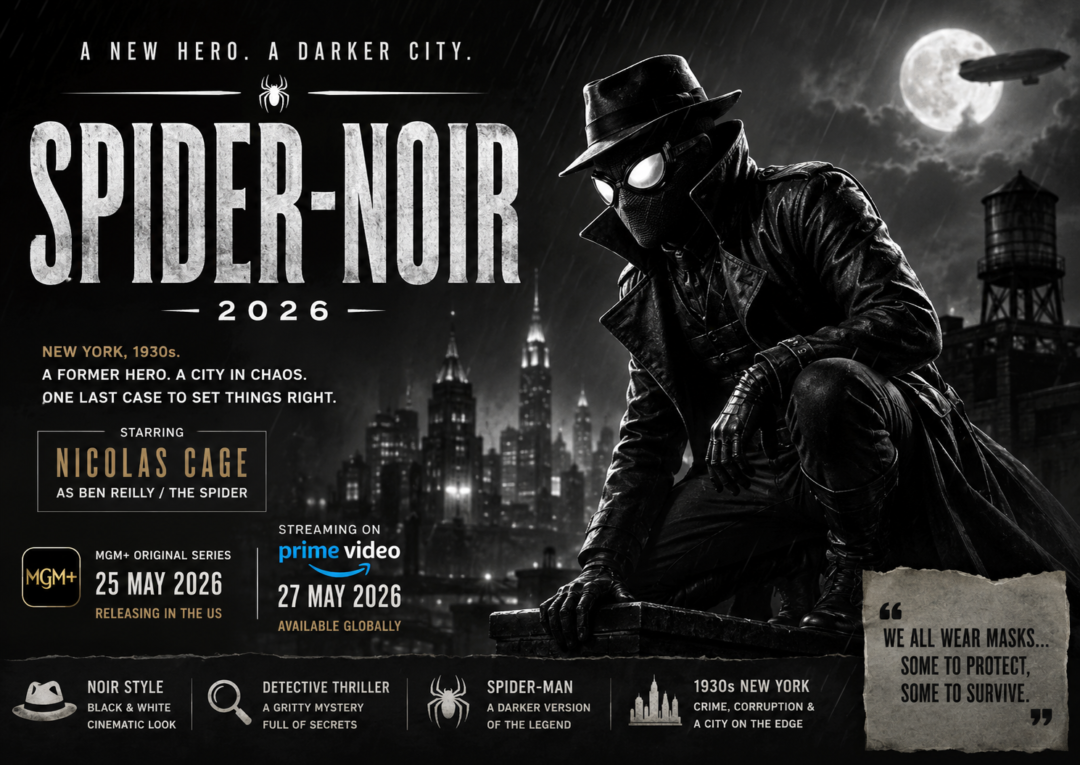
Set in 1930s Depression-era New York, Spider-Noir follows a bitter, bruised version of Peter Parker navigating crime, corruption, and conspiracy in a world that has no room for heroes. It’s grimy. It’s stylish. And Nicolas Cage — who originally voiced the character in the animated Spider-Man: Into the Spider-Verse — finally steps into the role in live action.
If you’ve been wondering what all the noise is about, here’s everything you need to know — the plot, the cast, the tone, and why this show feels genuinely different from anything Marvel has done before.
What Is Spider-Noir Actually About?
Here’s the quick version: Peter Parker in this world is not your friendly neighbourhood Spider-Man. He’s a private detective. He works the kind of cases no one else wants — missing persons, blackmail, shady dealings in the back alleys of a New York that’s rotting from the inside.
The show is set during the Great Depression. Poverty is everywhere. Corruption runs deep in government and law enforcement. And somewhere beneath all of it, a larger criminal conspiracy is pulling strings that eventually drag Peter into something way bigger than anything his detective agency was built to handle.
What makes this setup genuinely interesting is the time period. The 1930s backdrop isn’t just aesthetic window dressing — it shapes everything. There are no S.H.I.E.L.D. databases to hack, no satellites, no superteams to call in. Peter Parker is completely alone, using street smarts, spider-sense, and a lot of improvised problem-solving to stay alive in a city that doesn’t care about him at all.
Where Does It Fit in the Marvel Universe?
Spider-Noir exists in its own pocket of the multiverse — first introduced in the comics back in 2009 and then made famous by Into the Spider-Verse in 2018. The show doesn’t require you to have watched every Marvel project to enjoy it, which is honestly refreshing.
It’s a standalone story set in a clearly defined alternate timeline. No Infinity Stones, no universe-level threats — just one flawed, determined man trying to figure out what being a hero even means when the whole system is broken.
Nicolas Cage as Spider-Noir — Does It Actually Work?
This was the question everyone was asking before the show dropped. Nicolas Cage is a fascinating actor — capable of genuine brilliance and genuinely unhinged choices in equal measure. Could he carry a full live-action Marvel series as a 1930s noir detective Spider-Man?
Honestly? The answer is yes. More than yes, actually.
Cage brings something to this role that a younger, more conventional casting choice simply couldn’t — a kind of weathered, world-weary authenticity. His Peter Parker isn’t performing toughness. He just looks like someone who has been through things. His voice, his posture, the way he delivers lines with that slightly off-kilter cadence — it all fits the character almost perfectly.
Returning from his Spider-Verse voice role to live-action, Cage plays a version of Peter Parker who’s been around the block too many times. Bitter, sharp, but not without a moral core. Every scene he’s in has a certain weight to it.
Whigham plays the corrupt police chief who serves as one of the show’s key antagonists. If you know Whigham from Boardwalk Empire or Mindhunter, you already know he can do menacing authority with his eyes closed. He does not disappoint here.
A younger street-level character who gets pulled into Peter’s world. Attah brings real emotional grounding to the show — his storyline is one of the more genuinely affecting threads running through the season.
Morris plays a morally ambiguous character who operates a jazz club that serves as both a social hub and a backroom deal venue. His performance is charming and quietly threatening — a great contrast to Cage’s stoicism.
The show fills out its world with a dense, well-realised supporting cast — journalists, street informants, immigration officials, crime bosses. None of them feel generic. Everyone has a reason to be in this story.
“It’s not about a Spider-Man. It’s about what you do when you have power in a world that punishes people for using it.”
Spider-Noir — Show Premise, 2026
The Tone, Style, and What Makes It Different
Marvel shows — at least the Disney+ ones — have a very specific aesthetic. Slick production, well-lit action, emotionally accessible storytelling. Spider-Noir is shot and written as though it actively doesn’t want to feel like those shows.
The colour palette is deliberately cold and muted. Black, grey, slate — with flashes of amber from street lamps and the occasional red that hits harder because everything around it is so drained of colour. The cinematography leans into shadows in a way that feels genuinely cinematic rather than just stylistically edgy.
The Writing — Sharp Edges Everywhere
The scripts for Spider-Noir are the real standout. The dialogue feels like it was written by someone who actually loves the noir genre — there’s a rhythm to it. Sentences that land with a specific kind of blunt weight. Conversations that circle around what characters are actually saying without ever quite getting there directly.
Peter narrates parts of the show in a classic noir voiceover style. It could have felt self-conscious or gimmicky. Instead it works because the writing earns it — the things he’s observing and commenting on are genuinely worth the observation.
🎬 What the Show Gets Right — A Quick Breakdown
- Period Authenticity: The 1930s setting is built with care. The production design, the language, the social realities of Depression-era New York — it all feels researched rather than approximate. The show doesn’t romanticise the era. It shows you exactly how ugly it was.
- Spider Powers as a Burden: This is handled better than almost any other Spider-Man adaptation. The powers aren’t cool. They’re disorienting. They make Peter strange in a world that’s already suspicious of anyone who seems different. That tension drives a lot of the show’s emotional core.
- Moral Complexity That Doesn’t Feel Forced: Nobody is purely good or purely evil. The police chief who’s corrupt also genuinely believes in maintaining order. The crime bosses have their own codes. Peter himself makes some choices in the show that are hard to defend easily. It feels like a real world rather than a moral fable.
- Pacing That Trusts the Audience: The show takes its time. Investigations build slowly. Characters are allowed to exist in scenes without things constantly happening to them. For viewers used to the relentless pace of MCU projects, this might take an episode or two to adjust to — but stick with it. The payoff is real.
- Score and Sound Design: Jazz. Brass. Low percussion. The music in Spider-Noir is doing serious work in every scene, and it’s doing it without announcing itself too loudly. It lives in the background and shapes your emotional response to things before you’ve even consciously registered it.
The Plot — What Happens (Spoiler-Light)
We’ll keep this vague enough that you can still go in fresh, but detailed enough to give you a real sense of what the show is actually doing narratively.
The season opens with Peter already established as a private detective in 1933 New York. He’s been operating quietly for years — taking small cases, staying below the radar, using his powers carefully in a city where being different carries very real danger.
The inciting case involves a missing woman from the city’s immigrant community — a case that initially looks routine but quickly reveals connections to a much larger criminal operation involving city hall, the docks, and an organisation that seems to be building toward something significant.
The Real Themes Running Through the Season
What the show is really about, beneath the mystery plot, is power and accountability. Who gets to have power. Who decides how it’s used. What it costs the people who hold it — and what it costs the people who don’t have any.
The 1930s setting makes these questions feel urgent rather than abstract. In Depression-era America, those questions weren’t philosophical — they were a matter of survival. And the show never lets you forget that.
Should You Actually Watch It?
That depends on what you’re looking for. If you want a fast, fun, action-heavy Marvel experience with lots of quips and spectacle — this isn’t that show. Spider-Noir is deliberately slow in places, deliberately dark throughout, and more interested in character and atmosphere than plot mechanics.
But if you’ve been waiting for a superhero show that treats the genre with the same seriousness as the best prestige TV dramas — this is it.
Watch It If You Liked:
- True Detective (Season 1): The slow-burn investigation structure and the atmosphere of moral decay in institutions are very similar. If you loved the way that show built dread patiently, Spider-Noir scratches the same itch.
- Boardwalk Empire: The period setting, the corrupt power structures, the beautifully dressed ugliness of 1930s organised crime — there’s real overlap in DNA here.
- Into the Spider-Verse: Not in style, but in spirit. The same respect for this version of Peter Parker. The same interest in what it feels like to be a Spider-Man who doesn’t quite fit anywhere.
- Peaky Blinders: The combination of stylish aesthetics, brutal world-building, and a protagonist who operates in a moral grey zone has a lot in common with this show’s energy.
Skip It If:
- You need your superhero shows to be fun and light in tone — this one won’t give you that.
- You want it to connect heavily to the broader MCU — it’s largely self-contained.
- You’re not patient with slow-burn storytelling in the first two to three episodes.
Final Verdict:
Marvel’s Best Show in Years.
Nicolas Cage is legitimately great in this role. The writing is sharper than anything Marvel has produced in live-action for a long time. And the decision to fully commit to the noir genre rather than hedge toward conventional superhero storytelling pays off in a big way.
It’s not a perfect show. The pacing will frustrate some viewers. A few storylines get introduced and then slightly underdeveloped. But the things it gets right, it gets spectacularly right — and those moments are exactly what good genre television should feel like.
If you’ve been looking for a reason to care about Marvel again, Spider-Noir might be it. Give it three episodes. The web catches you slowly — but once it does, you’re not getting out.
Entertainment Review — May 2026