When AI Meets
Space:
Anthropic ×
SpaceX.
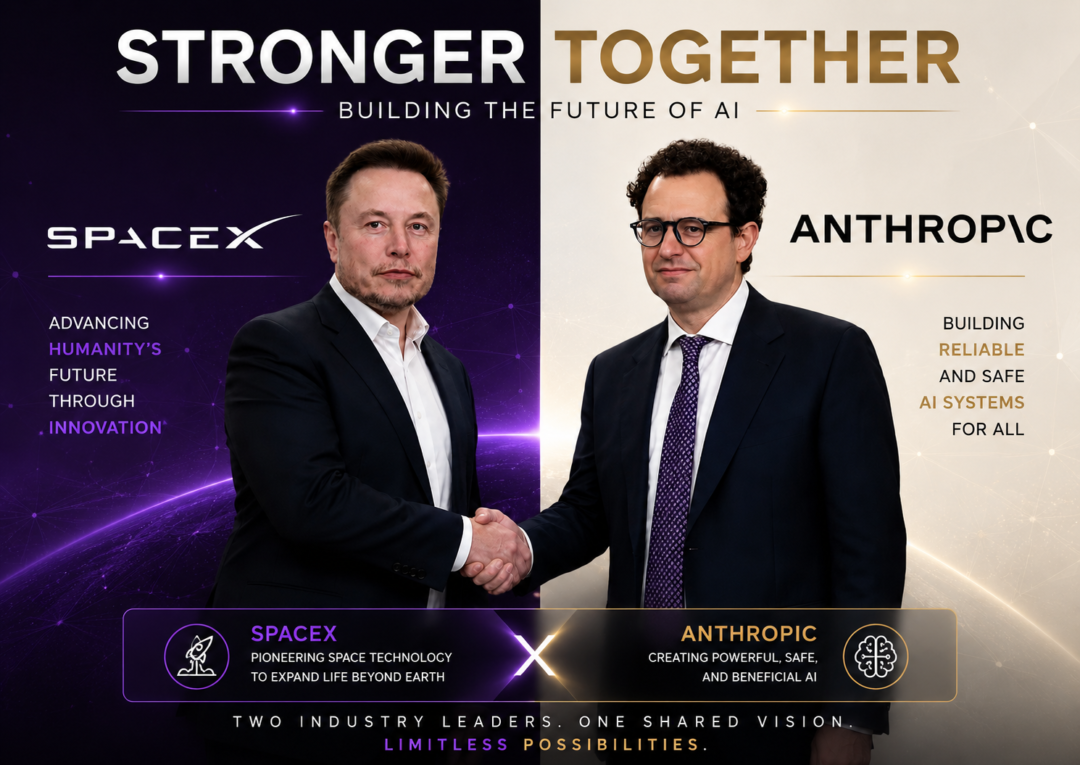
Picture this: a satellite orbiting 550 kilometres above Earth quietly processes your company’s logistics data, flags a supply chain risk before your team even notices it, and sends the alert back down before your morning coffee is done. That’s not science fiction anymore. That’s the kind of future Anthropic and SpaceX are quietly building — together — in 2026.
The partnership between Anthropic, the AI safety company behind Claude, and SpaceX, the private space giant behind Starlink and Falcon rockets, is one of the most consequential business developments of the decade. Not just for tech people. For every company that depends on data, connectivity, and intelligent decision-making — which, frankly, is every company.
This isn’t just two big names in the same press release. It’s two fundamentally different capabilities — advanced AI reasoning and global satellite infrastructure — finding a reason to combine. And when that happens, the landscape shifts for everyone operating beneath them.
Why These Two Found Each Other
It’s easy to look at Anthropic and SpaceX as companies living in completely different worlds. One is a San Francisco AI lab founded by ex-OpenAI researchers obsessed with making AI safe. The other is Elon Musk’s rocket company that launched a car into orbit just to prove a point.
But underneath the surface, they share something that most people miss: a belief that the most important infrastructure in the next decade won’t be roads or pipelines. It’ll be intelligence networks — both digital and orbital.
Think of it less like a merger and more like a joint venture between the world’s smartest analyst and the world’s fastest delivery system. One does the thinking. The other makes sure that thinking reaches everywhere — including places where traditional internet infrastructure simply doesn’t exist.
Why 2026 Is the Right Moment
Timing matters in business. And the timing here isn’t accidental. A few things converged in 2025–2026 that made this kind of partnership not just possible, but almost inevitable.
Starlink crossed a critical threshold: enough satellites in orbit to offer genuinely reliable, low-latency coverage across most of the world’s landmass. That includes remote industrial sites, offshore platforms, rural logistics hubs, and maritime operations that traditional fibre or cellular can’t reach.
At the same time, Claude 3 and subsequent versions of Anthropic’s models demonstrated something important: they could handle complex, multi-step enterprise tasks with a level of reliability that made serious business deployment viable. Not just chatbots. Real workflows.
What the Partnership Actually Looks Like
Let’s get specific — because the real story isn’t in the headline, it’s in the use cases that are going to change how actual businesses operate day to day.
Claude models compressed and optimised for deployment through Starlink’s terminal network. Businesses in remote areas — mining operations, agricultural enterprises, offshore energy platforms — can now run AI-assisted decision-making without a fibre connection. The satellite handles the pipe. Claude handles the thinking.
SpaceX has the capacity to process imagery and telemetry from orbit. Pair that with Claude’s analytical reasoning and you get something powerful: an AI that can watch a shipping port, a factory floor, or a weather system from space and surface actionable insight without a human having to interpret raw data first.
Manufacturing, logistics, energy — industries that run on remote assets are the first to benefit. A pipeline monitoring system that flags anomalies and auto-generates maintenance reports. A smart port that tracks container movement and updates ERP systems without manual input. These aren’t hypothetical. They’re being piloted right now.
When terrestrial infrastructure fails — floods, earthquakes, conflict zones — Starlink stays up. Pair that with Claude’s ability to process and synthesise incoming data from multiple sources and you have an AI-powered coordination layer for disaster response that governments and humanitarian organisations are already exploring.
India’s semi-urban and rural economy is massive — and historically underserved by enterprise AI because of connectivity gaps. Starlink’s India rollout, combined with Claude’s multilingual capability, opens a direct pipeline to markets that global enterprise software has never properly reached. This is a genuinely new frontier for business AI adoption.
Sovereign AI operating over sovereign satellite infrastructure is something governments have wanted for years. The Anthropic-SpaceX combination gives allied governments a path to AI capabilities that don’t depend on terrestrial commercial networks — critical for both continuity of operations and strategic autonomy. Procurement conversations are already happening.
“The next competitive moat isn’t just who has the best AI — it’s who has AI that works everywhere, all the time, no matter what.”
Enterprise Technology Desk — May 2026 Analysis
What This Means For Your Business
Here’s the part that actually matters for business operators, not just tech enthusiasts. Because the Anthropic-SpaceX partnership isn’t just a headline — it’s a structural shift in how enterprise AI gets delivered and consumed. And if you’re not thinking about what that means for your operations, your competitors probably are.
🔑 The Business Implications — Sector by Sector
- Logistics & Supply Chain: Real-time visibility across global routes, including maritime and cross-border legs that previously fell into data black holes. AI-powered rerouting recommendations during disruptions, pulling from satellite telemetry and Claude’s reasoning in one integrated layer. The companies that adopt this first will have a structural advantage in cost and responsiveness.
- Energy & Resources: Remote asset monitoring at a scale that wasn’t economically viable before. Predictive maintenance recommendations generated automatically. Environmental compliance tracking handled by AI rather than manual audits. The ROI math on this is compelling — even conservative estimates show significant operational cost reduction in the first 12–18 months.
- Financial Services: Secure, satellite-backed AI for markets where traditional banking infrastructure is thin. Insurance products that price risk using real-time satellite data. Trade finance decisions supported by AI that can verify ground conditions directly — not just via reported data. This is where frontier finance is headed.
- Agriculture & Food Systems: Crop monitoring, yield prediction, and supply estimation powered by orbital imagery interpreted by AI. For companies operating in agricultural supply chains — from trading houses to retail chains — this changes the quality and speed of procurement decisions significantly.
- Healthcare in Remote Areas: Diagnostic AI support delivered over Starlink to clinics with no reliable internet. Drug supply chain monitoring. Epidemiological pattern recognition from satellite-level population movement data. This isn’t philanthropy — there are commercial models here, and several are already being structured.
- Government & Public Sector: Urban planning, infrastructure monitoring, emergency management — all use cases where the combination of satellite coverage and AI analytical capacity creates capabilities that have previously required far larger human teams and budgets.
The Road That Got Us Here
To understand where this partnership is going, it helps to understand the sequence of events that made it possible. This didn’t happen overnight.
The Hard Questions Business Leaders Should Ask
Every major technological shift creates winners and losers — usually determined not by the technology itself, but by how quickly and intelligently organisations adapt. Here are the questions that smart leadership teams are asking right now.
For Technology & Operations Leaders
- Where are our current connectivity gaps? Remote operations, field teams, and distributed assets that currently rely on patchy coverage are the first candidates for Starlink-delivered AI. Mapping those gaps now tells you where the ROI potential is highest.
- What manual data collection processes could AI-plus-satellite replace? Site surveys, compliance checks, asset monitoring, quality sampling — anything involving human observation of remote physical conditions is a candidate for automation. Calculate the cost of those processes today; that’s your baseline for ROI modelling.
- How is your data architecture prepared for edge AI? Running AI at the satellite edge requires different data handling than cloud-based AI. Your IT architecture may need updating before you can take full advantage of this capability.
For Strategy & Business Development Leaders
- Which of your markets are currently underserved by AI tools? If your competitors are using AI heavily in mature markets but you both operate in frontier markets where AI deployment has been limited by connectivity — that’s a potential advantage window closing fast.
- What partnerships put you in the early adopter ecosystem? The companies that will get first access to Anthropic-SpaceX enterprise offerings are those already in the Anthropic enterprise partner network or the Starlink commercial tier. Understanding your current positioning matters.
- How does satellite AI change your competitive moat analysis? In sectors where data advantage drives decisions — commodities, logistics, insurance, agriculture — the players with real-time satellite AI will build informational advantages that are genuinely hard to replicate. That changes the competitive landscape analysis for the next decade.
For HR & Workforce Leaders
- Which roles are evolving, not eliminating? Field analysts, remote site managers, compliance officers — their roles aren’t disappearing, but the nature of the work is shifting. They’ll spend less time collecting data and more time acting on AI-synthesised insight. Training for that transition matters now.
- Do you have AI literacy in leadership? Understanding enough about how Claude-style models work to make good deployment decisions isn’t optional anymore. Leadership teams that can’t evaluate AI capability claims are flying blind in the new environment.
The Risks That Deserve Honest Attention
This isn’t a story without complications. Any honest analysis of a partnership this significant has to look at what could go wrong — or what concerns genuinely deserve scrutiny.
- Data sovereignty and privacy: When AI processing happens via satellite infrastructure, the question of where data actually travels — and whose jurisdiction it falls under — gets complicated. For regulated industries and government clients, this is a non-trivial legal question that needs careful structuring before deployment.
- Concentration of critical infrastructure: A world where critical decision-making AI and the connectivity layer that delivers it are controlled by a small number of private actors is one that regulators are paying increasing attention to. Businesses building on this stack should monitor the regulatory environment closely.
- Technical reliability expectations: Satellite connectivity, even at Starlink’s impressive coverage levels, has moments of interruption. AI systems built for critical operations on top of this infrastructure need robust fallback protocols. Don’t design for the average case; design for the worst connectivity moment.
- AI safety in high-stakes contexts: Anthropic’s explicit safety focus is actually one of the arguments for this partnership — they’re probably the right AI company to be deploying in high-consequence, remote, hard-to-oversee environments. But any deployment of AI in critical operations requires serious human-in-the-loop design thinking. That responsibility sits with the deploying organisation, not just the technology provider.
- Cost access inequality: Like any new infrastructure, early deployment economics will favour large enterprises. The mid-market and smaller businesses that could benefit most from removing connectivity barriers may face pricing structures that keep this out of reach initially. Watch for how the cost curve develops over 2026–2028.
Final Read:
The Future Doesn’t Wait.
Anthropic brings the intelligence. SpaceX brings the reach. Together, they’re building something that most business leaders haven’t fully modelled into their competitive planning yet.
If you’re in logistics, energy, agriculture, financial services, or government — the question isn’t whether this development is relevant to your sector. It is. The question is whether you’re in the group that acts early, or the group that reacts when the advantage has already shifted.
The companies that will look back at 2026 as a turning point are the ones that started asking the right questions now — before the window of early adoption closed. That window is open. But not indefinitely.
Technology Analysis — May 2026