🌍 India on the World Stage | June 2026
Modi at G7 Évian:
The Trust
That Moves
the World.
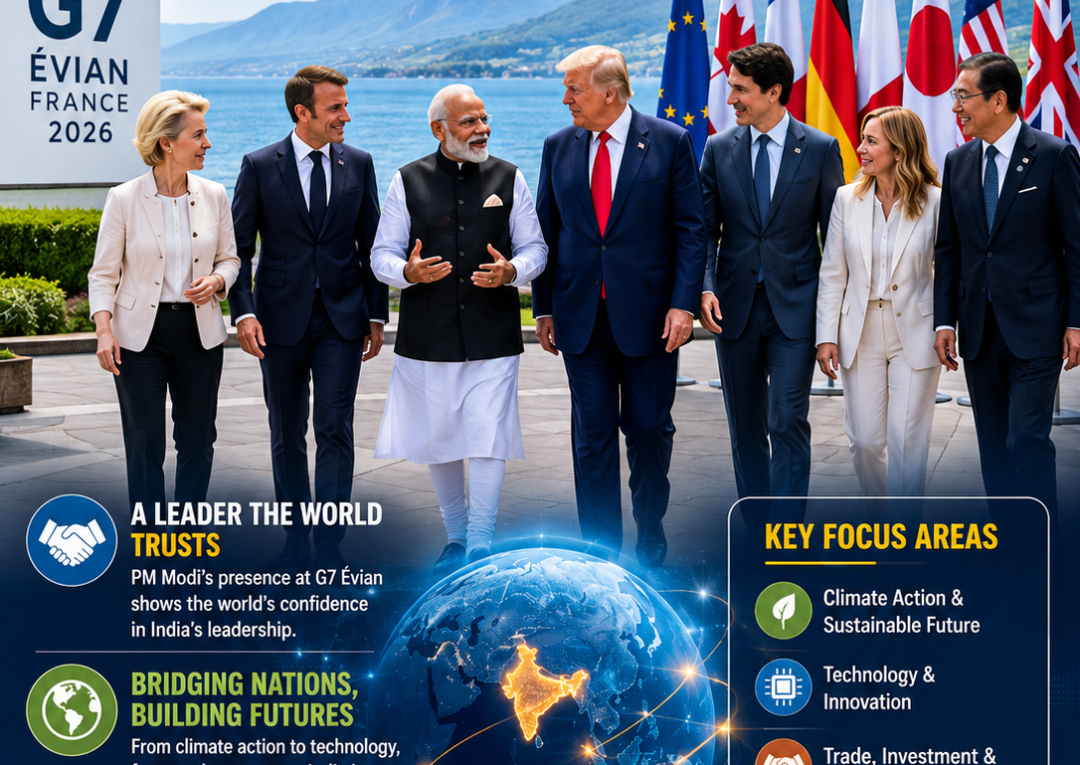
There’s a photograph from Évian, France that says more than any press release could. PM Narendra Modi, seated at a G7 roundtable — flanked on one side by US President Donald Trump, and on the other by German Chancellor Olaf Scholz. Not at the edges of the table. Not as a silent guest. Right in the middle of where decisions get made.
This is India’s new address in global affairs. And the G7 Summit on June 15–17, 2026, made that clearer than ever before. The world is watching a country that once watched from the sidelines now step in as a genuine player — one that both sides of every major conflict actually want to talk to.
But this wasn’t just a photo op. The summit unfolded against a backdrop of real, active crises — West Asia burning, the Strait of Hormuz under threat, global supply chains fraying at the edges. And India sat at the centre of it all, not as an observer, but as a nation that had skin in the game, a clear voice, and the rare ability to speak to all sides without choosing one.
The Line That Stopped the Room
When world leaders gather, most statements blur into each other after a while. Diplomatic language does that — it smoothens edges, qualifies everything, says a lot without really saying much.
Modi didn’t do that at Évian.
Speaking during the session titled “Forging New Partnerships and Rebuilding International Solidarity,” he said something that cut through all the noise: “Today, the world does not suffer from a shortage of resources. It suffers from a shortage of trust.”
That’s not a throwaway line. It’s an entire diagnosis of the current world order packed into one sentence. Resources exist — money, technology, food, energy. What’s broken is the faith between nations, between leaders, between institutions that were built for a different era.
That single framing — trust as a strategic asset — is actually what gives India its leverage right now. Because India is one of the few major nations that every side of every conflict is still willing to listen to. That’s not a small thing. In 2026, it might be the most valuable geopolitical commodity there is.
Why India Gets Invited — Eight Years Running
Let’s step back for a second. The G7 is a club of the world’s wealthiest democracies — the US, UK, France, Germany, Italy, Japan, Canada. India is not a member. Never has been. And yet, this was the 8th consecutive time India received an invitation to participate.
That doesn’t happen by accident. It’s a deliberate signal from the G7 bloc that India’s presence in the room changes the conversation — and changes it for the better.
Here’s why it keeps happening.
🔑 Why the G7 Keeps Calling India Back
- Largest Democracy in the World: India’s democratic legitimacy gives it moral authority in conversations about governance, institutions, and global norms. The G7 needs that voice in the room — especially as authoritarianism rises elsewhere.
- Voice of the Global South: The developing world — Africa, Southeast Asia, Latin America — doesn’t have a permanent seat at G7 tables. But India does, and Modi has consistently used that platform to raise concerns that others would rather not hear. That advocacy isn’t just altruistic. It builds India’s own influence across dozens of nations.
- Diplomatic Neutrality That Actually Works: India buys Russian oil despite Western pressure. It maintains ties with Gulf states while deepening relations with the US and France. It talks to Iran. It works with Israel. In a world of forced alliances, that multi-directional posture is genuinely rare — and extremely useful for countries that need a go-between.
- Economic Weight That’s Growing Fast: India is now the world’s fifth-largest economy — on its way to third. The G7 knows that any conversation about global trade, supply chains, or digital infrastructure that excludes India is an incomplete one.
- Digital and Tech Infrastructure: India’s digital public infrastructure — UPI payments, Aadhaar identity, ONDC commerce layer — is being studied and replicated by dozens of nations. At Évian, India actively promoted partnerships in AI, semiconductors, and cybersecurity.
The Real Crisis:
West Asia at the Table
If you want to understand why Modi’s presence at Évian mattered beyond symbolism, look at what was actually being discussed — and what India’s stake in it was.
West Asia is on fire. Iran-Israel tensions, Houthi disruptions in the Red Sea, maritime security concerns in the Strait of Hormuz — these aren’t background noise. They’re front-page every day, and they’re directly hitting India’s economy.
Every spike in Brent crude is a direct hit on India’s current account deficit, rupee stability, and inflation. The conflict in West Asia isn’t a faraway problem — it shows up in your petrol price at the pump. India has a real, urgent economic stake in stability in the region.
Roughly 20% of the world’s oil moves through the Strait of Hormuz. Modi specifically raised this at the G7 session — flagging that disruptions to maritime trade through the strait have affected the global economy. He didn’t leave this as an abstract concern. He named it directly.
Modi told G7 leaders that “several Indian civilians have also lost their lives” — a reference to Indian seafarers aboard vessels caught in West Asia conflict zones. This was a pointed, serious statement — India isn’t just watching the conflict, it’s losing people in it.
Throughout his remarks, Modi stressed that lasting solutions to global conflicts can only come through dialogue, diplomacy, and international cooperation. This is India’s consistent line — and it’s one that keeps multiple doors open simultaneously, giving India more reach than nations that have fully picked a side.
Modi specifically called for ensuring the safety of seafarers in global maritime trade. India has one of the world’s largest merchant navy communities. Raising seafarer safety at the G7 was both a humanitarian appeal and a signal that India intends to shape the rules of maritime security going forward.
The proposed Modi–Trump bilateral on June 17 had long-term energy partnership as a key agenda item. The idea: reduce India’s dependence on volatile West Asian supply by deepening US energy imports — while also advancing the final stages of the India-US trade agreement that’s been in negotiation for over a year.
“We welcome the progress made in peace efforts in West Asia. But this conflict has caused loss of life and property in our friendly countries — and Indian civilians have lost their lives.”
PM Narendra Modi — G7 Outreach Session, Évian, June 16, 2026
The Modi–Trump Handshake Moment
The photo went viral instantly. Trump was already seated when Modi walked into the outreach session. They shook hands. Modi was seen smiling. They were placed next to each other at the roundtable — and this was their first in-person meeting in over 16 months.
That gap matters. The last time both leaders were in the same room, the world looked very different. Since then: Operation Sindoor in South Asia, escalating West Asia conflict, ongoing trade negotiations, and a series of phone calls that kept the relationship functional — but not close.
Évian was a reset of sorts. And the agenda for their expected bilateral on June 17 was packed: West Asia crisis, Strait of Hormuz, long-term energy partnership, and the final stages of the India-US trade deal.
That’s actually sophisticated diplomacy at work. You don’t fix difficult things at a scheduled bilateral where the whole world is watching. You fix them in the margins of a G7 summit where the two leaders happen to be seated next to each other anyway.
How We Got Here — The Build-Up
Modi’s Évian moment didn’t come out of nowhere. It’s the product of years of deliberate relationship-building and consistent diplomatic positioning. Here’s the sequence.
India’s Playbook: What’s Actually Different Now
This isn’t just Modi doing what Indian leaders have always done at international forums. The nature of India’s engagement has genuinely shifted — and the Évian summit is the clearest expression of that shift yet.
From Passive Observer to Active Shaper
For decades, India’s posture at global forums was reactive. It responded to other nations’ proposals, defended its own positions, and occasionally shaped an agenda item. The new posture is different — India walks in with its own framing of issues, its own vocabulary (like “trust as a strategic asset”), and its own agenda that others have to engage with.
The BRICS Presidency Factor
India holds the BRICS presidency in 2026 — a grouping that includes Russia, China, Brazil, South Africa, and several newer members. That gives India a second, parallel seat in a very different conversation. France specifically mentioned India’s BRICS presidency as a reason to deepen its G7 involvement. The logic: India can translate between worlds that otherwise don’t talk to each other.
Digital Infrastructure as Soft Power
At Évian, India isn’t just talking geopolitics. It’s pitching its digital public infrastructure — UPI, Aadhaar, ONDC — as models for global adoption. This is smart, because it makes India’s domestic success stories into global diplomatic assets. When a developing nation wants to build a digital payments system, they’re now looking at India’s model, not America’s or China’s.
🔑 India’s Key Asks at G7 Évian 2026
- Maritime Security and Seafarer Safety: A formal, structured framework for protecting merchant shipping — and the workers who crew it — in high-risk zones. India wants this on the permanent G7 agenda, not treated as a one-off crisis response.
- Technology Partnerships Without Strings: Access to semiconductors, AI infrastructure, and cybersecurity tools through partnerships that don’t come with geopolitical conditionality. India wants to build its tech stack without being forced into one bloc’s ecosystem.
- Global South Development Financing: Reform of multilateral institutions — IMF, World Bank — to better reflect the financing needs of developing nations. India has been making this argument for years, but in 2026, with the Global South growing faster than the G7, it lands differently.
- Energy Security Without Sanctions Pressure: India’s purchase of Russian oil has drawn Western criticism. But India’s position — that it must serve the energy needs of 1.4 billion people before making geopolitical choices about suppliers — is increasingly being accepted as a legitimate position, not a provocation.
What This Means — For Professionals Watching
If you’re a policy analyst, foreign correspondent, or strategic professional trying to read where this is heading — here’s the clear-eyed version.
- India’s neutrality is strategic, not passive: When Modi refuses to explicitly condemn one side or the other in West Asia, it’s not fence-sitting. It’s a calculated positioning that lets India retain influence on both sides — and charge a premium for that access when mediators are needed.
- The Trump relationship is resilient but complex: The in-person reset at Évian matters, but the underlying tensions — US sanctions on Indian oil behavior, the seafarer death dispute — haven’t disappeared. Watch for what both sides actually agree to in the bilateral, not just the optics of the handshake.
- India is building its G7 case over years, not summits: Each consecutive invitation reinforces the precedent. In diplomatic terms, India is building a de facto permanent outreach seat — without ever formally applying for one. That’s elegant and efficient.
- The Global South framing is India’s most powerful card: No other major economy can credibly claim to speak for the developing world the way India can. That voice becomes exponentially more valuable when the G7 needs buy-in from those nations on sanctions, climate commitments, or trade rules.
- Watch India-US energy as the next defining bilateral: If the trade deal closes and a long-term energy partnership is formalised, it changes the calculus on Russia oil purchases — and potentially shifts how much flexibility India has in navigating future conflict zones.
The Seat at the Table
Was Never Given — It Was Built.
The trust-deficit speech wasn’t just good rhetoric. It was a statement of India’s value proposition to the world: we are a nation that builds trust when others spend it. In 2026, with wars active, alliances fraying, and institutions under stress, that makes India more relevant — not less.
The Strait of Hormuz, the seafarers who lost their lives, the energy markets whipsawing — these aren’t India’s crises to solve alone. But India’s ability to be in the room when they’re being discussed, to shape the framing rather than just react to it, to be invited back eight consecutive times — that’s the real story from Évian.
The world is short on trust. India, for now, has a surplus of it. What it does with that surplus over the next critical years will determine whether Évian 2026 is remembered as a moment India rose — or merely a moment India was present.
India Foreign Policy — June 2026