⚛Energy & Science · April 2026
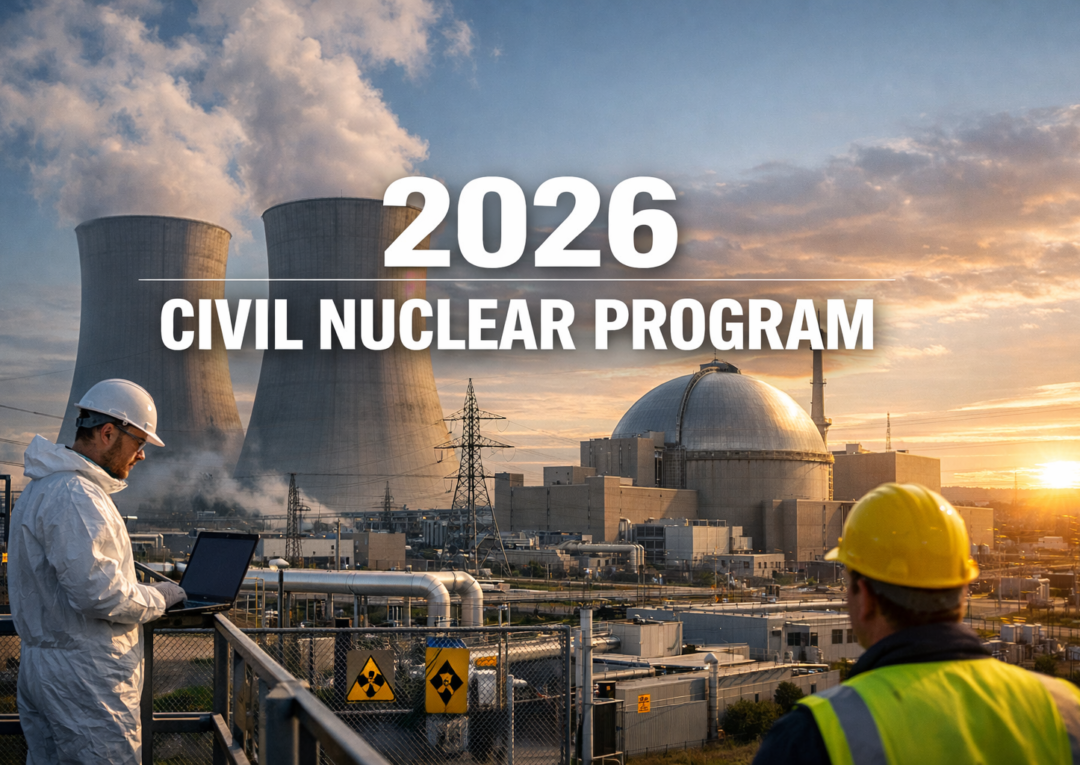
Civil Nuclear
Program 2026
The world is running out of time to fix its energy crisis. And the answer might just be hiding inside the smallest thing in the universe — the atom.
Imagine a world where a single pellet of uranium — roughly the size of your fingertip — produces as much energy as 800 kilograms of coal. That’s not science fiction. That’s nuclear energy. And in 2026, it’s back at the center of the world’s most urgent conversation: How do we power a planet of 8 billion people without destroying it?
From India’s ambitious reactor expansion to the United States reviving old plants, and from small modular reactors (SMRs) reshaping the energy grid to the Paris Climate Agreement pushing every nation to cut emissions — civil nuclear programs have become one of the most talked-about, most debated, and most important energy decisions of our generation. Let’s break it all down, simply and clearly.
What Is a Civil Nuclear Program?
A civil nuclear program is basically a country’s plan to use nuclear technology for peaceful purposes — mainly to generate electricity. The word “civil” is key here. It means we’re talking about power plants, energy research, and medical applications. Not weapons. Think of it as using the power of splitting atoms to light up homes, run hospitals, and charge electric vehicles — rather than building bombs.
Every country that runs a civil nuclear program must follow strict international rules. The International Atomic Energy Agency (IAEA) — a United Nations body — acts like the global watchdog. They inspect facilities, monitor uranium usage, and make sure no country is secretly using civilian programs for military purposes.
The Core Difference: Civil vs Military
- Civil Nuclear: Used for generating electricity, medical imaging, cancer treatment, and scientific research. Uranium is enriched to low levels (3–5%).
- Military Nuclear: Weapons-grade material enriched to 90%+. Governed by the Nuclear Non-Proliferation Treaty (NPT).
- Dual-Use Risk: The same technology can be misused — which is why international monitoring matters so much.
“Nuclear power is the only energy source that can provide clean, reliable baseload electricity at the scale the world needs.”
International Energy Agency (IEA), 2025 Energy Outlook
Why Is Nuclear Energy Important in 2026?
Here’s the reality check no one wants to hear: solar panels don’t generate power at night. Wind turbines don’t work when there’s no wind. But data centres, hospitals, and factories need electricity 24/7, 365 days a year. That’s a problem renewable energy alone hasn’t fully solved — yet.
Enter nuclear energy. It’s not intermittent. It doesn’t depend on weather. A single reactor can power an entire city for decades. And when it comes to carbon emissions? It’s one of the cleanest sources of electricity ever invented.
🌡️
Climate Crisis
The world needs to hit net-zero by 2050. Nuclear offers massive clean energy without the emissions problem of coal or gas.
⚡
Energy Security
Post-Ukraine war energy shocks reminded Europe how dangerous dependence on imported fossil fuels can be. Nuclear offers domestic energy independence.
🤖
AI Power Hunger
AI data centres consume enormous electricity. Big Tech companies like Microsoft and Google are now signing nuclear energy deals to power their servers.
📈
Rising Demand
Electric vehicles, digital infrastructure, and industrial growth are pushing electricity demand to record highs globally.
How Does Nuclear Power Work?
(Simple Explanation — No Physics Degree Required)
Okay, let’s simplify this. You know how burning coal or gas releases heat, which boils water, which spins turbines to make electricity? Nuclear power does the same thing — just in a much more powerful way.
Instead of burning fuel, nuclear reactors split atoms — a process called fission. When a uranium-235 atom is hit by a neutron, it splits into two smaller atoms and releases an enormous amount of heat. That heat boils water into steam, steam spins a turbine, turbine generates electricity. Same principle as a steam engine from the 1800s — just powered by atoms instead of coal.
Fuel Loading
Uranium fuel rods — enriched to about 3–5% — are loaded into the reactor core. A single fuel rod is smaller than your arm but incredibly energy-dense.
Chain Reaction
A controlled chain reaction begins. Neutrons split uranium atoms, which release more neutrons, which split more atoms. This is carefully controlled using control rods made of boron or hafnium.
Heat Generation
The fission process generates enormous heat — far more than any chemical burning process. This heat is transferred to coolant water circling the reactor.
Steam & Turbines
Hot water turns into steam. Steam drives massive turbines connected to generators. The turbines spin and produce electricity — the same electricity that flows into your home.
Cooling & Safety
The steam is cooled back into water using large cooling towers (those iconic cone-shaped structures you see at nuclear plants). The water is recycled. Nothing harmful goes into the air.
Quick Fact
One kilogram of uranium-235 can produce roughly 45,000 kilowatt-hours of electricity. To produce the same amount from coal, you’d need about 3,000 kilograms. That’s the power difference we’re talking about.
Recent Global Developments & Trends
2026 is proving to be a watershed year for nuclear energy globally. After years of reluctance following the Fukushima disaster in 2011, countries are actively reversing anti-nuclear policies and announcing ambitious expansion plans. Here’s what’s happening around the world:
Microsoft struck a 20-year deal with Constellation Energy to restart Pennsylvania’s Three Mile Island Unit 1 reactor to power its AI data centres. This is a historic moment — a closed nuclear plant coming back to life to meet tech industry power demands.
France, which already gets ~70% of its electricity from nuclear, announced plans to build 14 new reactors by 2050. President Macron called nuclear energy “the energy of French sovereignty.”
The UK government formally approved the Sizewell C nuclear project — a massive 3.2 GW plant — as part of its plan to quadruple nuclear capacity by 2050 and achieve clean energy independence.
China is building more nuclear reactors than any other country — with over 20 under construction simultaneously. By 2035, China plans to have more nuclear capacity than the entire current fleet of the United States.
Even Saudi Arabia — a nation sitting on vast oil reserves — is building its first civil nuclear reactor. When an oil-rich country invests in nuclear, it signals something profound about where energy economics are heading.
India’s Nuclear Expansion Story
India’s relationship with civil nuclear energy is one of the most fascinating in the world. For decades, India was cut off from international nuclear trade because it hadn’t signed the Nuclear Non-Proliferation Treaty (NPT). Then came the landmark India-US Civil Nuclear Deal of 2008 — a game-changer that brought India into the global nuclear mainstream.
Today, India operates 22 nuclear reactors across 7 sites, generating about 7,480 MW of power. But that’s just the beginning. Under India’s massive energy expansion plan, nuclear capacity is targeted to reach 22,480 MW by 2031–32 — that’s three times its current capacity in less than a decade.
Key Nuclear Sites in India
- Kudankulam, Tamil Nadu: India’s largest nuclear power plant, built with Russian collaboration under ROSATOM.
- Kakrapar, Gujarat: Home to India’s first indigenous 700 MW pressurised heavy water reactor — a proud milestone for Indian nuclear engineering.
- Gorakhpur, Haryana (GHAVP): Under revival after years of delays — expected to contribute significantly to northern India’s power grid.
- Jaitapur, Maharashtra: India’s most ambitious project — a 9,900 MW site (6 reactors) being developed with France’s EDF. If completed, it will be the world’s largest nuclear power plant.
The Three-Stage Nuclear Programme
India has a unique, brilliantly designed three-stage nuclear programme developed by Dr. Homi Bhabha — often called the father of India’s nuclear program:
1️⃣
Stage 1
Pressurised Heavy Water Reactors (PHWRs) using natural uranium. India is already well into this stage with multiple operating plants.
2️⃣
Stage 2
Fast Breeder Reactors (FBRs) using plutonium derived from Stage 1. The Prototype Fast Breeder Reactor (PFBR) at Kalpakkam is the centrepiece of this stage.
3️⃣
Stage 3
Thorium-based reactors. India has the world’s largest thorium reserves — making this stage a potential global energy game-changer for the next century.
Nuclear Energy Observer, 2025
Benefits vs Risks — The Big Debate
No energy source is perfect. And nuclear energy is probably the most debated one in history. Let’s put both sides on the table — fairly and honestly:
| Category | Benefits ✅ | Risks ⚠️ |
|---|---|---|
| Carbon Emissions | Near Zero | Construction Emissions |
| Reliability | 24/7 Baseload | Slow Startup |
| Energy Density | Extremely High | Waste Disposal |
| Land Use | Very Small Footprint | Exclusion Zones |
| Cost | Low Operating Cost | High Build Cost |
| Safety | Statistically Safest | High-Consequence Events |
| Jobs | High-Skilled Employment | Specialised Training Needed |
Here’s the truth that sometimes gets lost in heated debates: statistically, nuclear energy is safer per unit of energy produced than coal, oil, gas, and even rooftop solar (accounting for fall accidents during installation). The deaths per terawatt-hour from nuclear are among the lowest of any energy source ever measured.
The fear of nuclear is real, but it’s largely driven by two high-profile disasters — Chernobyl (1986) and Fukushima (2011). Both were tragic. Both are studied extensively. And both have led to design improvements that make today’s reactors fundamentally safer than those generations.
Environmental Impact & Clean Energy Future
Let’s talk about the elephant in the room: if nuclear is so clean, why do some environmentalists oppose it?
The carbon argument is solid. The entire lifecycle carbon footprint of nuclear — including mining uranium, building the plant, and decommissioning it — is comparable to wind energy and far lower than solar PV. Per kilowatt-hour, nuclear produces about 12 grams of CO₂ equivalent. Coal? Around 820 grams. That’s not even close.
The Waste Problem
The main environmental concern is radioactive waste. High-level nuclear waste remains radioactive for thousands of years. The entire world’s spent nuclear fuel over 60+ years of reactor operation could fit inside a single football field stacked about 10 metres high. It’s a small volume — but managing it long-term is a genuine challenge.
Good News on Waste
France already reprocesses 96% of its spent nuclear fuel — recycling it back into usable energy. Advanced reactor designs like Generation IV reactors and molten salt reactors can actually use existing nuclear waste as fuel, dramatically reducing the long-term storage challenge. This is not science fiction — it’s being actively developed today.
Nuclear + Renewables: Better Together
The smartest energy thinkers today aren’t choosing between nuclear and renewables — they’re arguing for both. Solar and wind produce electricity when nature allows. Nuclear fills the gaps, providing stable, always-on power. Together, they form the backbone of a genuine zero-carbon grid. Countries like Finland and France are already proving this model works.
Safety Measures & Modern Technology
This is where the story gets genuinely exciting. Nuclear technology in 2026 looks almost nothing like the reactors of the 1970s and 80s. Decades of engineering innovation have produced designs that would have seemed like science fiction a generation ago.
Small Modular Reactors (SMRs)
SMRs are the most talked-about nuclear innovation of the decade. Instead of massive billion-dollar plants, SMRs are compact reactors — producing 50 to 300 MW — that can be factory-built and transported to remote locations. They’re cheaper, faster to build, and designed with passive safety systems that don’t need human intervention to shut down safely in an emergency.
- NuScale Power (USA): The world’s first SMR design to receive regulatory approval. Multiple countries are evaluating NuScale units for deployment.
- Rolls-Royce SMR (UK): Britain’s homegrown SMR programme, targeting factory-produced units that could be operational by the early 2030s.
- BHABHA Atomic Research Centre (India): India’s BARC is developing its own indigenous SMR designs tailored for industrial heat applications and remote power needs.
Generation IV Reactors
These are next-generation designs that go beyond conventional light-water reactors. They operate at higher temperatures, use alternative coolants (like molten salt or liquid sodium), can consume existing nuclear waste as fuel, and are inherently meltdown-proof by design — not just by safety systems layered on top of a dangerous process.
Fusion Energy: The Holy Grail
While fission splits atoms, fusion merges them — the same process that powers the sun. If commercially achieved, fusion energy would mean virtually unlimited clean power with minimal waste and no meltdown risk. In December 2022, the US National Ignition Facility achieved ignition for the first time in history — producing more fusion energy than the laser energy used to trigger it. In 2026, private companies like Commonwealth Fusion Systems are targeting demonstration plants by the early 2030s. The race is on.
What It Means for Your Generation
If you’re a student reading this in 2026, here’s something worth sitting with: the energy decisions being made right now will shape the world you inherit. The plants being approved today will still be running when you’re in your 50s. The nuclear engineers being trained now will be the ones who either get this right — or don’t.
This is not a distant, abstract policy issue. It’s about whether your city will have affordable electricity in 20 years. Whether your country will be dependent on foreign oil. Whether the climate targets written in international agreements will actually be met — or will just remain polite promises on paper.
Career Opportunities Are Exploding
The global nuclear revival is creating a massive demand for skilled professionals. Nuclear engineers, radiation physicists, materials scientists, cybersecurity specialists for nuclear infrastructure, nuclear policy analysts — these fields are growing faster than they can be filled. For students in India especially, with BARC, NPCIL, and the Department of Atomic Energy investing heavily, there has rarely been a better time to build a career in this space.
The Geopolitical Angle
Countries that master civil nuclear technology gain enormous geopolitical influence. They export reactors, fuel, and expertise to developing nations — building long-term diplomatic relationships in the process. Russia’s ROSATOM has built reactors in over 30 countries. China is positioning itself as the nuclear partner of choice for Africa and Southeast Asia. India, with its unique three-stage programme and growing expertise, has the potential to join this league.
The Bottom Line
Civil nuclear energy isn’t the enemy of clean energy. It’s not the relic of cold war politics. In 2026, it’s one of the most promising, most needed, and most rapidly evolving fields in human civilisation. Understanding it isn’t just for scientists — it’s for every citizen who wants to participate meaningfully in decisions that will define our collective future.
Final Thought:
The Atom Can Save Us
We started with a fingertip-sized pellet of uranium. Somewhere inside that tiny cylinder is enough energy to power a home for years. That’s not just chemistry — that’s one of the most profound facts in physics.
The civil nuclear program of 2026 isn’t about repeating the mistakes of the past. It’s about using everything we’ve learned — about safety, about design, about governance, about international cooperation — to finally get this right. The climate is not waiting. The energy demand is not waiting. And the technology, for the first time in history, is genuinely ready.
The atom has always had the power to destroy. The question of our generation is whether we have the wisdom to use it to build instead.
⚛ From fission to fusion — the future is atomic.