⚖️ Indian Judiciary · Analysis · Current Affairs · April 2026
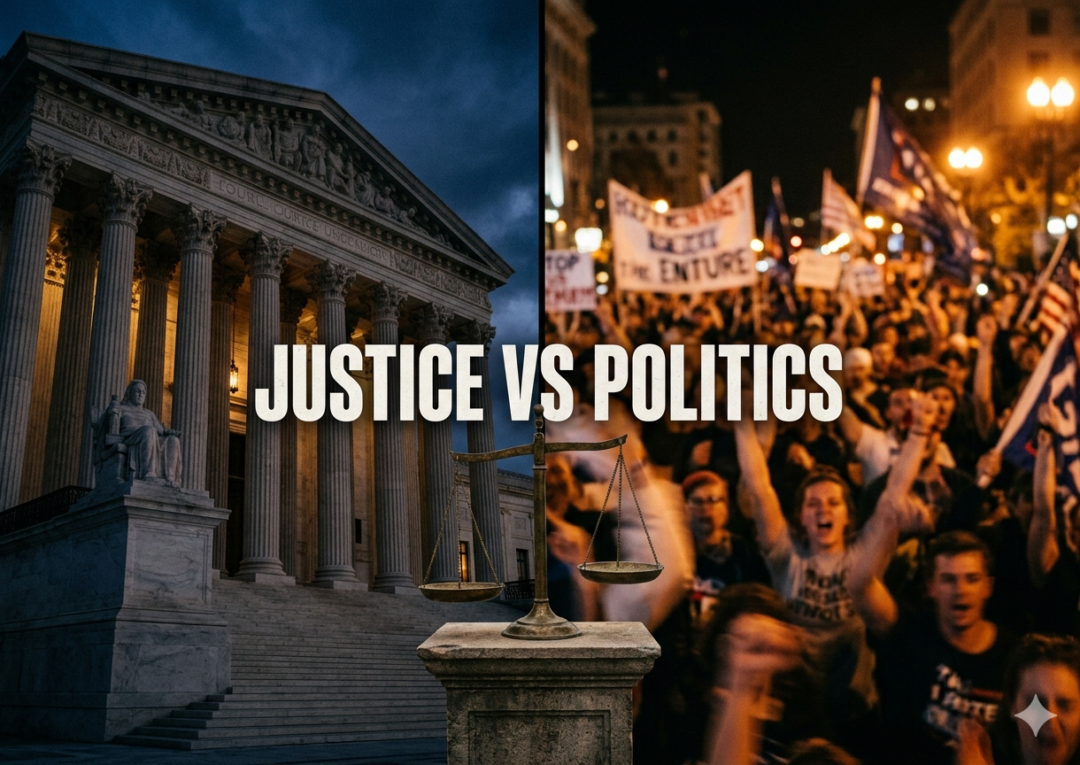
Judiciary
vs Politics
Where Is the Line?
Imagine a judge who just heard a case involving a political party. Now imagine that same judge attending a function hosted by that party’s leaders the very next evening. Would you still trust their verdict?
That’s the uncomfortable question at the heart of a debate that Justice Abhay S. Oka — one of India’s most respected Supreme Court judges — has reignited with a statement that’s equal parts bold and necessary.
This isn’t just a legal technicality. It’s about whether ordinary citizens can look at a courtroom and feel confident that the person in the black robes is working for justice — not for any party, flag, or faction.
What Happened? — The Statement That Sparked Debate
Before retiring from the Supreme Court of India, Justice Abhay S. Oka made a public statement that cut through the noise like a sharp legal brief. He expressed clear concern about judges attending political or government events — suggesting that such participation compromises the image of an independent judiciary, even if the judge’s actual decisions remain unaffected.
In simple words? He said: even the appearance of being close to power is a problem.
It wasn’t said in a courtroom. It wasn’t part of any judgment. But it sparked something important — a national conversation about where the line between the judicial and political world should actually sit.
And then, in a moment that added a personal dimension to his own words, Justice Oka chose to recuse himself from a case involving former Delhi Chief Minister Arvind Kejriwal — a decision we’ll dig into shortly.
Who Is Justice Abhay S. Oka?
To understand why his words carry weight, you need to know who said them.
⚖️ Justice Abhay S. Oka — A Quick Profile
- Full Name: Abhay Shreeniwas Oka
- Joined Supreme Court: August 2021
- Previous Role: Chief Justice of Karnataka High Court
- Known For: Strong emphasis on civil liberties, bail rights, and institutional independence
- Notable Positions: Consistently ruled in favour of individual rights against state overreach
- Retirement: April 2025, after a distinguished tenure on the apex court
Justice Oka isn’t a judge who played it safe. During his time on the Supreme Court, he was part of benches that questioned lengthy undertrial detentions, pushed for prison reforms, and reminded lower courts that personal liberty cannot be treated casually.
He wasn’t the loudest voice in the room — but when he spoke, people listened. Which is why his statement about judges and political events landed with such force.
Why Judicial Neutrality Matters
Here’s a simple way to think about it. Imagine you’re playing a game of cricket, and the umpire is wearing one team’s jersey. Would you trust his calls? Even if every single decision he made was technically correct — would it feel fair?
That’s judicial neutrality in a nutshell. It’s not just about being fair. It’s about looking fair. Because in a democracy, public trust in institutions is as important as the institutions themselves.
What Does Judicial Neutrality Actually Mean?
- Impartiality: A judge must not favour either party in a case based on personal, political, or social bias.
- Independence: No external pressure — from government, parties, or public opinion — should influence a court’s decision.
- Appearance of Fairness: Even if a judge is genuinely neutral, their public behaviour must not create doubt. This is what Justice Oka was specifically pointing to.
- Recusal: When a judge has a potential conflict of interest, they can voluntarily step back from a case. This is a healthy, ethical practice.
The Indian Constitution’s framers understood this deeply. Article 50 of the Constitution specifically directs the state to separate the judiciary from the executive. The idea was always that courts should be a safe harbour from political storms — not caught in the middle of them.
“Justice must not only be done — it must be seen to be done.”
R v Sussex Justices, 1924 — A principle still taught in every law school today
Judiciary vs Politics — Where Should the Line Be Drawn?
This is the million-rupee question. And it doesn’t have a perfectly clean answer — which is exactly what makes it worth discussing.
There are situations where judges and the political world genuinely overlap. Swearing-in ceremonies, national day events, Republic Day and Independence Day functions — these are attended by judges all the time, and most people consider that fine. After all, judges are citizens too.
But where exactly does attending a neutral national function end, and attending a politically loaded event begin? That’s where it gets murky.
- Republic Day / Independence Day state functions
- Constitutional events (President’s oath, etc.)
- Inter-institutional dialogues on governance
- Neutral academic or policy conferences
- Law Day and National Judiciary events
- Events hosted by political parties
- Rallies or functions of ruling party leaders
- Inaugurations of projects by sitting politicians
- Any event where appearance = endorsement
- Close social association with parties to active cases
The issue isn’t always the event itself — it’s the optics. A judge attending a function hosted by a Chief Minister whose government is involved in litigation before that judge’s bench sends a signal, even if nothing inappropriate happens.
And in a country where public trust in institutions is already fragile, signals matter enormously.
The Arvind Kejriwal Recusal Context Explained
Let’s break this down simply, because the word “recusal” can sound complicated when it really isn’t.
Recusal means a judge voluntarily steps out of a case because they believe — or it appears — that they might not be able to decide it completely impartially. It’s actually a sign of integrity, not weakness.
Justice Oka chose to recuse himself from a matter involving former Delhi Chief Minister Arvind Kejriwal. The specific reasons weren’t elaborated on publicly, but the very act of recusal speaks to the principle he had been voicing: that judges must protect the perception of fairness, not just the reality of it.
What makes this especially significant is the timing. His public statement about judicial neutrality and political events came around the same period as this recusal — which meant his actions and his words were aligned. That kind of consistency is what builds institutional credibility.
What The Law Says About Recusal
India doesn’t have a rigid statutory code that lists when a judge must recuse. Instead, it’s guided by common law principles, judicial precedent, and — most importantly — individual conscience. The Supreme Court has held in various judgments that a judge must disqualify themselves when there’s a “real danger” of bias, or even a “reasonable apprehension” of it in the minds of a fair-minded observer.
Legal Perspective: Can Judges Attend Political Events?
Technically? There’s no statute that explicitly bans a sitting judge from walking into a political function. But the law — and more importantly, judicial ethics — paint a very different picture.
📖 The Key Legal Frameworks
- Bangalore Principles of Judicial Conduct (2002): Internationally adopted guidelines that clearly state judges must avoid any activity that could lead a reasonable person to doubt their independence or impartiality.
- Restatement of Values of Judicial Life (1997): Adopted by the Supreme Court of India — judges are expected to not enter into public controversies unnecessary to discharge judicial duties.
- Article 124 & 217 of the Constitution: Lay down the foundations of judicial independence, which extends to conduct beyond the courtroom.
- In-House Procedure (1999): Provides a mechanism for dealing with complaints against judges — reinforcing that conduct norms exist.
Internationally, this is well-settled territory. In the United States, the Code of Conduct for Federal Judges explicitly prohibits judges from engaging in political activity. In the UK, judges are expected to avoid any public association with political causes or parties.
India’s approach has been more informal — relying on convention, individual conscience, and peer culture rather than hard statutory rules. Which is exactly why Justice Oka’s statement is so valuable: he’s pushing for that culture to get sharper and more defined.
Impact on Public Trust in the Judiciary
Here’s something worth sitting with for a moment. India’s judiciary handles over 4.7 crore pending cases. Millions of ordinary citizens — farmers, labourers, women fighting for their rights, small business owners — put their faith in courts every day, often as their last hope.
That faith is not automatic. It has to be earned and maintained. And it is fragile in a way that power-holders sometimes forget.
When a judge is seen at a political rally, or photographed at a party event hosted by people whose cases might come before them — that faith chips away. Not dramatically. Not overnight. But chip by chip, year by year.
This is why judicial ethics isn’t just a professional concern. It’s a democratic one.
Voices from Legal Experts & Public Opinion
This debate isn’t one-sided. Here’s how different voices tend to weigh in — and it’s worth hearing all of them.
Many senior lawyers and legal academics fully agree with Justice Oka. They argue India needs a formal, written Code of Conduct for judges that explicitly addresses political participation — not just vague conventions that depend on individual integrity.
Some former judges argue the current convention-based system works fine, and that judges can be trusted to use good judgment. They worry that rigid rules might politicise the rule-making process itself — who decides what counts as “political”?
Young law students and first-generation college students tend to strongly agree with stricter norms. For a generation that’s grown up with social media and instant scrutiny, optics matter as much as reality — and they expect institutions to acknowledge that.
Press freedom organisations and civil liberties groups have long advocated for stronger judicial independence norms. For them, a judge attending a political event isn’t just an optics problem — it’s a potential structural one that chills litigation against powerful actors.
Countries like Germany, Canada, and Australia have far more explicit judicial conduct codes. Legal scholars often point to these models as templates India could adapt — retaining flexibility while establishing clear red lines around political engagement.
What This Means for Indian Democracy
India is a country of extraordinary contradictions. It has one of the most detailed written constitutions on earth, and yet some of its most important institutions run largely on unwritten norms. The judiciary is a prime example of this.
For the longest time, “judicial independence” was maintained through individual virtue — through judges who chose, on their own, to keep a professional distance from power. That worked when the political climate was less polarised, media scrutiny was lower, and public cynicism about institutions was more forgiving.
Today, none of those conditions apply.
India is a democracy where every institution — from the Election Commission to the CBI to the judiciary — faces intense public questioning about its independence. In that environment, convention is not enough. Culture is not enough. What’s needed is structure.
🔑 Three Things That Would Strengthen Judicial Independence in India
- A Formal Code of Judicial Conduct: Moving beyond the 1997 Restatement to a binding, detailed, publicly accessible code — similar to what the US and UK have developed.
- Transparent Recusal Standards: Clear, published guidelines on when judges should recuse, and a public record of when recusals happen and why — building institutional accountability.
- Post-Retirement Employment Norms: One of the most debated aspects of judicial independence — should judges be allowed to take government appointments after retirement? Many experts say this creates a perverse incentive during their tenure.
Justice Oka’s statement — as simple and direct as it was — points toward all three of these structural needs. It’s a reminder that building a truly independent judiciary isn’t a one-time constitutional achievement. It’s a continuous, active, and sometimes uncomfortable project.
Final Thoughts: Should Judges Stay Completely Neutral?
Judges are human beings. They have opinions, friendships, values, and histories. Demanding that they become blank, opinion-less robots isn’t realistic — nor is it particularly desirable. A judge with no values is as worrying as a judge with the wrong ones.
But that’s not what judicial neutrality asks for. It asks for something far more specific: that in the exercise of their professional role, judges do not allow personal associations, political preferences, or social affiliations to influence their decisions — and that their public conduct reflects that commitment.
Justice Oka’s statement wasn’t a call for judges to live in hermetically sealed bubbles. It was a call for heightened awareness — for judges to ask themselves, before attending any event: “Would a reasonable person watching this have reason to doubt my impartiality?”
That’s a simple question. And it has the potential to do a lot of work.
“An institution’s independence isn’t just protected by law. It’s protected by the daily choices of the people who work within it.”
The real lesson from Justice Oka’s statement
The Scales of Justice Must Never Tilt
India’s democracy is worth fighting for. And one of the most important fights is quiet, unglamorous, and happens far from election rallies and prime-time debates.
It happens when a judge chooses not to attend a powerful politician’s event. When a bench recuses itself before anyone asks. When a court delivers a verdict that the government doesn’t like — and everyone, including the government, accepts it.
Those moments are what hold democracy together. Justice Abhay S. Oka spent his career creating them. And with this final, simple statement — he’s asking the rest of the bench to do the same.
The scales of justice need steady hands. That’s all. Steady, unswayed, unhurried hands.
Judicial Neutrality
Important for Democracy
Share & Discuss