⚖️ Justice • Human Rights • Landmark Verdict 2026
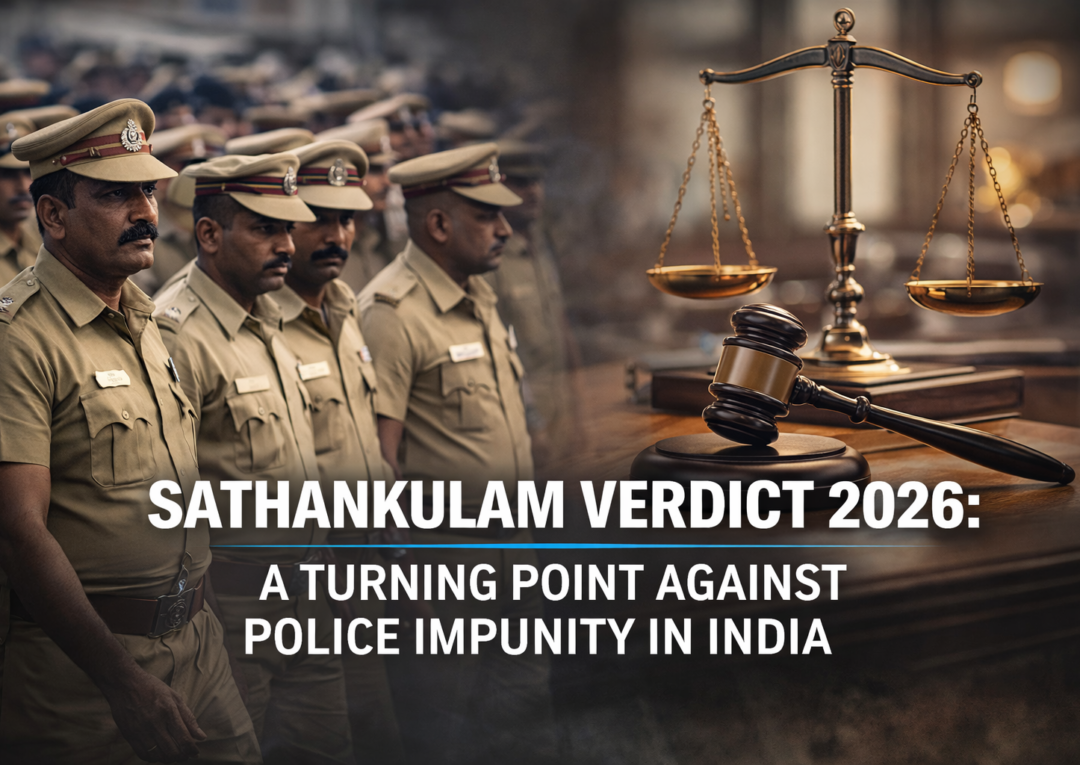
Sathankulam
Verdict 2026:
When Justice
Finally Spoke
The verdict that shook a nation, challenged decades of police impunity, and gave voice to every family that ever wept outside a police station.
Imagine losing your father. Not to an illness, not to an accident — but to the very people who were supposed to protect him. Imagine watching the country go silent, and then, six years later, watching a courtroom finally break that silence.
That is what the Sathankulam verdict of 2026 means. It’s not just a legal judgment. It’s a statement — loud, clear, and long overdue — that no uniform gives anyone the right to destroy a human life. And it has the entire country talking.
What Happened in Sathankulam?
Let’s go back to June 2020. A small town in Tamil Nadu’s Thoothukudi district. A father and son — P. Jayaraj, 59, and his son J. Bennicks, 31 — were arrested by the local police for allegedly keeping their mobile phone shop open a few minutes past the COVID-19 lockdown deadline.
That’s it. That was their “crime.” Staying open a little too late during lockdown.
They were taken into custody at the Sathankulam police station on the night of June 19, 2020. When their family visited the next morning, what they saw was horrifying. Both men had visible injuries. Both were in pain. Within days — Bennicks on June 22, Jayaraj on June 23 — both were dead.
What Reportedly Happened Inside
According to multiple sources, including witness statements and a CBI investigation, the two men were subjected to severe physical torture during their time in custody. Medical reports showed injuries that simply could not have come from “illness” as the authorities initially tried to claim.
The family’s account, backed by other detainees and witnesses who later spoke out, described brutal beatings. It described things no family should ever have to imagine, let alone experience.
“They went in for a minor violation. They came out in coffins.”
A family member’s account, 2020
The case sent shockwaves across India — and this was at a time when the country was already reeling from the George Floyd protests in the United States. People were angry. People were scared. Because if this could happen to a shopkeeper and his son, it could happen to anyone.
Timeline of Events
P. Jayaraj and his son J. Bennicks are arrested by Sathankulam police for allegedly violating COVID-19 lockdown curfew by keeping their shop open late.
When family visits, both men show visible signs of severe physical trauma. They are shifted to a hospital after their condition deteriorates.
Bennicks dies on June 22. His father Jayaraj follows the very next day. The official cause is disputed. The nation is outraged.
Politicians, activists, celebrities, and common citizens take to social media. #JusticeForJayarajAndBennicks trends nationally. Protests erupt across Tamil Nadu.
Following public pressure and Madras High Court intervention, the Central Bureau of Investigation (CBI) takes over the probe, signaling that the case cannot be handled locally.
The trial drags through courts. Witnesses are examined. Evidence is presented. The family and their lawyers fight relentlessly, refusing to let the case die.
A court delivers a historic ruling, holding the accused police officers guilty and acknowledging the systemic failure that allowed custodial torture to occur. India takes notice.
Why This Verdict Matters
Here’s the honest truth — custodial deaths in India are not rare. According to data from the National Crime Records Bureau (NCRB), hundreds of deaths in police custody are reported every single year. But convictions? Those are vanishingly rare.
It doesn’t just punish individuals. It sets a precedent — a legal and moral statement that police officers are not above the law.
Why Convictions in Custodial Death Cases Are So Rare
- Police stations are closed environments with limited external oversight or independent witnesses.
- In many cases, the accused and the investigating officers belong to the same department — a classic conflict of interest.
- Families of victims are often poor, intimidated, or lack legal support to fight prolonged court battles.
- Evidence can be tampered with, post-mortem reports delayed, and witnesses pressured into silence.
- Legal proceedings stretch for years, draining the financial and emotional resources of victim families.
Against all of those odds, this case survived. The family persisted. The courts listened. And justice — slow, imperfect, but real — arrived.
“A conviction in a custodial death case is not just justice for one family. It is a warning to every police officer in this country.”
Human Rights Lawyer, 2026
What Is Police Impunity?
— A Simple Explanation for Students and Readers
Let’s break this down in plain language, because it’s one of those terms that gets thrown around a lot but rarely explained clearly.
Impunity means “freedom from punishment.” So police impunity means — police officers who break the law and face no consequences for it. They commit crimes, but nothing happens to them.
Imagine a student cheats on an exam. Normally, there are consequences — detention, failing marks, suspension. But now imagine the teacher who catches cheating students is the same person who grades their papers, and happens to be best friends with this student. Suddenly, the consequences disappear. That’s a very simplified version of police impunity — when the people who are supposed to enforce rules are the same ones breaking them, and the system around them lets them get away with it.
Why Does This Happen in India Specifically?
India inherited a police system largely designed by the British colonial administration. The Police Act of 1861 — yes, 1861 — still forms the backbone of policing in many states. That law was not designed to protect citizens. It was designed to protect the state from citizens. That’s a fundamental problem that hasn’t been fixed in over 160 years.
- Lack of independent oversight: No truly independent body exists at the state level to investigate police misconduct in most states.
- Political protection: Police forces operate under state governments, and political influence can shield officers from accountability.
- Low reporting rates: Victims — especially from marginalized communities — fear retaliation if they file complaints against police.
- Slow judiciary: Even when cases are filed, they take years or decades to resolve, discouraging victims from pursuing legal action.
The Sathankulam case cracked this system — even if just a little. And even a crack, after decades of impunity, matters enormously.
- According to NCRB data, India has reported over 1,800 deaths in police custody between 2010 and 2020 — that’s roughly one every two days.
- Of thousands of custodial death cases filed in India, the conviction rate has historically been under 1%.
- The Supreme Court of India has repeatedly called custodial torture a violation of Article 21 (Right to Life) of the Constitution — yet it continues to occur.
- India has signed the UN Convention Against Torture but has not yet ratified it in domestic law, creating a legal gap that advocates have long demanded be addressed.
- The Sathankulam case is considered one of the most high-profile custodial death convictions in India in the past two decades.
- The Madras High Court played a crucial role in ensuring the case didn’t get buried — it ordered the CBI probe and monitored proceedings closely.
The Court’s Decision Explained
Court verdicts can be confusing — full of legal jargon and complicated language.
The 2026 verdict in the Sathankulam case essentially did three important things:
| What the Court Did | What It Means in Simple Language | Significance |
|---|---|---|
| Held accused officers guilty | The court said: yes, these police officers tortured Jayaraj and Bennicks, and yes, that led to their deaths. | Accountability |
| Rejected the “natural death” narrative | The court refused to accept that the deaths were due to natural illness or unrelated causes, as some had argued. | Truth Established |
| Invoked custodial torture provisions | The court applied provisions that specifically deal with police abuse of power, not just ordinary assault — making the charges more serious. | Precedent Set |
What Makes This Verdict Legally Special?
Most custodial death cases in India fall apart because of what lawyers call the “closed room problem” — there are no independent witnesses inside a police station. The court in this case relied on medical evidence, the testimony of fellow detainees, the family’s accounts, and the sheer medical impossibility of the official version of events.
That’s significant. It means courts can and should go beyond the police’s own version of events. It means circumstantial evidence, medical records, and patterns of conduct can be enough to establish guilt. That’s a message that will echo in courtrooms across the country.
The truth has other ways of speaking.”
Legal Observer, Post-Verdict Commentary
Public Reaction & Impact
The verdict landed like a thunderclap. Social media erupted. News channels ran it as their top story for days. And on the streets of Tamil Nadu, people gathered — not to protest, but to celebrate. Because for once, the system had worked.
How Different Groups Responded
The Family: Selvarani, Jayaraj’s wife and Bennicks’ mother, who had fought relentlessly for six years, broke down in tears. She had said during the case that she wanted justice more than anything — not money, not compensation, but the acknowledgment that her husband and son were murdered, not forgotten. The verdict gave her that.
Human Rights Activists: Organizations across India celebrated, but many also pointed out that one verdict, however landmark, doesn’t fix a broken system. “This is one step,” activists noted, “but India needs structural reform — independent police oversight, ratification of the torture convention, and genuine protection for custodial complaints.”
Legal Community: Senior lawyers and judges across the country discussed the verdict as a potentially precedent-setting moment. The methodology used by the court — accepting medical evidence over police testimony — could influence how future custodial death cases are approached.
Political Class: Reactions were divided along predictable lines. Opposition parties hailed the verdict as a long-overdue rebuke of police culture. The ruling establishment was more restrained, though no one could outright dismiss the significance of the court’s finding.
Common Citizens: Perhaps the most powerful reaction came from ordinary people — especially those from Dalit and marginalized communities who know all too well what it means to fear the police station. For many, this verdict was not about one case. It was about every case that never made it to the headlines.
On Social Media
Within hours of the verdict, #SathankulamJustice and #JusticeForJayarajBennicks trended nationally. Young people shared explainer threads, older citizens shared their relief. Journalists wrote essays. Filmmakers announced documentaries. The country was, for one moment, united in the recognition that something important had happened.
What Changes Now?
The verdict is historic. But does it actually change anything? That’s the harder question. Here’s an honest assessment.
What Could Change — If We Push For It
- Police accountability culture: Officers across the country now know — in a way they didn’t quite before — that convictions in custodial death cases are possible. That changes the calculus, however slightly.
- Judicial approach: The methodology of this verdict could guide courts in accepting medical evidence and secondary testimony in similar cases, lowering the “proof barrier” that has historically protected abusive officers.
- Anti-torture legislation push: Activists and legal experts are using this moment to renew calls for a comprehensive Prevention of Torture Bill in India — a law that has been proposed and delayed multiple times over decades.
- State police reforms: Multiple state governments are facing renewed public pressure to implement the Supreme Court’s 2006 Prakash Singh judgment directives on police reform — a ruling that has been largely ignored for nearly twenty years.
- Emboldening other families: Perhaps most importantly, this verdict will encourage other families in similar situations to file cases, fight longer, and believe that the system can work for them too.
What Won’t Change Automatically
One verdict doesn’t change a culture. The structural problems — outdated police laws, political interference, lack of independent oversight, poor conditions inside police stations — still exist. Dalit and minority communities, who face disproportionate custodial violence, need far more than a single courtroom win.
As one activist put it: “We celebrate today. Tomorrow, we go back to work.”
Justice Is Slow. But It Speaks.
P. Jayaraj went to his shop that evening in June 2020 not knowing it would be the last ordinary thing he ever did. J. Bennicks, his son, had no idea that a lockdown curfew violation would cost him everything. They didn’t ask to be symbols. They didn’t ask to be part of history.
But history chose them. And six years later, a courtroom — through the voices of witnesses, the honesty of medical evidence, and the relentlessness of a grieving family — chose to speak their names and say: this was wrong, and the people who did this must be held accountable.
The Sathankulam verdict of 2026 is not the end of the story. It is, perhaps, the beginning of a different chapter — one where police impunity is not a guarantee, where custodial deaths are not quietly buried, and where ordinary families dare to hope that the scales of justice might someday tip in their direction.
The question for all of us now is simple: what do we do with this moment?
Justice for Jayaraj & Bennicks India 2026