🎮 Gaming Deep Dive | June 2026
Forza Horizon 6:
Japan, JDM &
The Race of
the Decade.
Fourteen years. That’s how long the Forza Horizon community has been asking — begging, really — for one specific location. Every Reddit thread, every Xbox survey, every “where should FH6 go?” YouTube poll landed on the same answer. Japan.
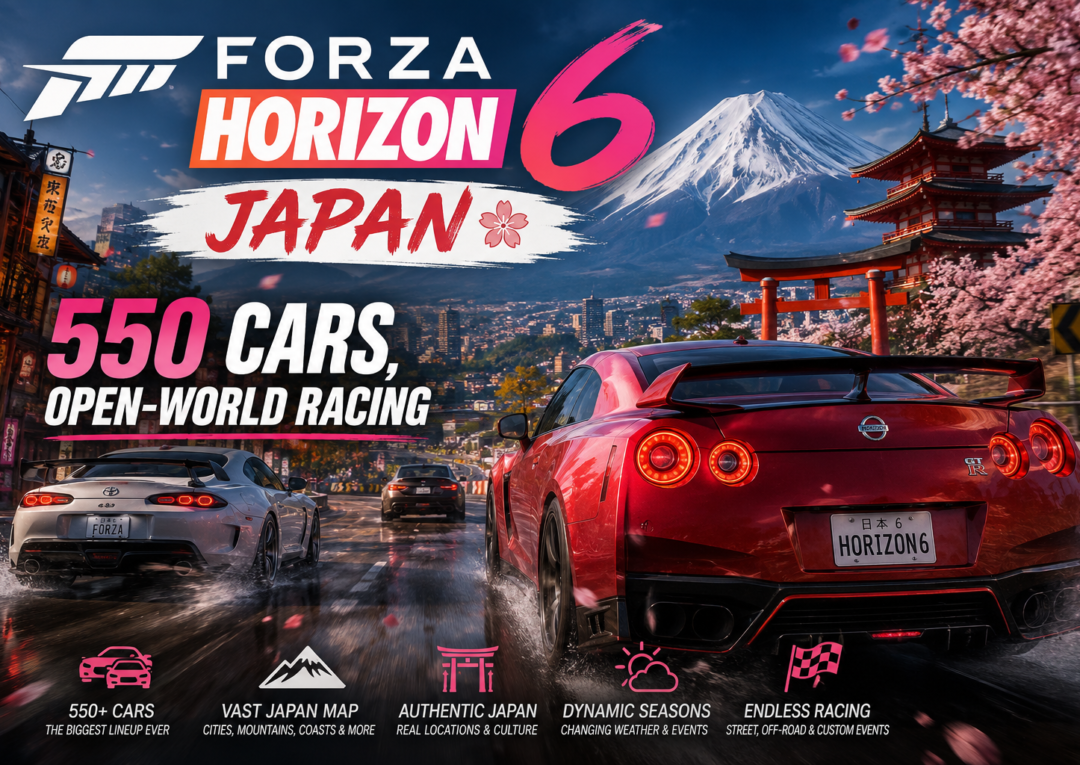
Playground Games finally listened. Forza Horizon 6 launched on May 19, 2026, and it’s everything the wait suggested it would be — and then some. Mt. Fuji on the horizon, neon-lit Tokyo expressways cutting through the night, mountain touge passes that make your palms sweat, and over 550 cars ready to be thrown sideways across it all.
Whether you’ve been a Forza fan since Colorado in 2012 or you’re new to the franchise entirely, this one lands differently. Japan isn’t just a pretty backdrop here. It actively shapes how the game feels, how it sounds, and how it plays. Let’s break all of it down.
Why Japan Was Always the Right Call
If you’ve been part of the Forza community for even a couple of years, you already know this. Japan has been the number one fan-requested location since roughly forever. And it’s not hard to understand why.
Japan is where car culture as a lifestyle was basically invented. The JDM scene, touge mountain pass racing, the infamous Daikoku parking area meetups, the obsession with engine tuning that borders on spiritual — it’s a country that treats cars the way some people treat religion. That’s exactly the kind of energy a Horizon game thrives on.
Playground Games brought in cultural consultants and a dedicated Japanese team to make sure they got this right. Art Director Don Arceta described Japan as having “such a unique culture — from cars, to music, to fashion — that make it perfect for the next Horizon setting.” That care shows in the final product.
From Tourist to Racing Legend
The story kicks off with your character arriving in Tokyo as a newcomer. You’re basically a tourist who needs to qualify for the big tournaments. It’s a familiar Horizon premise, but the Japan context gives it a specific flavour — you’re not just winning races, you’re earning your place inside a culture that takes its car enthusiasm very seriously.
It won’t win any awards for narrative depth. The character models are a bit wooden, and the dialogue is about as deep as a puddle. But that’s never really been what Horizon is for. Nobody picks up a Forza game for the story. They pick it up to drive.
The Cars: 550+ Reasons to Keep Playing
The car roster in Forza Horizon 6 is the largest the franchise has ever shipped at launch — and for a Japan-set game, the weighting makes total sense. This isn’t a list padded with irrelevant exotics. It’s a curated collection that understands what people want from a Japanese open-world racing game.
Nissan Skylines in every generation, multiple GT-R variants, the Supra across eras, AE86, Evo vs STI, FC and FD RX-7 — it’s all here. This is the first Forza game where the JDM roster feels genuinely comprehensive rather than cherry-picked.
Toyota’s GR GT Prototype is on the cover for a reason. It’s the flagship car of the game — and it’s a jaw-dropper. Seeing it tear through mountain fog at sunrise is genuinely cinematic. One of the best cover cars in Horizon history.
Every car has its own independent skill tree. Drifts, near-misses, jumps — all feed into Skill Points you spend on perks, XP boosts, credit rewards, and even hidden cars. It adds a layer of progression that makes your garage genuinely feel like yours.
The tuning suite is deep as ever. Paint, liveries, performance upgrades — hours disappear once you start. The only real criticism here: interior customisation and exhaust tip options are still lacking compared to some competitors. Small gripe, but worth noting.
Japan’s terrain — from mountain dirt tracks to snowy alpine routes — means off-road and rally builds actually get to shine. The RJ Anderson Polaris Buggy featured in the gameplay trailer is exactly the kind of wild card that makes Horizon’s variety feel earned.
“This series has always understood that car enthusiasm is not one thing. It’s all of it — thrown into one giant mechanical buffet.”
Autoblog — Forza Horizon 6 Preview, April 2026
Touge Battles: The Game-Changing New Mode
If there’s one new feature in FH6 that genuinely changes how you think about racing in a Horizon game, it’s Touge Battles. And honestly, it’s about time.
Touge — mountain pass racing — is basically a sport in Japan. Two cars, a narrow winding road, and a chase format where you’re either trying to pull away or close the gap depending on which run you’re on. It’s been a staple of Japanese car culture since the 80s, immortalised by manga like Initial D, and it fits Forza’s open world perfectly.
🏔 How Touge Battles Actually Work
- Chase Format — Not Just a Race: One car leads, the other chases. The lead car wins by pulling away; the chasing car wins by keeping up or overtaking. Then you switch. It’s a completely different mental model from a standard Horizon race.
- No “Throw Power at It” Strategy: Reviewers have noted this plays unlike anything else in the game. Raw speed doesn’t solve touge. It’s about precision, braking points, and reading the road — which rewards players who actually learn to drive rather than just upgrade their car to S1 and floor it.
- The Mountain Routes Are Built for It: Playground clearly designed sections of the Japan map with touge in mind. The tight hairpins, the blind crests, the elevation drops — it all works in a way that feels intentional rather than retrofitted.
- Authenticity Over Spectacle: This isn’t arcade drift-and-flash. The touge events feel grounded. That’s a deliberate design choice, and one that pays off significantly for anyone who’s ever watched an Initial D episode and wanted to actually be in it.
Visuals & Tech: Next-Gen Finally Makes Sense
Forza Horizon 5 was gorgeous. Forza Horizon 6 is what “next-gen visuals” actually means when a studio takes full advantage of the hardware they’re working with.
Ray-traced reflections and global illumination are the headliners on the tech side — and they genuinely matter in Japan. The neon-soaked Tokyo expressways at night, rain-slicked mountain roads catching headlights, the misty morning light filtering through cedar forests. This is a game that rewards slowing down and just looking around.
On PC, you’re getting uncapped framerates, NVIDIA DLSS 4, AMD FSR 3, Intel XeSS 2.1, ultrawide monitor support, and Steam Deck / ROG Ally compatibility. For a racing game, the Steam Deck optimisation is particularly welcome — these are the kinds of games that are perfect for handheld sessions.
Improved Physics — You Can Actually Feel It
This one’s subtle if you’re new to the franchise, but long-time players will notice it within minutes. The driving physics in FH6 have been meaningfully tightened. Cars feel heavier through corners. Weight transfer is more pronounced. The feedback through a controller — and especially through a wheel setup — is noticeably better than FH5.
It’s still an arcade racer at heart. You’re not in Gran Turismo territory. But the physics improvements reward engagement in a way previous Horizons didn’t quite manage. If you actually learn a car’s handling, you’ll be faster than if you just max out the performance index and hope for the best.
New Features Worth Knowing About
Beyond Touge Battles, there are a few other additions in FH6 that are worth understanding before you boot up.
Auto Drive — The Commute Feature
New to FH6 is something called Auto Drive. You set a destination, activate Anna (the in-game virtual assistant), and the car drives itself there while you enjoy the scenery. It sounds unnecessary — and for competitive players, it probably is. But the Japan map is genuinely massive, and sometimes you just want to passively take in the landscape without constantly steering. It’s a nice option to have.
Valley Estate — A Stake in the World
This is the franchise’s take on giving you something that feels like your own space within the game world. The Valley Estate functions as a base of operations — a place you actually invest in and develop over time. It gives the open world a sense of permanence that previous Horizon games sometimes lacked.
Seasons — Four Versions of Japan
The seasonal system returns, and Japan makes it sing. Winter in the alpine north means actual snowfall and ice — the mountain resort sections transform completely. Summer brings heat haze and rain. Autumn hits the forests with colour. Each season changes not just how the map looks but how the roads actually behave, which feeds directly into what strategies work in the weekly challenges.
Where to Play It — Platform Breakdown
- Xbox Series X|S — Day One: The primary platform. Launched May 19, 2026. Full 4K ray tracing, full feature set. Xbox Game Pass included — which means if you’re already subscribed, you’re playing for free from day one.
- PC (Microsoft Store & Steam) — Day One: Simultaneously with Xbox. Full PC feature set — uncapped framerates, DLSS 4, FSR 3, ultrawide, wheel support. Steam Deck verified and ROG Ally compatible. Arguably the best place to play if you have the hardware.
- Xbox Cloud Gaming — Included with Game Pass: Stream it on almost anything with a decent internet connection. Great for people who want to dip in during commutes or from devices that can’t run it natively.
- PlayStation 5 — Later in 2026: Microsoft has confirmed PS5 is coming — “later in 2026” is the official window. Following FH5’s pattern, expect it roughly six to eight months post-launch. No specific date yet.
- No Last-Gen: FH6 doesn’t support Xbox One or older hardware. This is a current-gen-only release, which is part of why the visuals are as strong as they are.
Final Read:
Japan Was Worth the Wait.
The Japan map is the best open-world canvas this franchise has ever built. The Touge Battle mode is a genuine mechanical breakthrough. The car roster is the most thoughtfully assembled in series history. And the visual upgrade — ray tracing, global illumination, four dramatically different seasons — makes this the most beautiful game Playground Games has shipped.
Its weaknesses are real but minor: the narrative is thin, character models are forgettable, and wheelspins remain an irritating carrot-and-stick for progression. None of that comes close to outweighing what works.
If you’ve been a Forza fan since the beginning, this is the game you’ve been waiting for. If you’re new and looking for the best entry point into the franchise, FH6 is probably it. Japan arrived, and it delivered everything the hype promised — and then a little more.
Gaming Review — June 2026