⚡ Policy Analysis | April 2026
Delhi EV Policy
2026–30:
Can Delhi Finally Breathe?
Picture this. It’s a December morning in Delhi. You step outside, and you can’t see the building across the street. Not fog — smog. The air quality index is flashing 450. Schools are shut. Flights are cancelled. Children are breathing air that doctors compare to smoking multiple cigarettes a day.
This isn’t a dystopian novel. This is Delhi — one of the most storied, resilient, and magnificent cities in the world — choking on its own success. And now, the Rekha Gupta-led BJP government has put forward something that wants to change that story completely.
The Delhi EV Policy 2026–2030 is officially out for public consultation. With a ₹3,954 crore budget, hard deadlines for phasing out petrol and diesel vehicles, and a comprehensive roadmap for electric vehicles — this might be the most consequential urban policy in India this year. Let’s break it all down.
First, Let’s Understand the Problem
You can’t really appreciate how bold this policy is without first confronting how bad things are. Delhi’s air pollution isn’t a seasonal inconvenience — it’s a year-round public health emergency that gets catastrophically worse every winter.
Studies conducted across institutions — from IIT-Kanpur to SAFAR-IITM — consistently peg the transport sector as responsible for anywhere between 20% and 41% of PM2.5 emissions in the city. A 2025 analysis by the Centre for Science and Environment (CSE) found that vehicles now contribute roughly 51–53% of Delhi’s local pollution. That makes transport the single largest local source — not farm fires, not firecrackers, not construction dust. Vehicles.
And the trend is moving in the wrong direction. Local sources contributed nearly 35% of PM2.5 in 2025, up from 27.3% in 2024. Delhi can no longer rely on reductions in regional pollution blowing in from outside to offset its own emissions. The city’s own vehicles are driving this crisis.
Poor air quality has irreversibly damaged the lungs of an estimated 2.2 million children in Delhi. Every winter — from October through February — the city records poor to severe air quality on the AQI scale. In April 2026, Delhi recorded AQI levels exceeding 500, with PM10 concentrations hitting 58 times the World Health Organization’s safe guidelines. Nitrogen dioxide levels surged to three times the national safe limit and nearly ten times the WHO guideline. Carbon monoxide — predominantly emitted by vehicles — has seen widespread exceedances across monitoring stations.
The Supreme Court once called Delhi “worse than narak.” That’s not hyperbole. It’s a measurable, documented crisis with real human lives at stake. This is the context in which the EV policy must be understood.
With that as the backdrop — here’s what the Rekha Gupta government is proposing to do about it.
The Delhi EV Policy 2026–30 — A Complete Breakdown
The draft policy was uploaded on April 7, 2026, on the Transport Department’s website, inviting suggestions and comments from citizens and stakeholders until May 10, 2026. Chief Minister Rekha Gupta described it as a “significant step towards establishing a clean, accessible and sustainable transport system in the capital.”
Here’s what makes this policy structurally different from earlier efforts — it combines three levers simultaneously: financial incentives to encourage EV adoption, tax exemptions to make EVs price-competitive, and hard regulatory mandates that don’t give polluters an escape route.
The Budget — Where the ₹3,954 Crore Goes
This isn’t a vague commitment. The allocation is detailed, year-wise, and publicly accountable. Here’s how the money breaks down:
Spending is also mapped out year-by-year: ₹965.5 crore in Year 1, ₹1,012.75 crore in Year 2, ₹1,231.5 crore in Year 3, and ₹744.5 crore in Year 4. This kind of year-wise planning matters — it signals that this isn’t just a political announcement but an operational roadmap with money attached to each phase.
An EV Fund will be created, supported by budgetary allocations, environmental charges, and central government schemes. A high-level EV Apex Committee, chaired by the Transport Minister, will oversee implementation.
The Four Big Pillars of the Policy
Think of the Delhi EV Policy 2026 as resting on four foundational pillars. Each one addresses a different barrier that has historically slowed EV adoption in Indian cities.
Purchase subsidies are delivered directly to buyers via Direct Benefit Transfer. Electric two-wheelers priced up to ₹2.25 lakh get up to ₹30,000 in Year 1, ₹20,000 in Year 2, and ₹10,000 in Year 3. Electric three-wheelers (L5M category) get ₹50,000 in Year 1, tapering to ₹30,000 in Year 3. The front-loading of larger subsidies in Year 1 is a smart demand-creation tactic.
All EVs registered in Delhi during the policy period get 100% exemption on road tax and registration fees. Electric cars priced up to ₹30 lakh enjoy full exemption until March 2030. Strong hybrid vehicles get a 50% concession. Vehicles above ₹30 lakh don’t get exemptions — a deliberate progressive design that prioritises mass-market EVs over luxury buyers.
Delhi Transco Limited (DTL) has been designated as the nodal agency for public charging and battery swapping infrastructure. A dedicated digital portal will handle approvals, monitoring, and operations. With ₹1,000 crore specifically earmarked for this, the government is acknowledging what most EV policies get wrong: you can subsidise vehicles all you want, but without convenient charging, adoption stalls.
This is where the policy gets its real teeth. Hard deadlines, not suggestions. From January 2027, no new petrol/diesel three-wheelers. From April 2028, no new petrol/diesel two-wheelers. Government fleet electrification is mandatory. School bus electrification targets are set. Fleet aggregators face zero-induction rules for ICE vehicles. The word “mandatory” appears throughout this document for a reason.
The biggest single allocation — ₹1,718 crore — goes to scrapping incentives. This makes complete sense. Delhi’s biggest pollution problem isn’t new vehicles. It’s old ones. Vehicles older than 15 years are disproportionately polluting. By financially incentivising their owners to scrap them and switch to EVs, the policy attacks the problem at the root — not just the margins.
The Hard Deadlines — A Phased Revolution
This is the part most people haven’t fully absorbed yet. This isn’t a wishlist. These are mandatory timelines written into the draft policy. Here’s how the transition unfolds:
Government Leading by Example — The Institutional Shift
One of the sharpest signals in this policy is what it demands from the government itself. It’s easy to tell citizens to switch to EVs while the government’s own fleet continues running on diesel. This policy doesn’t do that.
After the policy notification, all vehicles hired or leased under the Government of NCT of Delhi will be electric only — except for emergency or specially exempted vehicles. That includes every department, every agency, every government hire. This is leading from the front.
All new inter-state buses added by the Delhi Transport Corporation will also be electric. This matters because DTC buses carry millions of commuters every day — switching them to electric isn’t just an emissions decision, it’s a statement about what public transport in India’s capital can look like.
🏫 The School Bus Electrification Mandate — Why It’s More Important Than It Looks
The school bus target sounds modest at first — 10% by Year 2, 20% by Year 3, 30% by March 2030. But this mandate is actually one of the most strategically intelligent parts of the policy, for three reasons:
- School buses run in concentrated areas during peak pollution hours — morning and evening rush. Converting them to electric has a disproportionate impact on local air quality near residential zones.
- Children are the most vulnerable population to PM2.5 exposure. Nearly 2.2 million children already have damaged lungs from Delhi’s air. Electrifying the vehicles that carry them to school is both symbolic and urgently practical.
- Schools represent institutional buyers — they procure fleets, not individual vehicles. A mandate here creates demand certainty for manufacturers, which helps drive down prices for everyone.
Reading the Policy Critically — What Works, What Needs Watching
A good policy analysis doesn’t just describe what’s on paper. It interrogates whether what’s on paper will actually work in the real world. Here’s an honest look at the strengths and the gaps.
What This Policy Gets Right
Most EV policies rely only on incentives. This one pairs financial pull (subsidies) with regulatory push (mandatory deadlines). That combination is far more effective than either alone. The 2027 and 2028 deadlines give manufacturers certainty to invest.
Delivering incentives via Direct Benefit Transfer reduces leakage and ensures buyers directly benefit. This is a lesson learned from India’s LPG subsidy reform — the DBT model works at scale when implemented properly.
₹1,000 crore for charging is one of the most serious public commitments to EV infrastructure in any Indian city. Range anxiety kills EV adoption — this allocation directly addresses that barrier.
Capping tax exemptions at ₹30 lakh ex-showroom prevents the policy from becoming a subsidy for luxury EV buyers. The focus is on mass-market vehicles — which is exactly where the pollution problem is largest.
₹1,718 crore — the largest single allocation — targets old vehicle removal. That’s economically sound. Old vehicles produce dramatically more pollution per km than new ones, so replacing them delivers faster air quality improvements.
The Environment Department is tasked with periodically quantifying actual emission reductions from new EV registrations. Building in measurement is how you hold a policy accountable — rare in Indian urban governance.
What Needs Close Watching
The UPSC Lens — Why This Policy Matters for Aspirants
If you’re preparing for UPSC or other competitive exams, the Delhi EV Policy 2026 is a goldmine of interconnected concepts. It doesn’t sit in one subject box — it straddles polity, environment, economy, and governance simultaneously.
- Federalism & Urban Governance: This is a state-level policy under a Union Territory with special status. How Delhi’s government interacts with central schemes, NITI Aayog’s EV frameworks, and the National Clean Air Programme (NCAP) is a live example of cooperative and competitive federalism.
- Environmental Policy Design: The policy is a case study in command-and-control regulation (hard deadlines) versus market-based instruments (incentives and tax exemptions). Understanding why both are needed — and when each works — is core to environmental governance questions.
- Social Justice & Green Transition: The three-wheeler and two-wheeler mandates will disproportionately affect lower-income vehicle operators. How do you manage a just transition? That’s a concept from international climate discourse (just transition for workers) being tested in an Indian urban context.
- Public Finance: An EV Fund backed by environmental charges, budgetary allocations, and central schemes is an example of earmarked taxation and fiscal federalism. The DBT delivery mechanism ties into broader welfare architecture under Aadhaar-linked disbursements.
- Participatory Governance: The 30-day public consultation process — uploading a draft policy and inviting citizen feedback before finalization — reflects the principle of deliberative democracy and right to participation, relevant to GS2 governance topics.
- India’s Climate Commitments: India has committed to net zero by 2070 and 50% non-fossil fuel energy by 2030 under its NDCs at COP26. City-level EV policies like Delhi’s are the ground-level implementation of those national targets. The connection between global commitments and local policy is a frequently tested theme.
“A policy is only as good as the institutions that implement it. In Delhi’s case, the ambition is undeniable — the test is now in the execution.”
The real measure of the EV policy
Delhi’s EV Push in the National Context
Delhi doesn’t exist in isolation. What happens here tends to become a template — or a warning — for the rest of urban India. And there’s a broader national momentum that this policy is both reflecting and contributing to.
India’s EV market has been accelerating. The central government’s FAME-II scheme provided the initial demand-side push. PM e-Bus Sewa is electrifying public transport across cities. The PLI scheme for auto components is building domestic EV manufacturing capacity. Delhi’s policy layers on top of all of this — but it also goes further in the mandates it sets.
At the international level, this policy lands at a critical moment. India’s average PM2.5 concentration in Delhi was the fourth highest globally in 2025. With WHO guidelines for PM2.5 at 5 μg/m³ annually — and Delhi routinely recording 10–20 times that level — international climate and health scrutiny is intensifying.
For India to credibly claim its role as a climate leader in global forums, its most visible city needs to start breathing cleaner air. The Delhi EV Policy 2026 is, among other things, a statement to the world: we’re serious about this now.
🔋 Where Does This Leave Individual Citizens?
If you live in Delhi, this policy will touch your life in concrete ways over the next four years:
- If you’re planning to buy a two-wheeler — the subsidies are front-loaded, meaning you get more money if you switch to an EV sooner rather than later. Year 1 incentives are triple those of Year 3.
- If you’re an e-rickshaw or auto operator — the ₹50,000 purchase incentive plus scrapping benefits can make the switch economically viable, especially with easier financing support.
- If you’re a student or parent — school bus electrification directly affects air quality during the hours children spend commuting. The mandate starts in Year 2.
- If you’re a business owner using a fleet — the zero-induction rule for ICE vehicles in aggregator fleets is already live from January 2026. Transition planning is no longer optional.
- If you have an old vehicle (15+ years) — the scrapping incentive is the most generous part of this policy. ₹1,718 crore is waiting to help you retire an old polluter and make the switch.
Delhi’s Electric Bet —
Big Enough to Actually Matter
I want to be clear about something. This is a draft policy, not a finished law. It’s out for public comment, and what finally gets notified may look somewhat different. The timelines might shift. Some incentives might be revised. That’s how democratic policymaking works.
But the direction is unmistakable. The Rekha Gupta government has proposed a framework that is more ambitious — in both its financial commitment and its mandatory timelines — than anything Delhi has seen on the EV front before.
Whether this becomes Delhi’s cleanest chapter yet depends on three things: political will to hold the 2027 and 2028 deadlines even under industry pressure, institutional capacity to actually build the charging infrastructure that the ₹1,000 crore promises, and public participation during the consultation window to make this a policy the city owns — not just one that was handed down.
The comment deadline is May 10, 2026. If you have something to say about the air you breathe — now is the time to say it.
Draft Policy — Open for Comments
Deadline: May 10, 2026
📊 Preview Snippet / SEO Reference
Delhi EV Policy 2026–30: Rekha Gupta’s Plan to Cut Pollution (60 chars)
/delhi-ev-policy-2026-rekha-gupta-electric-vehicles (52 chars)
Delhi EV Policy 2026–30 explained: ₹3,954 crore budget, mandatory e-vehicle deadlines, charging infrastructure, and what it means for India’s green future. (161 chars)
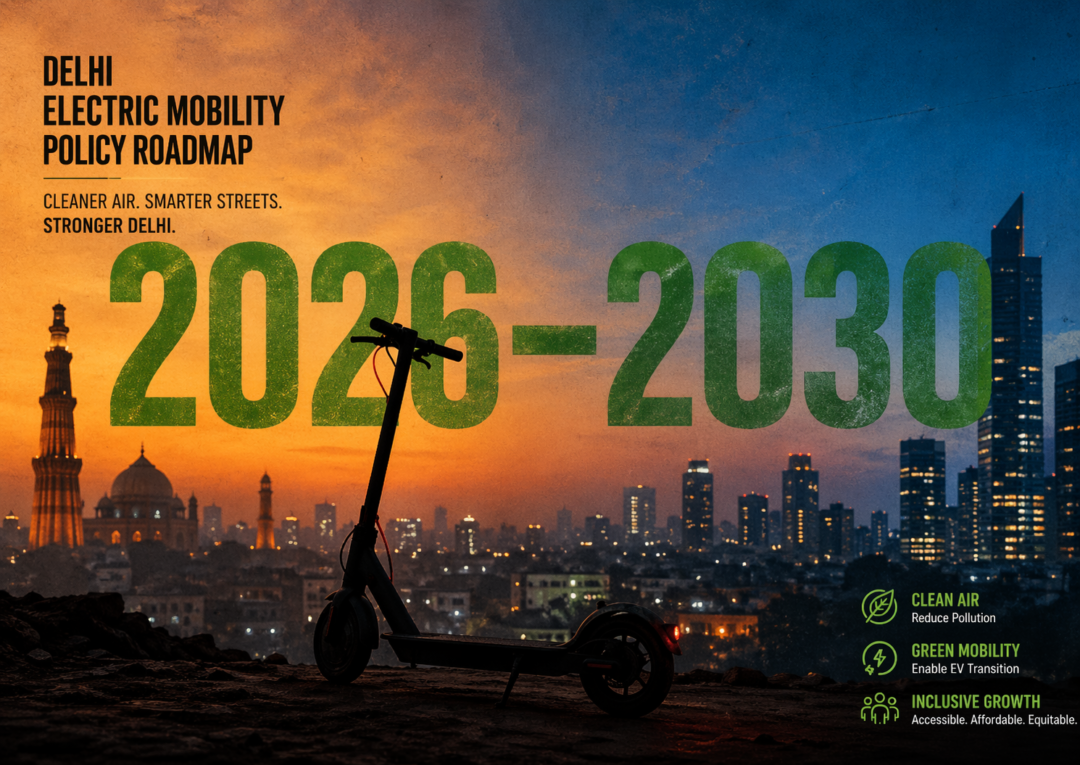
1080 × 765 px — Suggested concept: Deep cinematic composition — foreground shows an electric scooter silhouetted against a glowing Delhi skyline at dusk; background features a smoggy orange sky gradually transitioning to clear electric blue on the right side. Bold green “2026–2030” typography overlaid. Gritty grain texture, policy-meets-city energy. No generic stock feel — urgent, editorial, real.