🗳️ Election Analysis | Phase 2 | 2026
The 3-Crore
Vote Battle
& the Great Bengal
Exclusion.
Let’s be honest — when most people hear “West Bengal elections,” they think of the political slugfest between TMC and BJP. The dramatic rallies. The accusations flying. The rhetoric. But buried under all of that drama is a story that’s actually more important for students of democracy, governance, and Indian polity to understand.
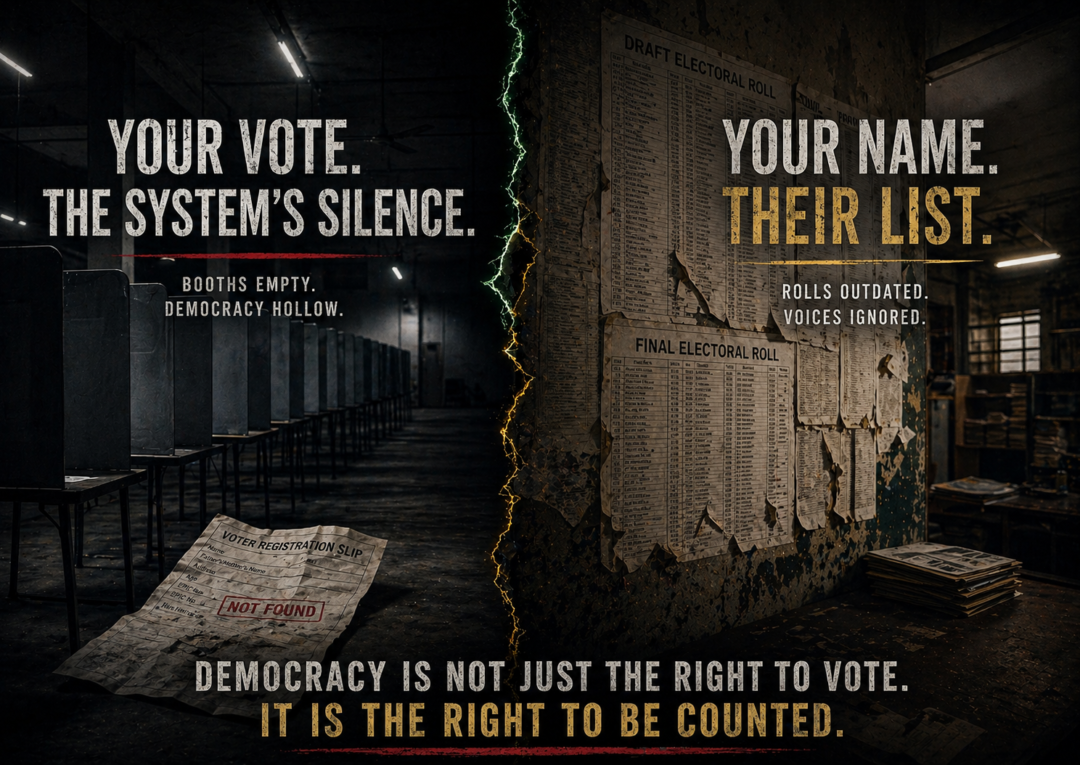
Before a single vote was cast in Phase 2, approximately 5 lakh names had already been wiped from the voter rolls. Over 4,000 cases were piling up at election tribunals. And the opposition was calling it what they believed it to be — a systematic, deliberate purge of voters who might not vote a certain way.
They called it the “Great Bengal Exclusion.” Whether that label is accurate is exactly the kind of question that demands analytical thinking rather than partisan reaction. And that’s what we’re here to do — break it all down, fact by fact, institution by institution, for anyone who wants to actually understand what’s happening in one of India’s most politically charged states.
Phase 2 — Which Seats, Which Districts?
Phase 2 of the West Bengal elections covers 30 assembly constituencies spread across 7 key districts. If you’re mapping this for UPSC or political analysis, these are not random seats — they represent some of the state’s most socially diverse, economically varied, and politically volatile terrain.
Why does the geography matter? Because each district has a distinct social composition. Purulia has a large Scheduled Tribe population whose participation rates and political preferences differ significantly from urban South 24 Parganas. Any meaningful analysis of voter deletions must account for whether the removals were concentrated in particular demographic pockets — and that’s exactly what opposition parties claim.
| District | Phase 2 Seats | Key Factor |
|---|---|---|
| Purulia | 6 seats | High ST population, BJP stronghold |
| Bankura | 5 seats | Swing district, tribal + OBC concentration |
| Jhargram | 4 seats | Junglemahal belt, history of Maoist presence |
| Paschim Medinipur | 7 seats | Industrial towns + agrarian base, contested |
| Purba Medinipur | 3 seats | Coastal, TMC historically dominant |
| South 24 Parganas | 3 seats | Minority-heavy, Sundarbans fringe |
| Hooghly | 2 seats | Industrial, mix of communities |
The 3-Crore Vote Battle — What It Actually Means
Three crore voters. That’s the scale of the electorate across the Phase 2 constituencies. To put that in perspective — that’s more voters than the entire population of many European countries going to the polls in a single phase of a state election.
At this scale, even a 1% discrepancy in the voter rolls translates to roughly 3 lakh votes — and in assembly elections where margins between winners and runners-up can be in the hundreds or low thousands, a 3 lakh swing across targeted constituencies is not trivially small. It’s potentially election-defining.
“In assembly elections, margins are measured in hundreds. Voter deletions measured in lakhs. That math is the whole controversy.”
West Bengal Phase 2 — Electoral Analysis, 2026
This is the core arithmetic that opposition parties — primarily BJP and the Left-Congress alliance — have been highlighting since the voter roll revision process concluded. Their contention isn’t just philosophical. It’s numerical. And for UPSC aspirants studying Election Commission processes, this is a live case study in how voter roll management intersects with democratic outcomes.
The “Great Bengal Exclusion” — What Are the Claims?
The phrase “Great Bengal Exclusion” was coined by opposition leaders to describe what they allege is a systematic deletion of valid voter names from the electoral rolls — particularly targeting voters from communities, localities, and demographic groups seen as less likely to support the ruling TMC.
Here’s the breakdown of the specific claims being made, and the institutional responses to them:
📋 The Opposition’s Core Allegations
- Scale of deletions: Approximately 5 lakh names were removed during the voter roll revision process. Opposition parties claim a significant number of these were valid, living voters — not duplicates or deceased individuals as officially stated.
- Geographic concentration: Deletions are alleged to be disproportionately concentrated in areas with strong BJP or Left Front voter bases, particularly in parts of Purulia, Bankura, and North Bengal districts.
- Process irregularities: Claims that Booth Level Officers (BLOs) — the ground-level officials who conduct door-to-door verification — were pressured or directed to mark certain voters as “not traceable,” triggering deletion without due notice.
- Inadequate notification: Voters whose names were deleted claim they received no prior notice — a violation of the prescribed process under the Registration of Electors Rules, 1960, which requires a 30-day public notification before deletions are finalized.
- Tribunal backlog: Over 4,000 cases have been filed before election tribunals by voters claiming wrongful exclusion. The sheer volume suggests this isn’t a marginal issue.
This is where it gets analytically interesting. Both positions contain partial truths. The Election Commission does conduct voter roll revisions independently. But the BLOs who execute ground-level verification are state government employees — and in a state with West Bengal’s history of political pressure on government machinery, the independence of that process is legitimately questionable.
The Institutional Framework — UPSC Must-Know
For students of Indian polity and governance, this controversy is a perfect lens to understand the institutional architecture that governs elections. Here’s what you need to know cold.
The ECI is a constitutional body under Article 324, empowered to superintend, direct and control all elections to Parliament and state legislatures. The Chief Election Commissioner has security of tenure comparable to a Supreme Court judge — precisely to insulate the body from political pressure. The voter roll revision process falls within its mandate.
Governed by the Representation of the People Act, 1950 and the Registration of Electors Rules, 1960. The Electoral Registration Officer (ERO) for each constituency has the authority to add, delete, or modify entries. Deletions require a prescribed process including public notification, a 30-day objection window, and a quasi-judicial hearing before finalization.
BLOs are the frontline of electoral roll management — typically government teachers or other state employees deputed to conduct door-to-door verification of voters. They are accountable to the ERO, not the state government. But in practice, they are state employees and the line of accountability is thin. This is the structural tension that makes allegations like those in Bengal credible enough to warrant investigation.
Not widely understood — election tribunals are not the same as election courts. Election courts adjudicate disputed election results post-election. Tribunals or quasi-judicial bodies under the ERO system hear grievances about voter roll inclusions and deletions before and during elections. The 4,000+ cases in Bengal represent a real institutional burden and a real democratic signal.
Once elections are announced, the MCC kicks in — and the ECI gains extraordinary executive power over election-related state machinery. In theory, this means the state government cannot direct BLOs or other election officials from this point. In practice, influence is harder to switch off than a legal code. This gap between de jure and de facto independence is a classic governance concept.
The right to vote in India flows from Article 326 of the Constitution — universal adult franchise. It is not a fundamental right in the strict Part III sense, but the Supreme Court has interpreted it as a constitutional right that cannot be arbitrarily curtailed. Wrongful deletion from a voter roll, if proven, is therefore not merely an administrative error — it’s a constitutional violation.
The Timeline — How the Controversy Unfolded
Understanding the sequence of events is critical to evaluating the merits of each side’s argument. Here’s the chronological picture.
Why This Matters — Beyond Bengal
Here’s what separates analysis from commentary: the West Bengal voter deletion controversy isn’t just a Bengal story. It’s a national question about the structural integrity of India’s electoral machinery. Let’s be specific about why.
1. The BLO Independence Problem
India has over 1 million Booth Level Officers. They are the capillaries of the electoral system — doing the actual, granular work of verifying who exists where. They are state employees deputed to the ECI for this function. But their service conditions, promotions, and daily working lives remain within state government control. This is a structural conflict of interest that has never been fully resolved — and Bengal, with its historically high political pressure on government machinery, is where that conflict is most visible.
2. The Scale Makes It Unprecedented
5 lakh deletions in a single revision cycle is not routine. India’s voter rolls do require regular cleaning — deceased voters, duplicate entries, and relocated voters accumulate over time. But the pace and geographic concentration of this revision cycle has been flagged by electoral analysts as statistically unusual. Whether that unusualness reflects genuine data cleaning or political manipulation is exactly what investigation must determine.
3. Tribunal Backlog as a Democratic Stress Signal
4,000+ tribunal cases isn’t just a legal number. It’s a stress test result for the system. Each case represents a real person who believes their democratic right was violated and has gone through the effort of formally contesting it. When a system generates that volume of contestation, something has gone wrong — whether it’s the process, the communication, or the execution.
4. What Happens if Courts Intervene Post-Election?
Here’s the scenario that academic and legal observers are watching: if tribunal cases succeed in demonstrating that voters were wrongly deleted, and if those voters come from constituencies where the margin of victory was narrower than the number of deleted voters — you have a constitutional crisis in the making. Indian electoral law provides for election petitions on grounds of improper voter roll management. This is not a theoretical problem.
The Political Landscape — TMC vs BJP vs Left-Congress
You cannot separate the voter deletion controversy from the political context it sits in. West Bengal’s political ecosystem is one of the most combative in India — and the three-way contest between TMC, BJP, and the Left-Congress alliance creates dynamics that are worth understanding for anyone studying Indian democracy.
Three-Party Dynamic — What Each Side Is Playing
| Party/Alliance | Phase 2 Positioning | Voter Deletion Narrative |
|---|---|---|
| TMC (Trinamool Congress) | Incumbent, defending | Calls exclusion narrative manufactured; points to ECI independence |
| BJP | Primary challenger | Claims most deletions in BJP-leaning areas; has escalated to Central intervention demand |
| Left-Congress Alliance | Third force, rebuilding | Agrees with exclusion narrative; claims own voter bases also hit; sees this as systematic |
What makes Bengal politically interesting is the anti-incumbency factor interacting with the voter roll controversy. If TMC loses seats in Phase 2, the deleted voters narrative becomes a powerful explanatory tool for the opposition — even if causation cannot be proven. Elections don’t wait for tribunal verdicts.
And if TMC holds its seats comfortably? The ruling party will point to that as evidence that the deletions were routine administrative cleaning and the opposition’s narrative was politically motivated. Neither outcome will actually settle the empirical question — which is why institutional investigation matters regardless of the result.
UPSC Prep — Concepts This Case Tests
For aspirants preparing for UPSC Mains or state PCS exams, the Bengal Phase 2 controversy is a gift — it directly maps to multiple GS Paper 2 syllabus areas. Here’s what you can extract from it.
📖 GS Paper 2 Concepts — Live Application
- Article 324 & ECI autonomy: Powers of the Election Commission, limits of its authority, appointment and removal of CEC — how the Anoop Baranwal judgment (2023) changed the appointment process.
- Representation of the People Act, 1950 — Sections 19-22: Conditions for registration as voter, grounds for deletion, role of ERO, and appeal mechanisms. Bengal is a live test of whether Section 22 (deletion process) was followed properly.
- Model Code of Conduct — Scope and Limitations: What the MCC can and cannot control about state government behavior during elections. The BLO independence problem sits right at this boundary.
- Federalism and Central vs State friction in elections: The demand for Central Observer deployment, deployment of Central Armed Police Forces (CAPF), and the constitutional basis for ECI overriding state decisions during elections.
- Political Violence and Free & Fair Elections: West Bengal’s Junglemahal belt has a documented history of election-related violence. The interplay between law and order (state subject) and election conduct (ECI subject) is a key federalism tension.
- Universal Adult Franchise — Article 326: The constitutional foundation of the right to vote, judicial interpretation of that right, and the conditions under which it can be legitimately restricted (age, citizenship, mental capacity, imprisonment) versus conditions that are constitutionally impermissible.
What to Watch After Phase 2
The story doesn’t end on polling day. For political analysts and governance students, these are the developments worth tracking in the weeks and months that follow.
- Tribunal case outcomes: Will the 4,000+ voter cases succeed in getting names reinstated — or at minimum, create a documented record of wrongful exclusions? This paper trail matters for any future election petition.
- ECI response to representations: The Election Commission’s formal response to opposition representations about the deletion process will signal how seriously the institution is treating the concern. Silence or dismissal would itself be a data point.
- Phase-wise vote share data: If BJP and Left-Congress see significantly lower vote shares in constituencies with the highest concentration of deletions, that would be circumstantial (not conclusive) evidence supporting the exclusion narrative.
- Election petitions in High Court: Close-result seats will almost certainly see election petitions filed on voter roll grounds. The Calcutta High Court’s handling of these petitions will be a key institutional test.
- National policy response: Whether this controversy triggers a broader national conversation about BLO accountability, voter deletion notification standards, or enhanced ECI oversight of the revision process. Previous state-level controversies have produced national-level reforms.
- Phase 3 and beyond: Does the controversy dampen voter turnout in subsequent phases among communities that feel excluded? Or does it galvanize turnout as a form of protest? Both are historically documented responses to voter suppression narratives.
Final Thought:
Democracy Is a Process, Not Just a Day
The West Bengal Phase 2 elections put 3 crore voters in front of ballot boxes. But the real story isn’t just what happens on polling day — it’s what happened in the months before it, in the offices of Booth Level Officers doing door-to-door checks, in the tribunal rooms where 4,000 people are fighting to be counted, and in the institutional spaces where the independence of election machinery either holds or bends.
The “Great Bengal Exclusion” may or may not turn out to be a coordinated, politically motivated purge. That’s an empirical question that requires evidence, investigation, and due process to answer — not Twitter outrage or pre-packaged political narratives from either side.
What is already clear is that thousands of people believe their names were wrongly removed. That 4,000+ formal cases are a legitimate democratic stress signal. That structural vulnerabilities in the BLO system are real, documented, and unresolved. And that in elections decided by margins of hundreds of votes, the arithmetic of deletion matters.
For students of Indian democracy, this isn’t just a Bengal story. It’s a question about whether the machinery of the world’s largest democracy is robust enough to protect the right of every eligible citizen to participate — not just in theory, but in practice, in every constituency, in every phase.
Phase 2 Analysis — 2026