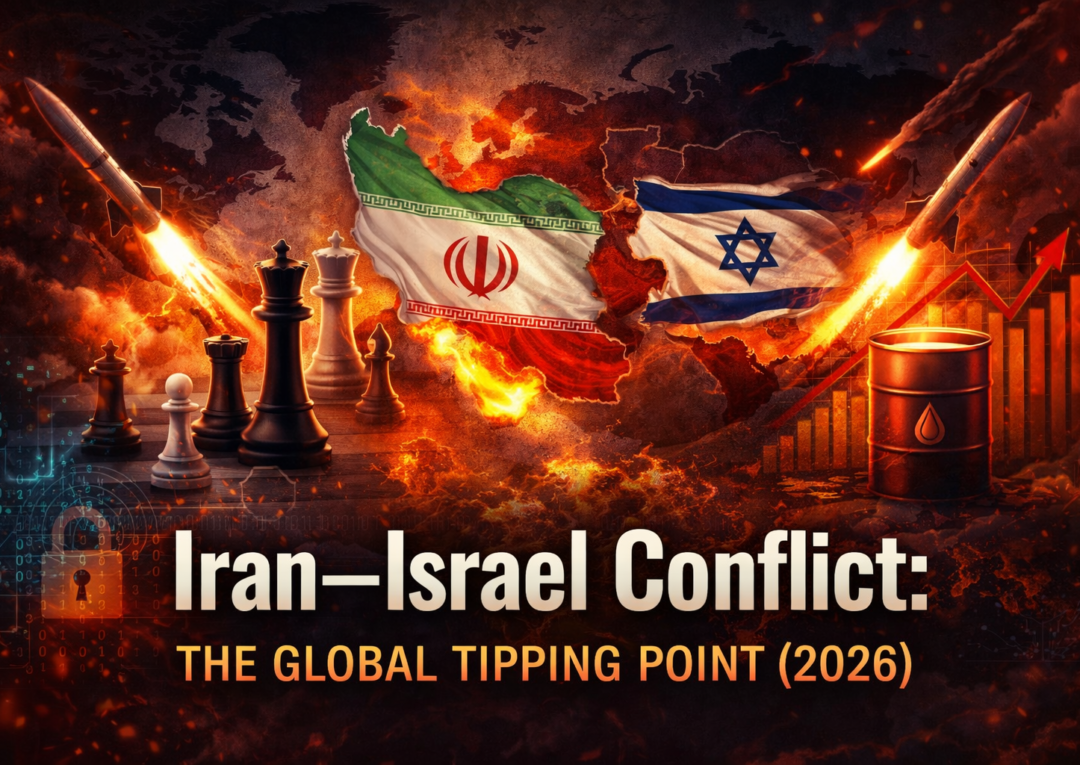
🚨 Global Security Report | 2026 Edition
The Tipping Point:
Iran, Israel, and
The Fragile Future
There’s a specific kind of pit in your stomach when you wake up to a news notification about missiles lighting up the sky halfway across the world. You check your phone, see the words “Iran” and “Israel” trending, and for a second, the world feels very small and very dangerous.
This isn’t just another headline. For decades, we spoke about the “Shadow War”—a game of cats and mice played in the dark corners of the Middle East. But the shadow is gone. Today, we are witnessing a direct, face-to-face confrontation between major powers that has the potential to rewrite the rules of the 21st century. Whether you live in New York, London, Delhi, or Dubai, this conflict is already sitting at your kitchen table.
The Chessboard — Why Now?
Why is this happening now? To understand the current fire, we have to look at the three players holding the matches. It’s a complex triangle of survival, dominance, and a desperate search for stability.
1. Iran’s Regional Ambition
Iran isn’t just a country; it’s a regional powerhouse with a “Forward Defense” strategy. By supporting allies in Lebanon, Yemen, and Iraq, Iran has built a buffer zone. But as economic sanctions bite harder and internal pressures grow, the leadership in Tehran feels it must show strength to survive. For them, every move is about keeping the fight away from their own borders.
2. Israel’s Survival Instinct
For Israel, the math is simpler but much more grim. They see an Iran with an advanced nuclear program as an “existential threat”—meaning a threat to their very existence. This isn’t just political rhetoric; it’s a core trauma that dictates every missile launch and every intelligence operation. They feel they cannot afford to wait for a first strike.
3. The US Balancing Act
Then there’s America. The U.S. is like a tired peacekeeper trying to prevent two neighbors from burning the whole apartment complex down. Washington wants to pivot to Asia, but the Middle East keeps pulling it back. They have to protect Israel while preventing a war that would send the U.S. economy into a tailspin during an election cycle.
The Ripple Effects On Your Wallet
Let’s talk about the “Boring” part of war that actually hurts the most: Economics. You might not see the missiles, but you will see the price of milk go up. Here is how the conflict translates into your daily expenses:
| # | Category | Risk Factor | Direct Impact |
|---|---|---|---|
| 1 | Energy (Oil & Gas) | Critical | +25% Hike |
| 2 | Global Logistics | High | Delayed Tech |
| 3 | Cyber Security | Severe | Banking Risk |
| 4 | Food Inflation | Medium | Grains/Oil |
The Strait of Hormuz: The World’s Jugular Vein
If you take a look at a map, there’s a tiny sliver of water called the Strait of Hormuz. It’s only 21 miles wide at its narrowest point. Yet, nearly 20% of the world’s petroleum passes through here. If a “Hot War” breaks out and this strait is blocked, the global economy doesn’t just slow down—it hits a brick wall. This is why the U.S. Navy maintains such a massive presence there; they aren’t just guarding water; they’re guarding the world’s bank accounts.
“In modern geopolitics, a missile fired in the desert is a price hike in your local supermarket.”
Global Economic Outlook 2026
Who Are the Key Actors?
This isn’t just about three countries. It’s about a web of alliances that could drag the whole world into the fray. Let’s look at the current status of the “Big Three.”
(The Axis)
Iran leads the ‘Axis of Resistance.’ They rely on asymmetric warfare—drones, proxies, and cyberattacks. Their goal is to push the US out of the Middle East and isolate Israel. They are currently closer to nuclear capability than ever before.
(IDF)
Equipped with the world’s most advanced missile defense (Iron Dome/Arrow), Israel is the tech-military powerhouse. They are currently focused on a multi-front war, dealing with threats from the North, South, and East simultaneously.
(CENTCOM)
The US provides the ‘Ironclad’ support for Israel while trying to prevent a regional inferno. With multiple carrier groups in the region, they are the only force capable of keeping the sea lanes open and deterring a full-scale invasion.
The Invisible Front: Cyber Warfare
Why Your Phone is a Battlefield
Imagine waking up and your banking app doesn’t work. The power grid in your city flickers out. This isn’t science fiction; it’s the reality of modern geopolitical conflict. Both Iran and Israel possess some of the most sophisticated cyber-armies in the world. When they strike each other, the “collateral damage” is often the digital infrastructure that regular people rely on.
We’ve already seen ‘test’ attacks on water treatment plants and hospital systems. As the physical war heats up, the digital war will follow. This is why every life is in danger—it’s not just about bombs; it’s about the systems that keep us alive, fed, and connected.
The Human Cost: Every Life Matters
Beyond the maps and the oil prices, we have to talk about the people. The mother in Haifa who has 15 seconds to get her kids to a shelter. The student in Tehran who just wants a future without sanctions. The American soldier who is thousands of miles from home, sitting on a ship in the dark.
- The Refugee Crisis: A full-scale war could trigger a displacement of millions, dwarfing previous crises and putting immense pressure on Europe and neighboring nations.
- Psychological Toll: Living under the constant threat of ‘The Big One’ creates a generational trauma that doesn’t go away when the ceasefire is signed.
- The Youth Perspective: In both Iran and Israel, the younger generation is more connected to the world than ever. They want peace, but they are being handed a sword.
Final Thoughts:
The Path to De-Escalation
Is there a way out? Geopolitics isn’t a game you “win”; it’s a situation you manage. The hope lies in back-channel diplomacy, global pressure, and the simple fact that neither side truly wants a world-ending conflict. As we navigate 2026, our job as global citizens is to stay informed, demand transparency from our leaders, and remember that behind every headline is a human heart.
We are all connected. We are all vulnerable. 🌍
Stay Alert. Stay Informed.