🔥 Breaking News | April 2, 2026
Raghav Chadha Removed as
AAP’s Rajya Sabha Deputy Leader
— And the Silence Says Everything
“Politics is not always about the speeches you make in Parliament. Sometimes, it’s about the ones you’re no longer allowed to make.”
Here’s something you don’t see every day — a political party formally writing to the Rajya Sabha Secretariat to block one of its own MPs from speaking in Parliament. That’s exactly what the Aam Aadmi Party (AAP) did on April 2, 2026.
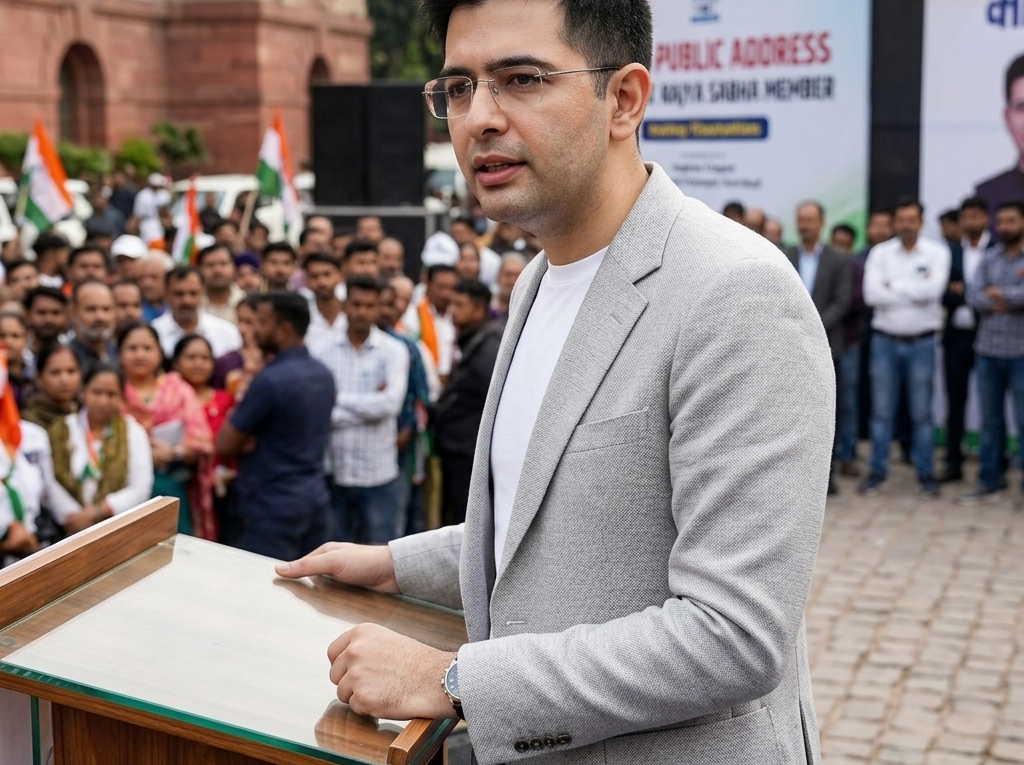
Raghav Chadha, the AAP MP from Punjab and one of the party’s most recognizable faces, has been removed as the Deputy Leader of the party’s Rajya Sabha group. His replacement? Ashok Kumar Mittal, a lower-profile MP from Punjab who founded Lovely Professional University. The move is quiet, formal, and loaded with political implications that go far beyond a simple reshuffle.
Who Is Raghav Chadha?
Quick Profile
Raghav Chadha is one of AAP’s youngest and most media-savvy leaders. He was elected to the Rajya Sabha from Punjab in March 2023 and has been a visible face of the party ever since. Here’s what you need to know:
- Age: 35 years old
- Education: Chartered Accountant (CA) and law graduate from Oxford University
- Political Career: Former MLA from Rajinder Nagar (2020–2022), Co-Incharge of AAP Gujarat (2022), National Spokesperson for AAP
- Personal Life: Married to Bollywood actress Parineeti Chopra in September 2023 — a high-profile wedding that made national headlines
- Parliamentary Focus: Known for raising issues like paid paternity leave, airport food pricing, gig worker rights, and telecom data plan transparency
Until today, Chadha was AAP’s Deputy Leader in the Rajya Sabha — a position that gave him significant influence over the party’s parliamentary strategy and speaking time allocation.
What Exactly Happened?
On April 2, 2026, the Aam Aadmi Party sent an official letter to the Rajya Sabha Secretariat making two key announcements:
- Raghav Chadha has been removed as Deputy Leader of the AAP parliamentary party in the Rajya Sabha.
- Ashok Kumar Mittal, MP from Punjab, has been appointed as the new Deputy Leader.
- AAP explicitly blocked Chadha’s speaking time — the party formally requested that he not be allocated any floor time to speak in Parliament on behalf of AAP.
This isn’t just a routine reshuffle. When a party writes to the Secretariat to block speaking time for one of its own MPs, it’s a very direct and formal way of saying: this person no longer speaks for us.
In India’s Parliament, each recognised party gets allocated speaking time based on their strength in the House. The party itself decides which of its MPs get to speak — and for how long. A deputy leader helps coordinate the party’s floor strategy, liaises with the presiding officer’s office, and represents the group’s position on legislation.
When a party writes to the Secretariat to block speaking time for one of its own MPs, it’s a very direct and formal way of saying: this person no longer speaks for us. Under parliamentary rules, parties must notify the Chair or Secretariat of any changes to their leadership positions.
Timeline of Events
Why Did This Happen?
The official reason? AAP hasn’t given one. But in politics, silence is its own kind of statement. Here are the key signals that led to today’s move:
When Arvind Kejriwal and Manish Sisodia were discharged by a Delhi court in the liquor excise case — a major legal and political win for AAP — the party held a massive roadshow and rally. Chadha was nowhere to be seen. He made no public statement. For a senior leader, that kind of silence was noticed.
Chadha’s name had been quietly removed from the party’s list of star campaigners for upcoming assembly elections — including in Assam. This was a visible sign that he was being kept away from the party’s electoral machinery.
According to party sources, Chadha has been out of the core decision-making loop for more than two years. When Kejriwal was in jail during the liquor case, key portfolios went to Atishi and Saurabh Bhardwaj. Chadha was neither given government responsibilities nor given a visible role in opposing the arrests.
Chadha was once powerful in the Punjab unit — even serving as an advisor to Chief Minister Bhagwant Mann. But Punjab leaders reportedly resented his influence, and Mann gradually became the undisputed voice of AAP in Punjab. This reshuffle also appears to be partly about restoring that balance.
Political circles have been buzzing about whether Chadha might join the BJP ahead of the Punjab assembly elections. AAP’s Sanjay Singh publicly dismissed the speculation but did not rule it out categorically — and issued the unusual warning that he’d be the first to oppose Chadha if he did leave. That’s not a denial. That’s a response to a real concern.
Some reports have framed this as Chadha being penalised for not speaking to the party’s official positions — raising public interest issues in Parliament without aligning them with AAP’s political messaging. The party appears to want its parliamentary voice to be coordinated and on-message.
“He was once among Kejriwal’s most trusted aides. Now, he’s being denied a microphone in the very House he was sent to represent.”
Reading the political tea leaves — AAP 2026
Who Takes Over — Ashok Mittal?
Ashok Kumar Mittal is a Rajya Sabha MP from Punjab and the founder of Lovely Professional University (LPU) — one of India’s largest private universities. He’s a significantly lower-profile figure compared to Chadha, at least in terms of media presence and national political visibility.
His appointment sends its own message. By picking a Punjab-based MP with strong ties to the state’s institutional landscape rather than a media-facing Delhi-centric politician, AAP appears to be signalling that it wants its Rajya Sabha presence to prioritise the Punjab connection — which is, after all, the only state where the party currently governs.
Mittal described his appointment as a learning opportunity. He said the party’s national convener had entrusted him with the role and that different MPs have taken on the responsibility at different times. He framed it as part of the normal rotation of parliamentary learning within the party.
⚖ What Does This Mean for AAP’s Rajya Sabha Strategy?
AAP has 10 members in the Rajya Sabha — seven from Punjab, three from Delhi. Sanjay Singh is still the party’s leader (floor leader) in the upper house. The deputy leader role is about parliamentary coordination and floor management, not necessarily about public visibility.
With Mittal in the role, AAP is effectively prioritising Punjab representation in its parliamentary leadership. Whether that translates into a stronger parliamentary performance — or simply a quieter one — remains to be seen.
The Bigger Picture — What This Says About AAP
This isn’t AAP’s first internal fracture. Swati Maliwal, another Rajya Sabha MP from the party, publicly fell out with the leadership over what she called pressure to vacate her seat. She remains an AAP MP — but she’s openly estranged from the party. That’s now a pattern forming in the upper house, not an isolated incident.
For a party that built its entire identity around being different from traditional political formations — less hierarchical, more transparent, driven by public interest — these internal tensions carry an uncomfortable irony.
Three Things Worth Watching
- Will Chadha respond publicly? So far, he has stayed silent on this development, much as he stayed silent after Kejriwal’s acquittal. His response — or continued silence — will tell us a great deal about his next move.
- Punjab elections on the horizon. The Punjab assembly elections are not far away, and this reshuffle needs to be read in that context. AAP cannot afford a high-profile defection or public split in the state where it holds power. The removal of Chadha may be a pre-emptive move — a way of minimising his influence before any potential party-switch could cause maximum damage.
- Will the BJP rumours materialise? Senior AAP leader Sanjay Singh has publicly said he does not believe Chadha will join BJP. But the political rumour mill in Delhi runs at a different speed. If Chadha does join a rival party, this letter to the Rajya Sabha Secretariat will look like a very calculated move in hindsight. If he doesn’t, it will still have cost him significant political stature within AAP.
There is also a structural observation worth making here. AAP’s parliamentary strategy in recent years has placed a strong emphasis on disciplined, coordinated messaging. That’s not inherently unusual for a political party — but it does mean that MPs who raise issues independently, outside the party’s curated talking points, risk being seen as “going off-script” rather than serving their constituents.
Chadha, ironically, has been raising genuinely popular issues in Parliament in recent months — from paid paternity leave to high food prices at airports, from gig workers’ rights to data plan transparency. These are the kinds of issues that build public goodwill. Yet within his own party, it appears that raising them without party coordination was not appreciated.
Why Should You Care?
If you follow Indian politics or broader democratic governance, this story matters beyond the AAP internal gossip angle. It raises some genuinely important questions.
- How much independence do MPs have within party systems? India’s anti-defection law makes it legally risky for MPs to vote against their party line. But the informal pressure — loss of speaking time, removal from committees, exclusion from lists — is a different kind of constraint. Chadha’s situation illustrates how parties can discipline members without any formal vote or public process.
- What does this do to parliamentary quality? If MPs who raise public interest issues independently get sidelined, it creates incentives for lawmakers to prioritise party loyalty over constituency representation. That’s a tension every democracy grapples with — but it’s worth naming clearly.
- How do parties manage dissent before elections? Every major political party in India has gone through moments where internal dissent becomes a liability ahead of key elections. How they handle those moments tells you a lot about the party’s health and long-term trajectory.
- What does AAP’s Punjab situation look like? AAP is currently the ruling party in Punjab and needs to defend that territory. Any signal of internal instability — especially involving leaders who are publicly recognisable — could feed opposition narratives. Managing Chadha quietly, through a formal letter rather than a public showdown, may be AAP’s attempt to contain the story. Whether it works is a different matter.
Final Word:
A Quiet Letter with Loud Implications
Raghav Chadha didn’t lose his seat. He didn’t cross the floor. He didn’t resign. He simply stopped being given the microphone — at least officially.
In Indian politics, that kind of quiet sidelining can sometimes be the beginning of a longer story, or the end of one. Which direction this goes will depend on what Chadha does next. Does he stay quiet and fade from view? Does he come out swinging? Or does the political chatter about a BJP move eventually have some basis?
For now, all we have is a formal letter, a new deputy leader, and a politician whose silence is louder than most people’s speeches.
Story Developing — April 2, 2026