⛽ Auto & Energy | June 2026
E85 Petrol:
The High-Ethanol
Fuel Changing
How India Drives.
Picture this: you pull into a petrol pump and you see a new option sitting quietly next to your regular 91 or 95 — a pump labelled E85. You’ve probably heard the term thrown around in government speeches, car launch events, maybe even a quick news headline. But what actually is it?
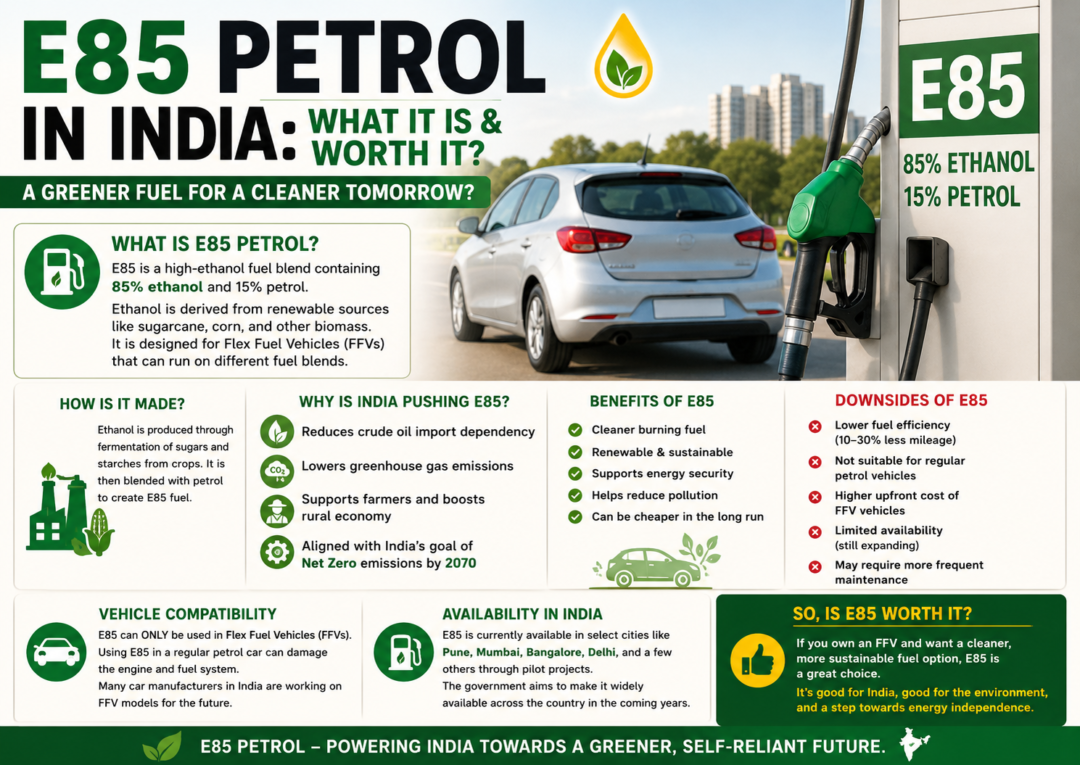
E85 is a high-ethanol fuel — a blend of 85% ethanol and 15% petrol — and it is quietly becoming one of the most talked-about energy transitions in India’s automotive story. It’s not just a government policy experiment. Toyota, Maruti, and TVS are already building vehicles around it. The fuel pumps are getting ready. And for anyone who drives, owns a car, or works in the automotive industry, this is something worth understanding now — before it becomes unavoidable.
This isn’t a technical textbook. Think of this as a conversation between someone who’s dug into the details and someone who wants the honest picture — the benefits, the real drawbacks, the cost maths, and what it actually means for India’s roads going forward.
So What Exactly Is E85?
Let’s start from the beginning — because a lot of the confusion around E85 comes from mixing it up with India’s more common ethanol blends.
You may have already heard of E10 or E20 — those are petrol blends with 10% or 20% ethanol mixed in. Your current car almost certainly runs on E10 without you even knowing it. E85 is on a completely different level. It’s the high-concentration version — 85% ethanol sourced mostly from sugarcane, maize, or damaged food grain, mixed with just 15% conventional petrol.
E10 — 10% ethanol: runs in virtually every petrol car today. Most people use this without realising.
E20 — 20% ethanol: India’s national target for 2025–26. Requires minor engine adjustments in some vehicles.
E85 — 85% ethanol: the flex fuel category. Requires dedicated Flex Fuel Vehicles (FFVs) or a kit-converted engine. Far higher performance ceiling — but not compatible with standard cars.
Ethanol itself isn’t new. Brazil has run its entire passenger vehicle fleet on high-ethanol fuel since the 1970s. The U.S. has E85 pumps across the Midwest, largely because they grow enormous amounts of corn. What’s new is India’s push to make E85 viable at scale — and the automotive industry is finally taking it seriously.
Where Does the Ethanol Actually Come From?
This is where India’s story gets interesting. Unlike the U.S., which leans on corn, India primarily uses sugarcane molasses — a byproduct of the sugar industry — to produce ethanol. Surplus sugar output, which has historically depressed sugar prices, now has a second life as transport fuel.
The government’s Ethanol Blended Petrol (EBP) programme has pushed this hard. India’s ethanol production capacity has grown significantly over the past five years, and the supply chain is maturing. Damaged foodgrain and excess rice from FCI stockpiles are also being used — which means this is partly a food-waste solution as much as it is an energy policy.
The Real Advantages — Why This Matters
Here’s where the honest case for E85 gets genuinely compelling — especially if you care about more than just the per-litre price at the pump.
Ethanol burns cleaner than petrol. The combustion produces less CO₂, less particulate matter, and lower hydrocarbon emissions. Studies suggest E85 can reduce lifecycle carbon emissions by up to 30% compared to regular petrol. For a country with severe urban air quality issues, this is not a small number.
E85 has an octane rating above 105 — significantly higher than premium petrol at 91–95. Higher octane means better resistance to engine knock, which translates to more efficient combustion and better power output in engines tuned for it. This is why performance car enthusiasts in the West use ethanol blends for track days.
India imports roughly 85% of its crude oil. Every rupee spent on imported crude is a rupee that leaves the economy. E85, produced domestically from sugarcane and foodgrain, keeps that money inside India. At scale, this meaningfully reduces India’s current account deficit pressure — especially when global oil prices spike.
Expanded ethanol demand creates a direct and sustained income stream for sugarcane farmers — one of India’s largest agricultural constituencies. It stabilises sugar prices, reduces the government’s subsidy burden on sugar exports, and creates a demand floor that doesn’t depend on global commodity cycles.
Ethanol has a higher latent heat of vaporisation than petrol — meaning it absorbs more heat as it evaporates inside the engine. This naturally cools the intake charge, reduces engine operating temperatures, and can extend engine longevity when the vehicle is designed around it. It’s an underappreciated engineering benefit.
Ethanol is virtually sulphur-free. Sulphur in petrol is a major source of SOx emissions and fine particulate matter — the stuff that causes respiratory illness in dense urban areas. Running high-ethanol blends directly reduces sulphur-related air pollution, which is a significant public health win in cities like Delhi, Mumbai, and Bangalore.
“E85 isn’t just a fuel. It’s India’s most credible exit ramp from crude oil dependency — if the ecosystem builds fast enough.”
India Threads Mobility Analysis — June 2026
The Part Nobody Talks Enough About — The Real Downsides
Any honest conversation about E85 has to include the uncomfortable parts. Because there are real limitations — and ignoring them is how you end up with a disappointed driver on the side of a highway.
Mileage Drop — This One’s Big
Ethanol has about 30–33% less energy per litre than petrol. That’s basic chemistry. So even though your engine may perform better moment-to-moment on E85 (higher octane, better combustion), you’ll use more fuel to cover the same distance.
The real-world number varies, but expect roughly 25–30% lower mileage on E85 compared to regular petrol in a similar engine. If the price differential between E85 and petrol doesn’t compensate for that gap, your per-kilometre cost actually goes up.
Not Every Car Can Run It
This is the single biggest barrier to E85 adoption right now. You cannot simply fill your existing petrol car with E85 and drive away. High-ethanol blends are corrosive to rubber seals, certain metals, and fuel system components in regular petrol vehicles. You need either a Flex Fuel Vehicle (FFV) built from the factory to handle E85, or a certified retrofit kit.
Toyota launched the first E85-compatible vehicle for India in 2023 — a modified Innova HyCross. Maruti has committed to flex fuel options. TVS and Bajaj have flex-capable two-wheeler prototypes. But for most existing vehicle owners in 2026, your current car cannot run E85.
Cold Starts Are a Problem
Ethanol has a much higher minimum vaporisation temperature than petrol. In cold climates — or even on cold mornings in northern India during winter — E85 can be genuinely difficult to start without a petrol assist system or special cold-start technology. Brazil solved this with small petrol tanks used only for cold starts. India will need similar engineering solutions for high-altitude or northern markets.
Pump Infrastructure Is Still Thin
Even in 2026, E85 pumps are concentrated in sugarcane belt states — Maharashtra, Uttar Pradesh, Karnataka. If you drive long-distance across India, range anxiety on E85 is a real consideration. The network is growing, but it’s nowhere near the ubiquity of regular petrol pumps yet.
E85 vs Regular Petrol — Honest Comparison
Let’s put the two fuels side by side. No spin, just the actual picture.
| Factor | E85 | Regular Petrol (E10/E20) |
|---|---|---|
| Ethanol Content | 85% | 10–20% |
| Octane Rating | 105+ | 91–95 |
| CO₂ Emissions | ~30% lower | Baseline |
| Mileage | ~25–30% lower | Baseline |
| Price Per Litre (Est.) | Lower (if subsidised) | Higher |
| Vehicle Compatibility | FFV only | All petrol vehicles |
| Cold Start Performance | Harder | Better |
| Energy Density | ~30% less per litre | Higher |
| Domestic Sourcing | Yes — sugarcane, grain | Imported crude |
| Air Quality Impact | Lower particulates, no sulphur | SOx + particulate emissions |
The table makes one thing clear: E85 isn’t a universally better fuel. It’s a trade-off fuel. You get environmental benefits, energy sovereignty, and performance potential — in exchange for mileage, compatibility, and infrastructure limitations. Whether that trade-off works for you depends entirely on your vehicle, your driving pattern, and your local fuel pricing.
What This Means for You Right Now
Let’s get practical. Because policy and chemistry are interesting, but what most drivers actually want to know is: should I care about this? Does it affect my next car purchase? Is this the future?
🔑 Who Should Pay Attention to E85 — Right Now
- New car buyers in 2026 onward: If you’re buying a new car this year or next, check whether the model offers a flex-fuel variant. Maruti and Toyota are both adding FFV options to mainstream models. Future-proofing your purchase matters — especially if E85 becomes more price-competitive with petrol subsidy rationalisation.
- Two-wheeler owners in Maharashtra and UP: These states have the most E85 pump availability right now. Bajaj and TVS flex-fuel two-wheelers are already available in pilot markets. If you ride daily in an E85-accessible area, the economics can work in your favour.
- Fleet operators and logistics companies: Large fleets consuming hundreds of litres daily have the most to gain from even a modest per-litre price difference. Fleet managers should be tracking E85 rollout infrastructure in their operating regions closely.
- Automotive professionals and mechanics: Understanding flex fuel engine specifications, material compatibility, and calibration differences is becoming a practical skill. E85-related service and tuning will become an increasingly common workshop requirement over the next three to five years.
- Performance driving enthusiasts: E85’s high octane rating is already being used in the motorsport and performance tuning community. Modified engines running on ethanol blends can produce meaningfully higher horsepower output — which is why you’ll see it used at track events even before it becomes mainstream at fuel pumps.
What Brazil Got Right — And What India Can Learn
Brazil is the world’s most advanced case study in ethanol-based transport. Since the 1979 oil crisis, Brazil has systematically built a flex-fuel ecosystem that today covers virtually the entire passenger vehicle fleet. More than 70% of all new cars sold in Brazil are flex-fuel capable. E85 — or even higher ethanol concentrations — is the default at most pumps.
The lessons India can take from Brazil are specific and practical.
- Price parity with petrol is the trigger: Brazilian consumers switched to ethanol when it was priced at 70% or less of petrol per litre — accounting for the mileage difference. India needs to get E85 pricing to that competitive zone to drive mainstream adoption. That means managing production costs and keeping supply consistent.
- Make it mandatory for new vehicles first: Brazil mandated flex-fuel compatibility across its new vehicle market, which forced the auto industry to engineer for it at scale. India’s phased mandate is following the same playbook. The key is consistent enforcement.
- Sugarcane is the supply backbone — protect it: Brazil’s entire ethanol programme depends on reliable sugarcane supply. India has a similar natural advantage but needs to ensure the agricultural supply chain — including water availability and farmer pricing — is stable enough to be a fuel supply source, not just a food crop.
- Infrastructure before demand, not after: The biggest mistake smaller ethanol programmes have made globally is waiting for consumer demand before building pump infrastructure. Brazil built pumps ahead of demand curves. India needs to do the same — particularly on highway corridors where range anxiety is most acute.
Three Scenarios for E85 in India — 2026 to 2030
Where does this actually go? Here’s a realistic view of three paths — not wishful thinking, not doomscrolling.
- Mainstream Adoption (~40% probability): E85 pricing lands consistently at 25–30% below petrol. Flex-fuel vehicles become the default for new petrol purchases by 2028. Highway pump network covers major corridors. India reduces crude import bill by 10–15%. This is the scenario the government is planning for.
- Niche Segment (~45% probability): E85 stays competitive only in sugarcane belt states. Two-wheeler and entry-car segments see meaningful adoption. Long-haul drivers and urban commuters in non-producing states continue using regular petrol. Gradual growth, but no transformational shift within this decade.
- EV displacement risk (~15% probability): India’s EV adoption — particularly in urban two-wheeler and small car segments — accelerates faster than expected, reducing the addressable market for any liquid fuel solution including E85. E85 becomes relevant primarily for commercial and rural transport rather than mainstream personal mobility.
Final Read:
The Pump Is Changing.
Is Your Car Ready?
What it represents is something genuinely significant: a credible, scalable path for India to reduce its dependence on imported crude, put more money into domestic agriculture, and clean up urban air quality — all without waiting for the full EV transition to play out.
If you’re buying a car in the next two years, check for flex-fuel compatibility. If you’re in the automotive or logistics business, start mapping the E85 infrastructure in your region. And if you care about where India’s energy story goes — this is one of the more interesting chapters unfolding right now.
The pump is changing. The question is just how fast the ecosystem around it catches up — and whether Indian drivers are ready when it does.
Mobility Analysis — June 2026