📊 Market Intelligence | June 2026
The Peace Premium:
Why Sensex
Nifty
Are Flying.
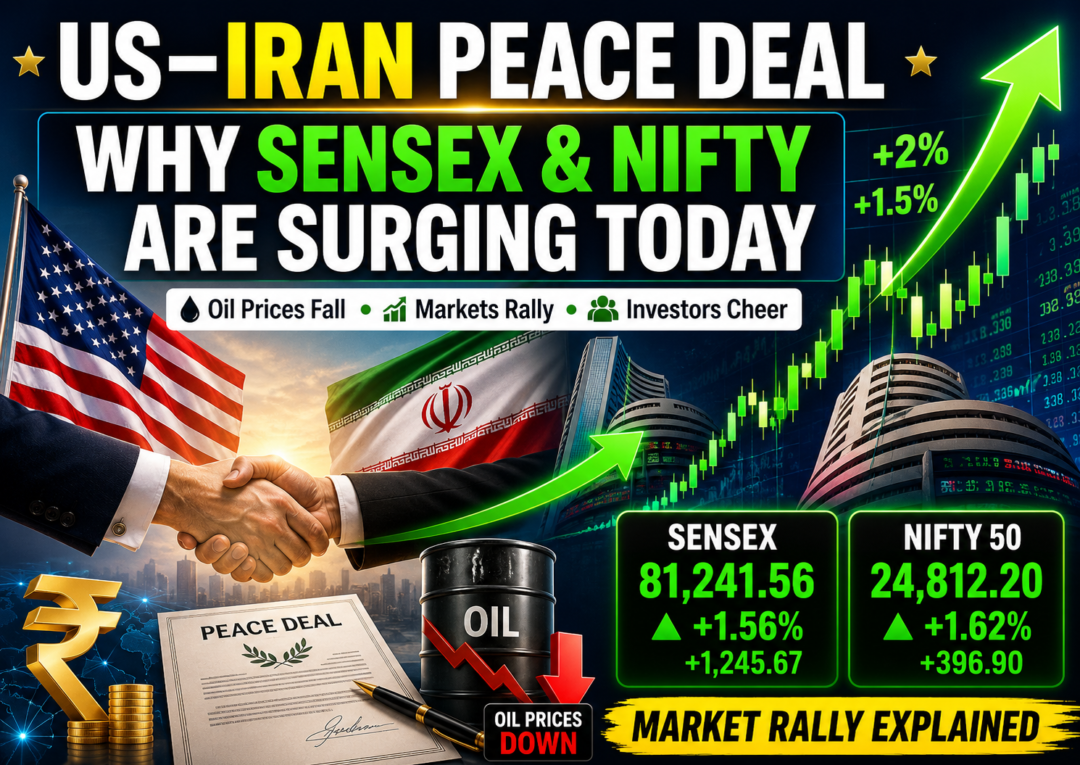
Traders walked into their terminals this morning and saw something they hadn’t seen in a long time — green. Deep, broad, convincing green across the board. Sensex up nearly 1,800 points. Nifty crossing 24,900. The rupee hitting its strongest level in over a year.
The catalyst? A confirmed framework agreement between the United States and Iran — the most significant diplomatic breakthrough in West Asia in nearly two decades. Oil markets responded first, crude dropping sharply as the “disruption premium” that had been baked into every barrel for months began unwinding. Indian markets followed, fast.
This isn’t just a headline trade. It’s a structural shift in the risk environment that Indian investors have been navigating since late 2024. And to understand why Sensex and Nifty are surging today — you need to understand exactly what was weighing them down before.
What the Deal Actually Says — And What It Doesn’t
Before getting into market mechanics, let’s be clear about what’s actually happened. A US–Iran framework agreement isn’t a full peace treaty — it’s a structured diplomatic understanding, likely covering Iran’s nuclear programme limitations in exchange for a staged removal of sanctions and a pathway to normalized oil exports.
Think of it as a political ceasefire with economic teeth. It doesn’t resolve every conflict in West Asia overnight. But it does change the single most important variable that markets were pricing: the probability of a Strait of Hormuz disruption.
There’s also something specific to India’s situation here. India imports roughly 85% of its crude oil. That’s not just an energy statistic — it’s a current account equation, an inflation equation, and a rupee equation, all rolled into one. When crude falls sharply, every one of those variables moves in India’s favour simultaneously. That multiplier effect is why Indian markets are reacting more dramatically than, say, European equity indices.
Why the Timing Amplifies the Move
Markets had spent the better part of Q1 and Q2 2026 pricing in a scenario where oil stayed above $90 and the West Asia risk environment remained elevated indefinitely. Portfolio managers had positioned accordingly — underweight on sectors exposed to input cost pressure, cautious on Indian OMCs, hedged on currency.
A sudden diplomatic breakthrough forces a position unwind. Everyone who was short Indian equities or hedged against a weak rupee is now covering — and that buying pressure amplifies the move beyond what pure fundamental re-rating would justify.
Sector by Sector: Who Wins Today
Not every sector celebrates equally. Here’s the split — because smart positioning now matters as much as understanding why it’s happening.
IOCL, BPCL, and HPCL are surging. These companies had been caught in the classic squeeze — buying crude at elevated prices but unable to pass the full cost to retail consumers due to political pricing constraints. A $12 drop in crude flips that equation fast. Margins recover. The structural headwind that’s been hurting them since Q3 2025 starts reversing today.
IndiGo and SpiceJet are bouncing hard. Aviation turbine fuel costs track crude closely, and any meaningful drop in crude improves airline unit economics significantly. That said — the sector still carries structural debt from post-COVID rebuilding. The fuel cost tailwind is real, but don’t mistake a relief rally for a fundamental transformation.
Lower crude means lower input costs across cement, steel, chemicals, and construction. These sectors have been absorbing elevated energy and logistics costs for months. The compression of that headwind — even partially — is meaningful for margins. Watch L&T, UltraTech, and the broader infra basket for sustained follow-through over the coming weeks.
Lower oil = lower inflation = more room for the RBI to cut rates. That’s the chain reaction that Nifty Bank is pricing today. A rate cut cycle that was stalled by stubborn energy-driven inflation now has more runway. PSU banks and private sector lenders with large loan books sensitive to rate movement are leading the charge.
HAL, BEL, and Bharat Forge are giving back some of their recent gains today. That’s expected — the defence sector had priced in a prolonged conflict environment, and a peace deal reduces the near-term urgency of procurement escalation. But the indigenisation story and multi-year order books don’t change. This is a sector to buy on dips, not sell into this weakness.
Indian IT is rallying partly on rupee strength (ironic — stronger rupee usually hurts export revenue) but mainly on the improved global growth outlook. A West Asia peace deal reduces the stagflation risk that had been pressuring global tech valuations. If central banks globally get more room to cut, growth multiples expand — and that benefits Indian IT names with US exposure.
“A peace deal doesn’t just lower oil prices — it changes what every equity multiple is worth.”
India Market Desk — June 2026
The India-Specific Transmission Mechanism
India’s relationship with this deal is more direct than almost any other major economy. Here’s why the market reaction in Mumbai is bigger than in Frankfurt or Tokyo.
🔗 Why India Is the Most Leveraged Play on This Deal
- Crude Import Bill Shrinks Instantly: India spends roughly $150–180 billion annually on crude imports. Every $10 drop in oil saves India approximately $12–15 billion in annual import expenditure. That’s a direct improvement in the current account deficit — and the market knows it.
- Rupee Gets a Structural Bid: A smaller current account deficit means less selling pressure on the rupee. The INR strengthening today isn’t just sentiment — it’s fundamental. Foreign institutional investors (FIIs) who had been hedging their India exposure against currency risk now have less reason to hedge. That reduces selling pressure on Indian equities from abroad.
- RBI Gets Room to Move: The Reserve Bank of India had been constrained — crude-driven inflation was keeping CPI sticky and making rate cuts risky. A sustained oil drop changes that calculation. If Brent holds below $80, the RBI’s rate cut window reopens in a meaningful way. That changes the interest rate environment for every company that carries debt.
- Consumer Spending Gets a Boost: Petrol and diesel prices feed directly into transportation costs, which feed into food prices, which feed into household budgets. Lower retail fuel prices — if the government passes through the crude savings — create real disposable income improvement for 1.4 billion consumers. That’s a consumption story that takes a few months to play through, but it’s real.
- FII Flows Can Re-accelerate: Foreign investors had been cautious on India because of the geopolitical risk premium and rupee vulnerability. Both have improved simultaneously today. Watch for FII inflow data over the next 2–3 weeks as a confirming signal that this rally has institutional backing, not just domestic retail momentum.
How We Got Here — The Road to Today
Today’s rally doesn’t happen in isolation. It’s the release valve for months of compressing pressure.
What Professionals Should Do Right Now
A sharp gap-up on geopolitical news is one of the trickiest moments in investing. The temptation is to chase. The mistake is to act without a framework. Here’s how serious investors are thinking about today.
For Equity Portfolio Managers
- Don’t chase the gap — grade your entry: Sensex up 1,800 points on day one of a peace deal is fast money. The real trade is the re-rating that plays out over the next 3–6 months as fundamentals catch up. Waiting for a pullback on profit booking in the first 48 hours is often the smarter entry point.
- Rotate from defensives back to cyclicals: Portfolios that had tilted defensive in the geopolitical risk environment — gold, IT, pharma — now need to rebalance toward cyclical recovery plays: OMCs, infrastructure, consumer discretionary, and rate-sensitive banking names.
- Scale back — don’t exit — defence positions: HAL and BEL are pulling back today, but the 10-year India defence indigenisation story hasn’t changed. This is a tactical entry opportunity, not a reason to exit a structural theme.
- Watch the deal for cracks: US–Iran frameworks have a history of stalling or unraveling. Any sign of implementation breakdown — on nuclear commitments, sanctions timelines, or regional behaviour — will reverse this trade quickly. Set your exit criteria before adding exposure, not after.
For Fixed Income Professionals
- Duration is back on the table: If crude holds lower and inflation softens, the RBI’s rate cut window reopens. Long-duration government bonds — which have been underperforming — become interesting again. This is the moment to revisit that position sizing.
- Corporate credit spreads should compress: Better macro environment, lower input costs, and improving corporate margins mean IG corporate bonds deserve a tighter spread. Watch for issuance activity to pick up — companies will want to lock in financing at improving rates.
For Indian Retail Investors
- Don’t panic-buy the gap-up: SIP investors should stay the course — don’t front-load lump sums into a single news-driven day. The structural story of Indian equities improves with this deal, but one-day returns don’t represent that story.
- Reassess gold allocation: Gold had been a legitimate hedge against geopolitical risk. With that risk reducing, a modest trim from gold back into equity — especially if you’re overweight — makes allocation sense.
- Fuel cost savings are real: If the government passes through lower crude to retail fuel prices, EMI repayments get easier, disposable income improves. That’s not a stock tip — it’s a financial planning note. Consumer-facing businesses benefit from this over the next 2–3 quarters.
Three Scenarios From Here
Where does this go? Investors need to be clear-eyed about the range of outcomes, not just celebrate today’s move.
- Deal Holds and Deepens (~45% probability): Full implementation proceeds. Iranian oil returns to market gradually over 12–18 months. Brent settles in the $70–80 range. India gets a sustained macro tailwind. RBI cuts rates twice before year-end. Sensex reaches new all-time highs on a combination of re-rating and earnings improvement. This is the bull case — and it’s also the one already significantly priced into today’s move.
- Deal Stalls But Holds (~35% probability): Implementation gets complicated — Congressional opposition, Iranian domestic politics, sanctions waivers delayed. Oil drifts back toward $85 but the outright confrontation risk stays low. Markets give back 30–40% of today’s gains but don’t crash. The geopolitical discount compresses but doesn’t fully disappear.
- Deal Collapses (~20% probability): Implementation fails — a specific triggering event (nuclear verification dispute, military incident, political change in either country) breaks the framework. Oil re-spikes, market re-prices geopolitical risk premium, Sensex gives back most of today’s gains. This is the tail risk that needs to be hedged, not ignored.
Final Read:
The Peace Premium Is Real. So Is the Risk.
India was always one of the most leveraged beneficiaries of any West Asia de-escalation — because it sits at the intersection of every variable that oil price affects: inflation, currency, rates, consumption, and capital flows. All of those arrows are pointing the same direction today.
But investing isn’t about identifying what’s happening today. It’s about positioning for what happens next. The professionals who will look back at June 2026 as the start of something big are the ones who bought the second pullback — not the first gap-up — and held with conviction through the noise of implementation uncertainty.
The peace premium is real. Capture it with discipline, hedge the tail risks with clarity, and don’t let one morning’s green numbers convince you the hard work of portfolio management is over. It never is.
Market Analysis — June 2026