🏍️ Moto Intelligence | June 2026
The Ninja 500
Is Back.
₹5.76 Lakh.
Worth It?
Here’s a thing that almost didn’t happen. A few weeks back, Kawasaki Ninja 500 forums across India were buzzing with a very uncomfortable rumour — that Team Green was quietly preparing to pull the plug on the Ninja 500 in India. Slow sales. E20 non-compliance. No CKD localization. The math wasn’t looking great.
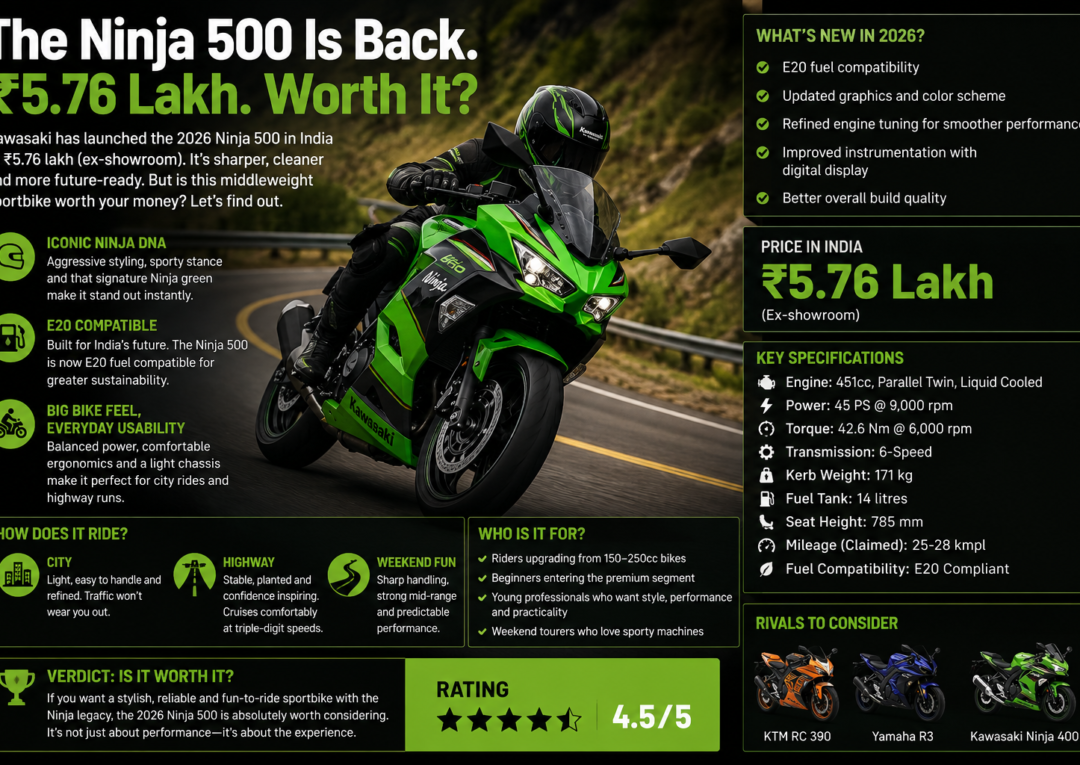
Then Kawasaki did something nobody saw coming. They launched the 2026 Ninja 500 at ₹5.76 lakh, draped it in the iconic Lime Green that screams racing heritage, and made it fully E20 compliant — essentially telling the critics to sit down.
Whether you’re a hardcore Kawasaki fan, someone evaluating a first premium sportbike, or a rider who just wants to know if this bike makes sense in 2026 — this piece breaks it all down. Specs, rivals, real talk on the price, and the honest verdict.
The Green Returns — What’s Actually New
Let’s start with the obvious. The 2026 Ninja 500’s biggest headline is the colour. Kawasaki’s signature Lime Green — the same shade you see on the ZX-10R, the Ninja 650, the ZX-6R — has finally arrived on the 500. It’s not just paint. For Kawasaki riders, Lime Green is identity. It’s heritage. It’s the colour of Superbike World Championship podiums.
Beyond the colour, the key mechanical update is E20 compliance. With BS6 Phase 2 strictly enforced in India, any bike not E20-ready was essentially living on borrowed time. The 2026 update kills that conversation dead. You can fill it at any modern petrol pump without a second thought.
What Stays the Same (And That’s Not a Bad Thing)
The 451cc parallel-twin engine is unchanged, and honestly, it doesn’t need to change. This is a motor that revs sweetly, pulls cleanly from low rpm, and makes city riding feel effortless while still having enough legs on the highway. The steel trellis frame — the same design philosophy as the flagship Ninja H2 — keeps the chassis light and agile.
At 157 kg kerb weight (with a full 14-litre tank), this is one of the lightest bikes in its segment. For reference, the Aprilia RS 457 tips the scales at 4 kg more. That difference is small on paper but very noticeable when you’re filtering through Bengaluru traffic or parking at a tight spot.
Full Specs Breakdown
⚙️ 2026 Kawasaki Ninja 500 — Complete Specifications
How It Feels to Actually Ride This Thing
Numbers are great. But what’s the Ninja 500 actually like on Indian roads? Here’s the honest picture.
The riding position is one of the first things you’ll notice — it’s surprisingly upright and approachable for a fully-faired sportbike. This isn’t the flat, aggressive crouch of a track-focused machine. Your wrists aren’t screaming after 30 minutes. Your knees aren’t folded into your chest. It’s sporty without being punishing, which makes it genuinely usable every day.
The parallel-twin engine has a character that grows on you. Low-end torque is generous enough for city riding without constant gear changes. Once you’re on the highway, it cruises at 100–120 kmph with complete composure — the engine barely feels stressed. And when you want to push it, the mid-range pulls cleanly before the top-end comes alive.
“The Ninja 500 isn’t a bike you buy with your brain. You buy it with your heart.”
CarbikGPT Review — June 2026
The Dunlop Sportmax tyres are a proper performance spec — not budget rubber slapped on to hit a price point. Combined with the trellis frame and the well-sorted monoshock, the bike handles confidently on broken surfaces without feeling nervous. The brakes are dual-channel ABS with a 310mm front disc — they’re progressive and confident without being grabby.
What it doesn’t have: traction control, riding modes, a USD fork, or quickshifter. At this price point, that absence is noted. The Aprilia RS 457 offers more electronic kit for significantly less money. That’s a real conversation.
Ninja 500 vs Aprilia RS 457 — The Real Comparison
This is the comparison that actually matters. The RS 457 is the Ninja 500’s direct rival in India — same displacement class, same target audience, same kind of buyer. But they’re very different bikes philosophically.
The RS 457 starts at ₹4.22 lakh. The Ninja 500 is ₹5.76 lakh. That’s a ₹1.54 lakh difference — a real, significant gap in a segment where value perception matters enormously. The RS 457 is locally manufactured (CBU vs CKD), which is a big reason for the price gap.
The RS 457 (457cc, ~47 HP) is slightly more powerful and more aggressive in delivery. The Ninja 500 (451cc, ~45 HP) is smoother and more linear — better for everyday riding. Both are 6-speed parallels with assist clutches, but they feel distinctly different in the real world.
RS 457 offers traction control, multiple ride modes, and a USD fork at a lower price. Ninja 500 gives you a TFT display with smartphone connectivity but no TC or ride modes. On paper, Aprilia wins the tech war handily. This matters to the modern rider.
Ninja 500 at 157 kg (full tank) edges out the RS 457 at ~175 kg. Lighter bike means more flick-ability in tight traffic and greater ease when parking or low-speed manoeuvring. Not a huge difference, but real riders notice it quickly.
The Ninja badge carries a specific weight. When you roll up on a Lime Green Ninja, people know what it is. The RS 457 is technically excellent but Aprilia’s India recall is smaller. For brand-conscious buyers, that intangible matters — and Kawasaki knows it.
The India Reality Check
Here’s where we need to be real. The Ninja 500 arrives in India via the CBU (Completely Built Unit) route — meaning it’s imported as a finished motorcycle and attracts significantly higher import duties than locally manufactured bikes. That’s the primary reason it costs ₹1.54 lakh more than the RS 457 despite being roughly equal in performance.
For most Indian buyers evaluating a first premium bike at this displacement, that price gap is a genuine objection. ₹5.76 lakh is a lot of money — it overlaps with the on-road prices of some smaller litre-class bikes and well-equipped 650cc options. The question you have to answer honestly: are you paying for the experience, the badge, or the motorcycle?
Who This Bike Is Actually For
- The upgrading commuter-enthusiast: If you’re on a 250cc or 300cc bike and want a genuine step up in performance and feel without going full 650cc, the Ninja 500 is a very compelling answer. The weight and seat height make it accessible; the engine makes it exciting.
- The brand loyalist: If you’ve ridden Kawasakis before — or if Lime Green runs in your blood — this decision is probably already made. The Ninja 500 fits perfectly into the Kawasaki ecosystem.
- The weekend rider with a work-week commute: The upright-ish riding position, smooth power delivery, and 25–26 kmpl fuel efficiency (respectable for a liquid-cooled twin) make this a bike you can actually ride to work on Monday and enjoy a mountain road on Saturday.
- The Aprilia buyer: If your priority list starts with tech, ride modes, and maximum performance per rupee — the RS 457 makes more logical sense. That’s not a criticism. It’s just honest positioning.
Timeline — Ninja 500’s India Journey
Final Verdict:
A Heart Purchase,
Not a Head One.
But the ₹1.54 lakh premium over the Aprilia RS 457 is real, and the RS 457 gives you more technology for that saving. Anyone who tells you the Ninja 500 is the objectively better value is not being fully honest with you.
Here’s the thing though — value isn’t always about spec sheets. Sometimes it’s about how a bike makes you feel when you see it parked outside. Sometimes it’s the sound of a parallel twin waking up on a cold morning. Sometimes it’s the Lime Green in your rear view mirror.
If you can genuinely stretch to ₹5.76 lakh for an entry-level sportbike, the Ninja 500 will reward you richly. If the budget is the real constraint, the RS 457 is the honest answer. But nobody who buys a Lime Green Ninja 500 regrets it. Not one person.
Verdict — June 2026