🏎 Automobile | May 2026
Mercedes AMG GT
4-Door Coupe:
1,169hp &
Pure Madness.
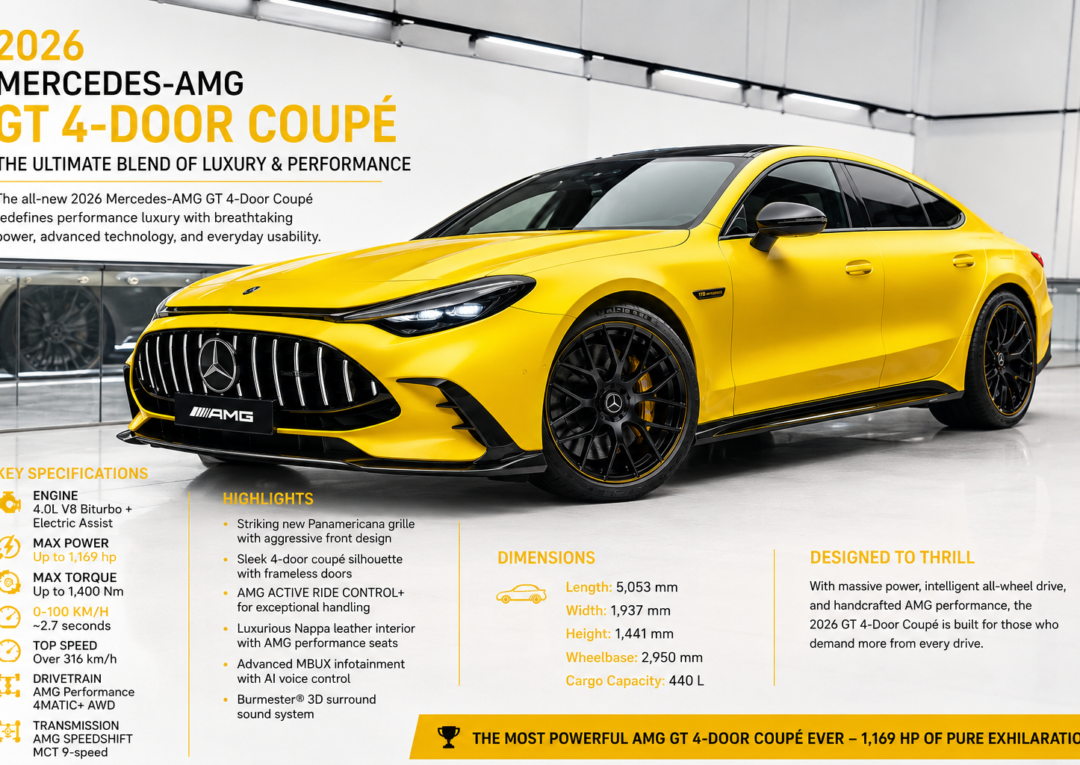
Let’s be honest — when someone says “family car,” a 1,169-horsepower machine with a racing-derived hybrid system probably isn’t what comes to mind. But that’s exactly what Mercedes-AMG is claiming with the all-new 2026 GT 4-Door Coupe.
This isn’t just a fast car. It’s a statement. A signal that AMG is done playing it safe. The new GT 4-Door sits at the very top of the Mercedes performance ladder — above the GT 63, above the C 63, above almost everything they’ve ever made. And with its AMG E Performance hybrid system borrowed directly from their Formula 1 programme, it might genuinely be the most technically advanced road car the brand has ever produced.
So what’s actually new? How does the powertrain work? And most importantly — is this the car that finally gives the Porsche Panamera Turbo S E-Hybrid and the BMW M5 a real rival to worry about? Let’s get into it.
The Powertrain: Not Just Hybrid. Formula 1 Hybrid.
Here’s where things get genuinely interesting — and a little mind-bending. The 2026 AMG GT 4-Door uses AMG’s E Performance system, which pairs a hand-built 4.0-litre twin-turbocharged V8 with an electric motor mounted on the rear axle.
The combustion engine alone produces around 630 hp. The electric motor adds another 204 hp continuously — and in short bursts, pushes total system output up to that headline-grabbing 1,169 hp figure. For context: that’s more than a Lamborghini Huracán. In a four-door car with a back seat and a proper boot.
The result is all-wheel drive torque vectoring that can split power between front and rear axles — and even between individual rear wheels — in milliseconds. In plain terms: the car can steer itself slightly using power, which makes it more stable, more controlled, and frankly more accessible for drivers who aren’t professional racing drivers.
The Numbers That Actually Matter
Design: Sharper, Lower, More Aggressive
If the previous AMG GT 4-Door looked like a sophisticated sports saloon, this one looks like it’s considering whether to eat you.
The front end is completely new — a wider, more aggressive grille flanked by a revised lighting signature that pulls the eye low and forward. The bonnet gets muscular power domes. The side profile drops noticeably at the roofline compared to the old car, giving it a fastback silhouette that sits much closer to the two-door GT Coupe aesthetically.
Round the back, quad exhausts are standard — because of course they are. The rear diffuser is now more pronounced, the spoiler more functional, and the overall stance is wider by a meaningful margin thanks to the revised wheel arch flares.
Interior: Where the Real Luxury Lives
The cabin is a significant step up. Mercedes has brought the hyperscreen setup from the EQS into this car — so you get a sweeping curved display that runs almost the full width of the dashboard, combining the driver’s digital cluster, the central infotainment, and a passenger screen in one uninterrupted piece of curved glass.
Materials are properly premium: Nappa leather as standard, Burmester surround sound, ambient lighting with 64 colours, and Mercedes’ latest MBUX system with improved voice control. The rear seats are actually usable for adults — which is the whole point of the 4-Door concept — with decent legroom and heating as standard.
“It’s a car that goes 325 km/h — and still has heated rear seats and a Burmester sound system.”
The AMG GT 4-Door Brief — May 2026
How It Actually Drives — On Road & Track
Performance cars at this power level often have a problem: they’re terrifying to drive at anything less than full commitment. AMG has clearly engineered against that problem here.
There are multiple drive modes — Comfort, Sport, Sport+, Race, and Individual — and the difference between Comfort and Race is dramatic. In Comfort, the air suspension softens, the throttle response mellows, and the car genuinely feels like a luxury saloon. It’s not pretending. It rides well. It’s quiet.
Switch to Race and the character transforms completely. The suspension drops, the steering weights up, the gearbox holds revs longer, and the electric motor’s instant torque fills every gap between shifts in a way that a pure combustion car simply cannot replicate. The electric torque-fill between gears is one of those things you have to experience to understand — it removes a sensation that drivers have accepted as normal (the brief torque dip between shifts) and replaces it with seamless, unbroken acceleration.
Air suspension in full soft mode, throttle mapping relaxed, noise insulation doing its job. This is actually a comfortable grand tourer — not a watered-down sports car trying to be comfortable. It rides bumps properly.
The car changes character here. Steering becomes more direct, the throttle sharpens, the exhaust note opens up. This is the sweet spot for fast road driving — engaging but not punishing. The best everyday performance mode.
Full attack. Suspension stiffens, stability control pulls back, the gearbox becomes aggressive. Under 2.8 seconds to 100 km/h stops feeling abstract and starts feeling very, very real. Not for everyday use. Absolutely spectacular on a track.
Up to ~40 km on pure battery power. Completely silent. Still up to 204 hp available. Genuinely useful for urban driving, congestion zones, or early morning exits. The EV mode isn’t token — it actually works.
Configure each system separately. Want soft suspension with maximum engine aggression? Done. Prefer sharp steering but relaxed gearbox? That works too. The level of personalisation here is genuinely impressive.
How It Compares to the Competition
This segment is tiny but brutally competitive. The AMG GT 4-Door is going head-to-head with essentially two serious rivals — and both of them are genuinely good cars.
Porsche Panamera Turbo S E-Hybrid
The Panamera is the benchmark this segment is measured against. More refined, arguably better to drive in everyday situations, and with Porsche’s reputation for build quality. But it produces around 700 hp in its most extreme form — less than two-thirds of what the AMG is claiming. The Panamera is the choice if you want the safe, proven, sophisticated option. The AMG is the choice if you want to feel the future arriving at high speed.
BMW M5 Touring / M5 CS
The M5 is a brilliant car — particularly in touring form where it’s the most practical of the group. The hybrid M5 puts out around 720 hp. Again, impressive. But it’s not playing at the same power level. BMW’s strength is driver feel — the steering, the balance, the playfulness. AMG counters with raw output and technical complexity.
The Ferrari Purosangue Factor
Worth mentioning — Ferrari’s Purosangue sits in a slightly different category (four-door SUV rather than proper saloon), but buyers are cross-shopping it. The Purosangue is naturally aspirated V12 drama versus AMG’s hybrid complexity. Both are around the £300,000+ mark. Both are extraordinary in completely different ways.
Pricing, Variants & Who It’s Actually For
Let’s talk money, because this matters. The 2026 AMG GT 4-Door starts somewhere north of £250,000 in the UK and will land in similar territory in continental Europe. In India, expect import duties to push the on-road price well above ₹4–5 crore for any specification worth having.
That’s a lot. But consider what you’re getting: a hand-assembled V8 with an F1-derived battery system, a chassis tuned in partnership with AMG’s motorsport division, and the full Mercedes luxury package. The list of options will extend the price significantly — carbon ceramic brakes, Burmester 3D sound (the upgrade over standard Burmester), rear-wheel steering, and the various AMG track packages are all extra.
- Who actually buys this: Typically entrepreneurs, senior executives, and car collectors who want one car that does everything — track day on Saturday, school run on Monday, client dinner on Tuesday.
- The business case: Interestingly, many buyers will run this through a company because of the hybrid powertrain — in several European markets, plug-in hybrids still qualify for business tax benefits.
- The Indian market: Limited numbers, high duties, but there’s a real audience. The AMG GT family has sold consistently well in India’s performance car segment.
- Resale: AMG GT 4-Doors at this performance level have historically held value well — the previous generation remains desirable. That matters when the initial outlay is this large.
What This Tells Us About AMG’s Direction
There’s a bigger story here beyond just the car itself. AMG is making a very clear statement with this reveal: electrification doesn’t have to mean boring.
The brand spent years resisting full electrification while their competitors rushed into EVs. Instead, they developed the E Performance hybrid system — which delivers real performance benefits, not just efficiency credentials. The electric motor doesn’t just help fuel economy. It fills torque gaps, enables torque vectoring, improves traction out of corners, and pushes total system output beyond what a combustion engine alone could achieve in a road-legal car.
This is the template for AMG going forward. The C 63 already uses a version of this system. The GT 4-Door takes it to its current limit. And with battery technology improving, the next generation of these systems will be even more capable — more EV range, more electric power, same V8 drama.
AMG isn’t becoming an EV brand. But it’s becoming a brand that uses electric technology to make its combustion cars even better. That’s a genuinely interesting position — and one that the 2026 GT 4-Door argues very convincingly.
Final Word:
The Four-Door That Breaks the Rules.
1,169 hp sounds like a number from a hypercar brochure. In this car, it comes with Nappa leather, a Burmester sound system, and a back seat that adults can actually sit in. That combination — exotic performance, daily usability, genuine luxury — is what makes this car genuinely special.
The competition is strong. Porsche’s Panamera Turbo S E-Hybrid is refined and proven. The BMW M5 is a driver’s car of the highest order. But neither of them is running 1,169 hp through a Formula 1-derived hybrid system. And in this segment — where bragging rights matter almost as much as lap times — that difference is significant.
If AMG’s goal with the 2026 GT 4-Door was to build the most powerful, most technically sophisticated, and most dramatic four-door performance car ever to wear a three-pointed star — they’ve done it. And then some.
Automobile Coverage — May 2026