⚡ EV Analysis | May 2026
Tata Tiago EV
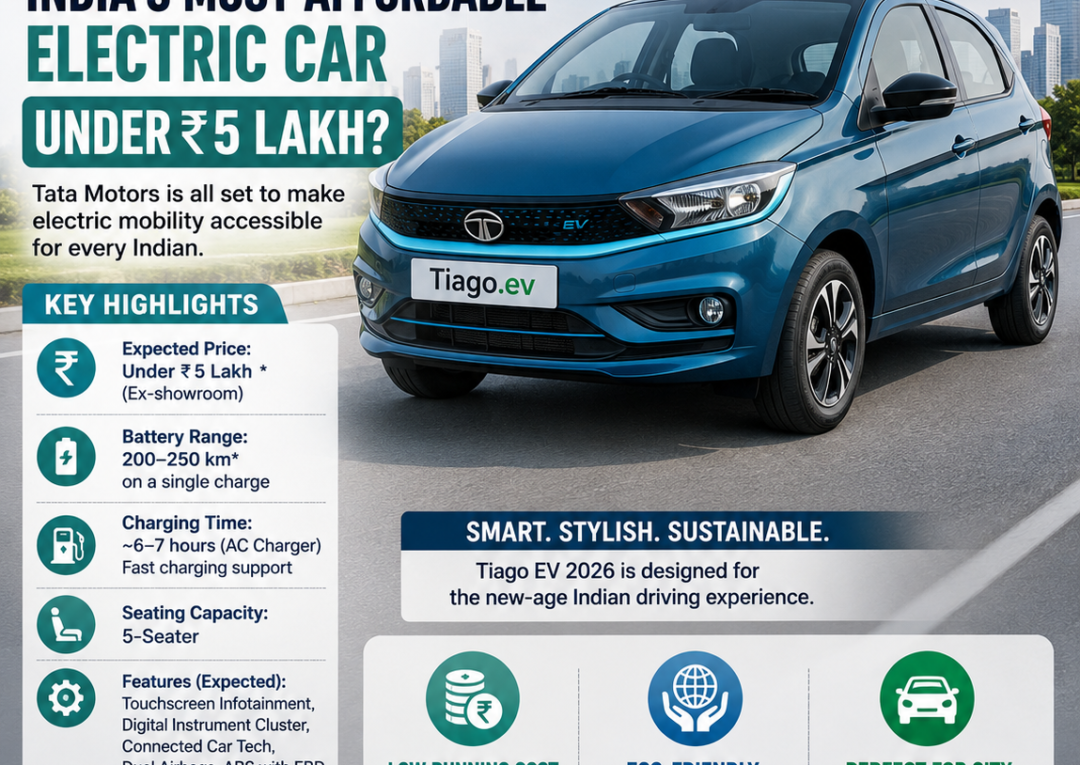
2026: India’s Most
Affordable
Electric Car?
Picture this — you’re stuck in Bengaluru traffic, watching the fuel gauge drop, and you’re doing mental math on petrol prices that seem to go up every other week. Sound familiar?
That’s exactly the problem Tata Motors has been trying to solve with the Tiago EV. It’s their big bet on making electric mobility accessible — not just for the tech-savvy EV enthusiast in a metro city, but for the average salaried Indian who’s finally ready to ditch petrol.
In 2026, the conversation around the Tiago EV has gotten even more interesting. Prices have shifted, the competition has gotten sharper, and there’s a burning question in every EV buyer’s mind: Is the Tiago EV finally inching toward the magical ₹5 lakh territory? Let’s break it down properly.
Why the Tiago EV Actually Matters in 2026
India’s EV market in 2026 isn’t the same beast it was three years ago. The government’s FAME III subsidies have pushed manufacturers harder, charging infrastructure has expanded significantly across Tier 1 and Tier 2 cities, and the monthly EV sales numbers keep hitting new records.
But here’s the uncomfortable truth — most EVs in India still sit in the ₹12–25 lakh bracket. That’s simply out of reach for a massive chunk of the Indian middle class. The Tata Tiago EV has always been the outlier trying to fix that gap.
Tata has smartly positioned this car not as a compromise but as a genuine alternative. And for a lot of first-time EV buyers, it’s the first electric car that doesn’t feel like a science experiment.
What’s New in 2026 — The Key Updates
Tata hasn’t done a full generation change on the Tiago EV for 2026 — but they’ve made meaningful refinements that matter in the real world.
Battery & Range — The Honest Picture
The top variant still carries the 24 kWh battery with an ARAI-certified range of 315 km. But experienced EV owners know ARAI numbers are optimistic. Real-world range — with AC on, city stop-go traffic, and mixed highway use — is closer to 200–230 km. That’s actually perfectly fine for daily urban commutes. Most Indians drive under 50 km a day.
The entry-level 19.2 kWh variant offers a more modest 250 km ARAI range (real-world ~180–200 km). For someone buying their first EV and primarily driving within city limits, this variant makes financial sense.
Charging — Getting Faster, Finally
- AC Home Charging (7.2 kW): Full charge from zero in roughly 3.5–4 hours on the 24 kWh pack. Plug it in overnight — done.
- DC Fast Charging (50 kW): 0 to 80% in about 57 minutes. Tata’s Zconnect app now integrates with most third-party charging networks.
- Tata Power Charger Network: In 2026, this has expanded to over 2,000 locations across India — not perfect, but no longer anxiety-inducing in major cities.
The Software & Features Upgrade
This is where Tata has quietly done good work. The 2026 Tiago EV gets a refreshed version of their infotainment system with better voice command integration, an updated Zconnect app with live charging station status, and a slightly revised instrument cluster. Nothing revolutionary — but it addresses feedback from early owners who found the old software clunky.
The Price Reality — Can It Really Be Under ₹5 Lakh?
Let’s address this head-on, because it’s the question everyone’s actually asking.
The ex-showroom price in 2026 starts at ₹7.99 lakh for the base Tiago EV XE variant and goes up to approximately ₹11.79 lakh for the fully loaded XZ+ LR variant. On paper, that’s not under ₹5 lakh.
But here’s where it gets interesting — and where a lot of online discussions miss the nuance.
📊 The Real Cost Calculation — 2026
- FAME III Central Subsidy: ₹25,000–₹50,000 depending on the variant and battery capacity. Still active in 2026 for sub-₹15 lakh EVs.
- State EV Subsidies: Maharashtra (up to ₹1.5 lakh), Delhi (₹1.5 lakh subsidy + road tax waiver), Gujarat (₹1.5 lakh), Tamil Nadu (road tax + registration waiver). Not every state, but major metro buyers benefit significantly.
- Zero Road Tax + Registration: In most EV-friendly states, this saves ₹40,000–₹80,000 compared to a petrol equivalent.
- Corporate/Fleet Buyer Deals: Tata’s fleet arm has been offering additional discounts of ₹30,000–₹50,000 for bulk purchases. Relevant for Ola/Uber driver-partners and small fleet operators.
- Effective On-Road Price (Delhi, Best Case): ₹7.99L (ex-showroom) − ₹1.5L (state subsidy) − ₹0.5L (FAME III) − ₹0.6L (road tax/reg savings) = approximately ₹5.39 lakh all-in. That’s as close to ₹5 lakh as it’s ever been.
“The Tiago EV isn’t cheap. But in the right state, with the right subsidies, it might be the most value-dense car in Indian automotive history.”
EV Ownership Analysis — May 2026
How It Stacks Up Against the Competition
The affordable EV space has gotten crowded in 2026. Let’s see where the Tiago EV actually stands.
| Model | Price (Ex-showroom) | Range (ARAI) | Verdict |
|---|---|---|---|
| Tata Tiago EV | ₹7.99L–₹11.79L | 250–315 km | Best overall value |
| MG Comet EV | ₹6.99L–₹9.50L | 230 km | City-only, cramped |
| Citroen ë-C3 | ₹11.50L–₹12.80L | 320 km | Pricier, good range |
| Tata Punch EV | ₹9.99L–₹14.49L | 421 km | Better range, higher price |
| BYD Seagull (2026) | ₹8.99L–₹11L | 400 km | New entrant, strong value |
The BYD Seagull’s entry in 2026 is genuinely threatening the Tiago EV’s position. It offers more range at a comparable price point — and Chinese manufacturing cost efficiencies are real. Tata’s response has been to lean harder on the service network advantage and trust factor. For first-time EV buyers, a Tata service centre 5 km away versus a BYD centre in limited cities still matters.
The Real-World Ownership Experience
Numbers are one thing. What’s it actually like to own a Tiago EV in 2026?
The Running Cost Advantage — This Is Real
This is where the Tiago EV genuinely wins. Charging at home on a standard domestic tariff (roughly ₹6–8 per unit in most Indian cities) means a full charge of the 24 kWh battery costs around ₹145–190. That covers 200 km of real-world range.
A comparable petrol hatchback doing 18 km/litre at ₹100/litre would cost ₹1,111 for the same 200 km. That’s a saving of roughly ₹900 every 200 km. For someone doing 1,500 km a month, that’s ₹6,750/month or ₹81,000/year in fuel savings alone.
Maintenance — The Invisible Advantage
EVs don’t need engine oil changes, timing belt replacements, exhaust system work, or clutch servicing. Tata’s service records show Tiago EV owners spending roughly 70% less annually on maintenance than petrol hatchback owners. The battery pack carries an 8-year/1.6 lakh km warranty — which is genuinely reassuring for a first-time EV buyer.
Where It Still Falls Short
- Interior quality: The plastics and overall cabin feel are budget-grade. At ₹10+ lakh effective pricing in non-subsidy states, buyers expect better material quality.
- Highway anxiety: 200 km real-world range means a Mumbai–Pune highway trip still requires a charging stop. Not a deal-breaker, but worth planning.
- Boot space: 242 litres is small. If you’re a family of four with luggage, it’ll be tight.
- No AWD/sporty option: For EV enthusiasts looking for something more engaging to drive, the Tiago EV isn’t that car.
Who Should Buy It — And Who Shouldn’t
Buy the Tiago EV If:
- You drive predominantly within city limits (under 80 km/day)
- You have home or workplace charging access
- You’re based in Delhi, Mumbai, Pune, Bengaluru, Hyderabad, or Chennai — where charging infra is now reasonably solid
- You’re eligible for state EV subsidies that bring effective pricing closer to ₹6–7 lakh
- You want the lowest running costs of any car available in India
- This is your second car and primary highway driver remains a petrol/diesel vehicle
Think Twice If:
- You regularly drive long inter-city routes (Mumbai–Goa, Delhi–Jaipur) without time to stop and charge
- You have no charging access at home and rely purely on public chargers
- You want a premium cabin feel at this price point — consider the Tata Punch EV instead
- You’re in a state without meaningful EV subsidies and the on-road price feels stretched
Final Verdict:
Close, But Not Quite ₹5 Lakh.
Still The Best Bet.
More importantly, it’s proof that mass-market EV adoption in India isn’t a far-off dream. It’s happening — slowly, imperfectly, but genuinely. The Tiago EV might not have the longest range or the most luxurious cabin, but it may be doing more for India’s EV transition than any other single product in the market.
For the professional daily commuter who’s done the math on fuel costs and is ready to make the switch — the Tiago EV in 2026 isn’t just an option. It might be the smartest financial decision on four wheels.
EV Analysis — May 2026