Markets & Finance | May 2026
The IPO Boom:
Why SpaceX
OpenAI Going
Public Could Change
Wall Street.
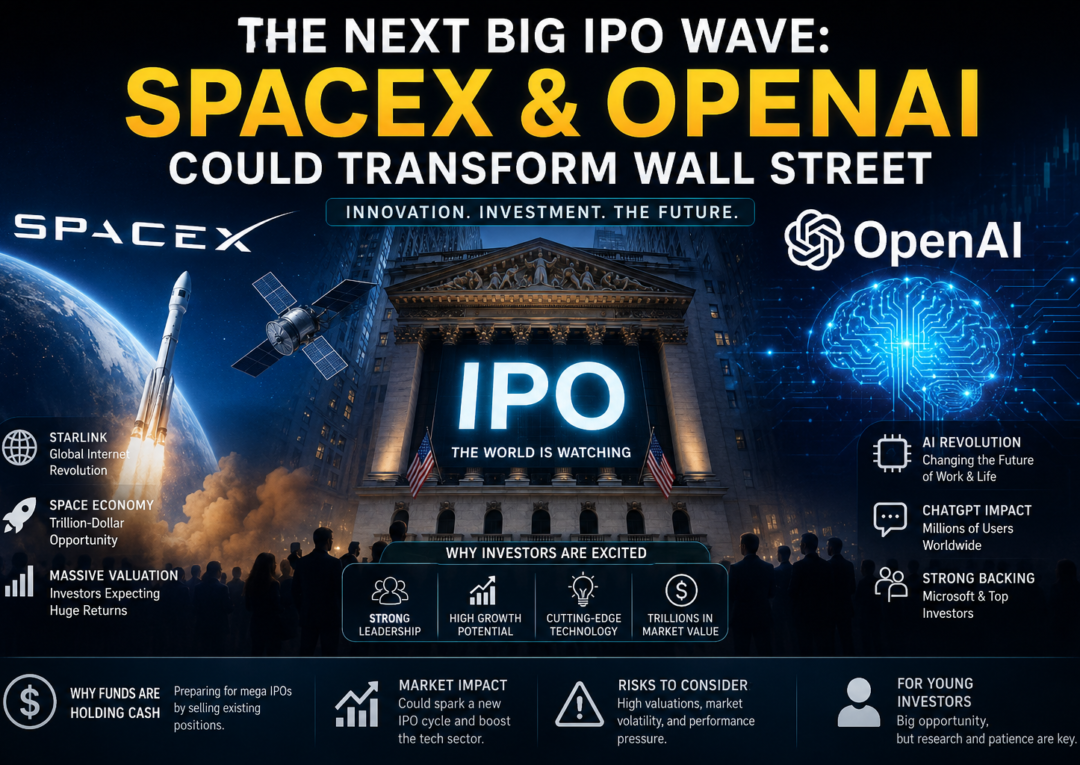
Picture this: it’s a regular Tuesday morning. You open your brokerage app, and right there — sitting next to your Nifty ETF — is a button that says “Buy SpaceX.” Or maybe “Buy OpenAI.” Companies that have been the exclusive playground of billionaires and venture capital firms for years, suddenly available to anyone with a Zerodha account or a Robinhood login.
That day might be closer than most people think. And when it comes, it won’t just be another stock market event — it could genuinely reshape how Wall Street works, who gets access to wealth-building opportunities, and what “investing in the future” actually looks like.
If you’re a student, a young professional just starting out, or someone who has heard these company names but has no idea where to begin — this piece is for you. Let’s break it all down.
First, What Even Is an IPO?
Let’s start from scratch, because a lot of finance content assumes you already know this stuff. You don’t have to.
IPO stands for Initial Public Offering. In simple language — it’s when a private company decides to sell shares to the general public for the very first time. Think of it as a company opening its doors and saying: “Hey, we’ve built something valuable. Want a piece of it?”
Before an IPO, a company is private. Only its founders, employees, and certain investors (usually venture capital firms or wealthy individuals) can own shares. Once it goes public, anyone — you, your college friend, your uncle in Pune — can buy a piece of the company through the stock exchange.
Famous IPOs you might have heard of: Meta (formerly Facebook) went public in 2012. Google went public in 2004. More recently, companies like Zomato and Nykaa created massive buzz in India when they listed. IPOs can generate extraordinary returns for early investors — but they also come with real risks, which we’ll get into.
Who Are SpaceX and OpenAI?
If you’ve been living under a rock (no judgment), here’s the quick version.
🚀 SpaceX
Founded by Elon Musk in 2002. SpaceX builds rockets and spacecraft. Their whole mission is to make space travel cheaper and eventually make humanity multi-planetary.
They’re not just an idea — they’ve sent astronauts to the ISS, launched thousands of Starlink internet satellites, and are building the Starship rocket that could one day take people to Mars.
SpaceX is currently valued at roughly $350 billion — making it one of the most valuable private companies in the world.
🤖 OpenAI
Founded in 2015, originally as a non-profit, OpenAI is the company behind ChatGPT — the AI assistant that’s been absolutely everywhere since 2022.
They’re at the cutting edge of artificial intelligence research. Their products are used by hundreds of millions of people and thousands of companies worldwide.
OpenAI’s valuation has climbed dramatically — hovering around $300 billion in the most recent funding rounds, with investor appetite showing no signs of cooling.
Both companies are, in one way or another, trying to shape the next 50 years of human civilization. Space and AI are arguably the two most important technological frontiers we’re navigating right now. And both of these companies are leading the charge.
That’s why their potential IPOs aren’t just a financial story. They’re a cultural and civilizational one.
Why Haven’t They Gone Public Yet?
This is the question everyone asks. If these companies are worth hundreds of billions, why are they still private?
The short answer: they don’t need the money the way they used to. Going public is traditionally how companies raise large amounts of capital. But SpaceX and OpenAI have had no shortage of investors willing to pour billions into them at private valuations. There’s no desperate need to tap the public markets.
- Private control: When you go public, you answer to shareholders. Every quarter, you’re expected to report earnings. Musk has been vocal about not wanting the short-term pressure that comes with public markets — he watched Tesla get brutally punished by Wall Street during its early years. Staying private means keeping the long-term vision intact.
- Strategic flexibility: Private companies can pivot, experiment, and absorb losses without panicking a public shareholder base. SpaceX has exploded rockets intentionally as part of testing — something that would’ve sent a public company’s stock into freefall.
- OpenAI’s structure is complicated: OpenAI was originally a non-profit. Its conversion to a for-profit “capped profit” structure has been a long, legally and reputationally complex journey. Taking that public requires navigating governance, mission commitments, and investor expectations simultaneously.
- Valuation timing: Both companies want to go public at peak valuation windows. With AI investment at a fever pitch and the space economy maturing, the conditions for a monster IPO are building — but the timing has to be right.
Why Would These IPOs Change Wall Street?
Here’s where it gets genuinely interesting — especially if you think about the bigger picture.
1. Scale That Dwarfs Almost Everything
To understand the size of what we’re potentially talking about: Saudi Aramco’s IPO in 2019 raised around $25.6 billion and was the largest IPO in history at the time. Alibaba’s 2014 U.S. IPO raised about $25 billion. These were considered mega-events.
A SpaceX IPO at current valuations could easily eclipse both. An OpenAI IPO would add to that. We’re potentially talking about two of the top five largest IPOs in history happening within the same cycle. That’s a once-in-a-generation capital markets event.
2. New Categories of Companies on Public Markets
Right now, if you want to invest in space, your options are pretty limited — Virgin Galactic, some aerospace defense contractors, and a few satellite companies. None of them are SpaceX. Once SpaceX lists, there’s suddenly a pure-play space economy stock that actually works.
Same with AI. You can currently get AI exposure through Nvidia, Microsoft (which has invested heavily in OpenAI), or Google. But owning OpenAI directly would be an entirely different proposition. It’s the difference between investing in the oil industry through a shipping company versus buying ExxonMobil directly.
3. The Retail Revolution — Your Moment
This one matters most for students and young professionals reading this. The 2020s have seen a genuine democratization of investing. Platforms like Zerodha, Groww, and Robinhood have brought millions of first-time investors into markets. The culture around investing has shifted — you don’t need a broker in a suit anymore.
When SpaceX or OpenAI go public, retail investors will have real access to these companies for the first time. Not through some expensive pre-IPO placement that’s only available to institutions. Not through a fund that takes a cut. Direct access, through an app, at whatever price the market sets.
“The biggest wealth-building events of the next decade will be the IPOs of companies that are being built right now. Being informed early is not the same as being early — but it helps.”
Finance Perspective — May 2026
4. Index Inclusion — Everyone Gets Exposure Whether They Want It or Not
Here’s something most beginners don’t know: once a company is public and large enough, it gets included in major stock indices — like the S&P 500 or the Nasdaq 100. Once that happens, every index fund or ETF that tracks those indices automatically holds shares in that company.
If you have a mutual fund, a pension plan, or an index ETF — and SpaceX or OpenAI enter major indices — you’ll own a tiny slice of them automatically. That’s how significant these IPOs could be for the average person’s portfolio, even without any active decision on your part.
The Real Risks Nobody Talks About Enough
Okay, here’s the part that’s less exciting but genuinely important. IPOs — especially high-hype ones — come with serious risks. And understanding them is what separates smart investing from gambling.
⚠️ What Could Go Wrong
- Valuation lock-in at the top: By the time an IPO reaches retail investors, the price often already reflects enormous optimism about the future. Companies like Lyft, Snap, and WeWork (which never even IPO’d cleanly) all launched to huge fanfare and then fell significantly. Buying at IPO price doesn’t mean buying cheap.
- Lock-up period selling: After an IPO, early investors and employees typically can’t sell for 90–180 days. When that lock-up period expires, a flood of selling often pushes the price down. This is a very predictable pattern that trips up new investors every cycle.
- Profitability questions for OpenAI: OpenAI spends an enormous amount of money on computing infrastructure. The AI arms race is capital-intensive. Whether that translates into sustainable profitability for shareholders — especially at a valuation of $300 billion — is genuinely uncertain.
- Regulatory and governance risk: Both companies operate in sectors where government and regulatory oversight is increasing rapidly. Space launches need FAA approval. AI is facing regulatory scrutiny in the EU, the U.S., and India. New rules could meaningfully affect business models.
- Competition doesn’t stand still: SpaceX is dominant today, but Blue Origin, Rocket Lab, and state-backed programs are not standing still. OpenAI is leading today, but Google’s Gemini, Anthropic, Meta’s LLaMA, and dozens of others are competing fiercely. Market leadership in technology is never permanent.
- The hype discount: When something is the most talked-about investment opportunity in a decade, the price tends to reflect that excitement — sometimes dangerously so. The fundamentals have to eventually justify the valuation, and that can take much longer than the excitement suggests.
What This Means for Indian Investors
If you’re reading this from India, you might be wondering — does any of this actually apply to me? More than you’d think.
- The LRS route: Indian residents can invest in U.S. stocks through the Liberalised Remittance Scheme (LRS), which allows up to $250,000 per year in overseas investments. Platforms like Vested, INDmoney, and ICICI Direct’s international trading feature make this accessible. If SpaceX or OpenAI list on U.S. exchanges, Indian investors can participate.
- Indirect exposure already exists: If you hold a Nasdaq ETF or a U.S. tech fund — many of which are available in India — and these companies eventually enter major U.S. indices, you’ll already have indirect exposure. Worth checking what’s in your existing funds.
- Currency and tax considerations: Investing in U.S. IPOs from India involves currency risk (rupee vs dollar) and specific tax treatment on capital gains and dividends from foreign securities. Always consult a CA or financial advisor before putting significant money into this.
- The education opportunity: Even if you don’t invest directly, understanding these IPOs — how they work, what drives valuations, what the risks are — is genuine financial education that will serve you for decades. The next SpaceX-equivalent might be an Indian startup that you can invest in directly.
The Bigger Picture: What Comes After?
Here’s a thought worth sitting with. SpaceX and OpenAI going public isn’t just about these two companies. It’s a signal about the kind of economy we’re building.
For most of modern stock market history, the companies that dominated public markets were industrial (steel, oil, cars), then financial (banks, insurers), then consumer (retail, media), then internet (Google, Amazon, Meta). Each transition created a new generation of public market wealth.
The next transition — AI and space — is happening right now. The companies that define it are, today, still largely private. When they go public, it marks the official handover of capital markets to the next era.
For young investors, this is actually an advantage. You have time. You’re learning about these sectors before they fully mature in public markets. That head start — in knowledge, not just in capital — is genuinely valuable.
You don’t need to rush. You don’t need to throw money at the first day of trading because you’re afraid of missing out. The most important thing right now is to understand what’s happening and why. The investment decisions can come later, informed by that understanding.
Final Take:
The Doors Are Opening. Are You Ready?
For the first time in a long time, the market might actually let everyone in. Whether you have ₹5,000 or ₹5 crore, you’ll theoretically have the same button to press.
The right response to that isn’t blind excitement. It’s preparation. Understand what these companies actually do. Understand what “valuation” means. Understand the risks. Learn how IPOs work. Build the knowledge base now, so that when the moment comes, you’re making an informed decision — not a reactive one.
The IPO boom is real. The opportunity is real. And for people who take the time to understand what they’re getting into, so is the potential upside. The question is whether you want to be someone who reads about it afterward — or someone who was ready when it happened.
Finance Intelligence — May 2026