⚡ EV Technology | May 2026
BYD’s Next-Gen
Blade Battery:
The EV Game
Just Changed.
Let’s be honest — range anxiety is still the number one reason people hesitate before buying an electric vehicle. You’ve done the math. You’ve checked the charging map. And somewhere in the back of your head, you’re still not fully convinced.
BYD just made that hesitation a lot harder to hold on to. The company has launched what it’s calling the next generation of its Blade Battery technology in 2026 — and the numbers are genuinely hard to ignore. Longer range, faster charging, better safety, and a design that pushes the limits of what lithium iron phosphate chemistry can actually do.
Whether you’re thinking about your first EV, upgrading from an older one, or just tracking where battery technology is going — this is the update worth paying attention to.
First, What Even Is Blade Battery Technology?
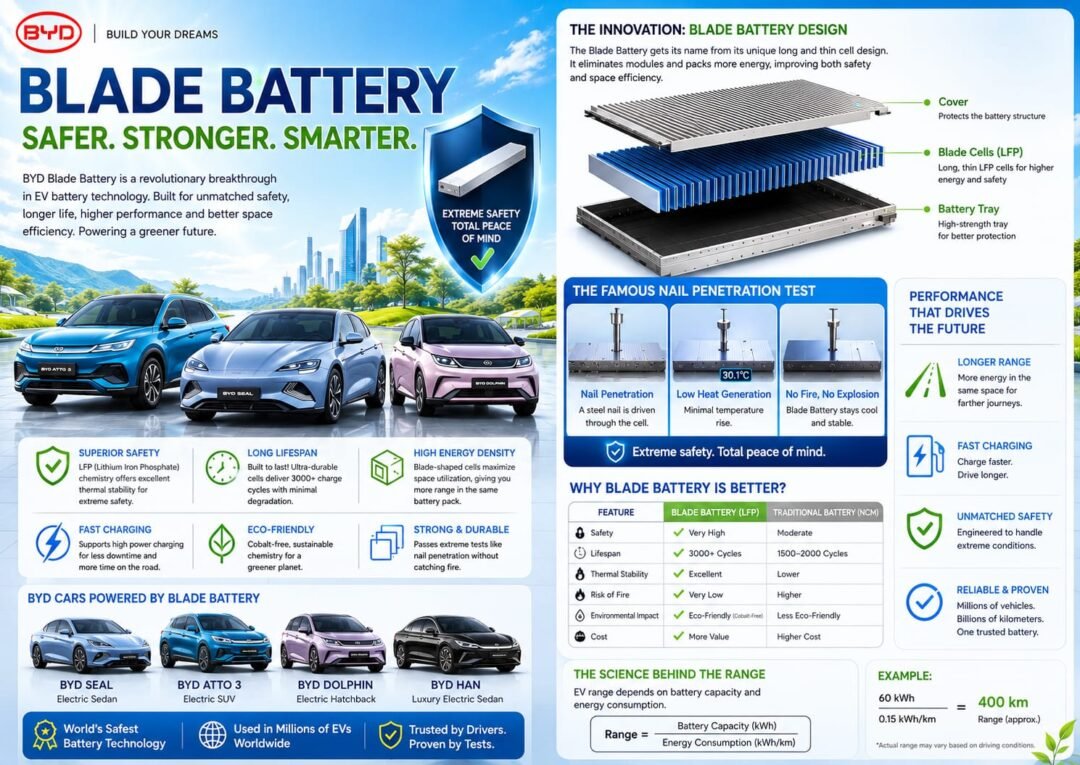
If you’re new to the term, here’s the short version. Traditional EV batteries pack individual cells into modules, and then those modules go into a large pack. It works — but it wastes a lot of space and adds weight.
BYD’s Blade Battery flips this. The cells are long, thin, and flat — like actual blades — and they’re stacked directly into the battery pack without the module layer in between. Think of it like removing the packaging inside a box and just filling it directly. You get more energy in the same physical space.
The result? A battery that’s safer than before, charges faster than before, lasts longer than before, and is cheaper to produce per kilowatt-hour. That combination doesn’t usually happen all at once. That’s why this matters.
What’s Actually New in 2026
Let’s get into specifics — because “next generation” is a phrase that gets thrown around a lot in the EV world without always meaning much.
1. Energy Density — The Real Step Change
The 2026 Blade Battery pushes LFP energy density to approximately 175–190 Wh/kg at the cell level. That’s a meaningful jump from the first-generation Blade’s ~150 Wh/kg. For context, most LFP batteries from other manufacturers are still in the 140–160 Wh/kg range.
In real-world terms, this is what enables the 1,000+ km range figure in BYD’s larger vehicles. Smaller cars in the lineup benefit proportionally — expect honest real-world range of 500–700 km in mid-size EVs with this pack.
2. Ultra-Fast Charging — The 10-Minute Promise
This is probably the headline that got the most attention. BYD claims the new Blade Battery supports peak charging rates above 4C — meaning a full charge in roughly 15 minutes under ideal conditions. The “10 minutes for 400 km” figure is based on charging from 10% to 80% at a 1,000kW+ ultra-fast charger.
3. Cycle Life — This Changes the Ownership Maths
BYD is quoting 5,000+ full charge cycles before the battery degrades to 80% capacity. If you charge once a day, that’s over 13 years of daily use. For comparison, most EV batteries today are warrantied for 8 years or 160,000 km — the new Blade is designed to outlast the car it sits in.
4. Thermal Management — Smarter, Not Just Safer
The new generation includes an upgraded thermal regulation system that works in both directions — cooling during fast charging AND pre-heating in cold weather to maintain performance. Cold weather has been a persistent weakness for EVs; BYD has addressed this with what they’re calling an “all-temperature” thermal architecture.
5. The Cobalt-Free Chemistry Stays
One thing that doesn’t change — and it’s worth saying clearly — is the LFP chemistry. No cobalt. No nickel. These are the materials with the most ethically and supply-chain-complicated sourcing stories in the EV world. BYD using LFP means the battery is cheaper, safer, and doesn’t depend on mining regions under geopolitical pressure. That matters more in 2026 than it did in 2020.
How It Stacks Up — The Honest Comparison
The EV battery space in 2026 is genuinely competitive. Here’s how BYD’s new Blade sits against the main alternatives.
| Battery Type | Energy Density | Charge Speed | Safety | Cost |
|---|---|---|---|---|
| BYD Blade Gen 2 (2026) | 175–190 Wh/kg | 4C+ capable | Excellent | Low |
| CATL Qilin (LFP) | 160–175 Wh/kg | 3C | Excellent | Low-Mid |
| Tesla 4680 (NMC) | ~300 Wh/kg | 2–3C | Good | High |
| Solid-State (2026 pilots) | 350–400 Wh/kg | Limited | Excellent | Very High |
The BYD Blade isn’t the highest energy density battery in the world — solid-state technology, still in limited production, exceeds it significantly. But solid-state is expensive, hard to manufacture at scale, and still proving itself in real-world conditions. The Blade’s advantage is that it’s real, available, affordable, and proven. That combination is what makes it commercially dominant right now.
“BYD didn’t just improve the Blade. They made the ‘good enough battery’ argument genuinely obsolete.”
EV Industry Observer — May 2026
What This Means for India Specifically
India has a complicated relationship with electric vehicles. The government wants EVs everywhere. Consumers want EVs that make sense for Indian roads, Indian weather, and Indian electricity infrastructure. The two haven’t always matched up cleanly.
The new Blade Battery changes the calculus in a few specific ways for Indian buyers and the market overall.
India’s summers are brutal. Batteries lose performance and degrade faster in extreme heat. The new Blade’s thermal architecture is specifically tested for high ambient temperature operation — a direct improvement for markets like India where 40–45°C summers are normal, not exceptional.
LFP chemistry is already the most cost-efficient EV battery type. Higher energy density from the new Blade means manufacturers can use a smaller (cheaper) pack to hit the same range target. This is the technology pathway to EVs reaching price parity with petrol cars in India — likely in the 2027–2029 window.
The 10-minute charge headline doesn’t fully apply to India’s current charging infrastructure. But even on a standard 50kW DC fast charger — which is increasingly common in Indian cities — the new Blade charges significantly faster than first-gen units. Practical gains are real, even without the extreme chargers.
BYD’s current India lineup — the Seal, Atto 3, and the e6 — are all candidates for Blade Gen 2 upgrades. BYD India has signalled local assembly ambitions; the new battery platform is a cornerstone of that roadmap. Expect refreshed variants with updated range specs by late 2026 or 2027.
India’s EV policy under PLI schemes incentivises local battery manufacturing. BYD’s LFP chemistry — requiring no cobalt and manageable amounts of lithium — is more compatible with India’s mineral import landscape than NMC alternatives. This matters for the long-term domestic EV manufacturing story.
The real volume opportunity for BYD’s battery technology in India isn’t premium passenger cars — it’s commercial vehicles and three-wheelers. Fleet operators, logistics companies, and e-rickshaw manufacturers are far more sensitive to total cost of ownership, and the Blade’s longer cycle life directly addresses their biggest concern: battery replacement cost.
Should You Wait for This?
If you’re actively shopping for an EV right now, this is probably the question on your mind. The honest answer depends on what you’re buying and when you need it.
🔑 The Decision Framework
- If you need a car in the next 3 months: The current generation of BYD EVs with the original Blade Battery is already excellent. Don’t let perfect be the enemy of good. Today’s Blade is already better than most competitors’ offerings. Buy with confidence.
- If you can wait 12–18 months: This is where timing gets interesting. Refreshed BYD models with Gen 2 Blade are likely arriving in major markets through late 2026 and into 2027. If range and charging speed are your primary concerns, waiting makes sense.
- If you’re buying for a fleet or commercial use: The cycle life improvement alone changes the 5-year total cost of ownership calculation dramatically. This is a compelling reason to plan your next procurement around Gen 2 availability.
- If you’re comparing BYD to other brands: Ask specifically whether the competitor uses LFP or NMC chemistry, what the cycle life warranty is, and what the battery replacement cost is out of warranty. The Blade Gen 2 wins those comparisons clearly.
- If you’re in a hot climate: Move this higher on your priority list. Thermal performance in high ambient temperatures is one of the most underrated specs in EV buying decisions, and it’s where the new Blade makes a real practical difference.
The Bigger Picture — Where Batteries Are Heading
It’s easy to get caught up in the specs of any single launch. But stepping back, the BYD Blade Gen 2 represents something important in the trajectory of EV technology overall.
-
- LFP is winning the volume game: Despite lower energy density than NMC, LFP has captured the majority of global EV battery market share in 2025–26. The reason is simple: it’s cheaper, safer, and lasts longer. The Blade Gen 2 closing the energy density gap accelerates this shift further.
- Solid-state is still 3–5 years from mass market: Toyota, Samsung SDI, and QuantumScape are all making progress on solid-state batteries. But manufacturing at scale, at competitive cost, remains unsolved. BYD’s improvements to liquid electrolyte LFP buy significant time — and market share — before solid-state disrupts the equation.
- Charging infrastructure is the binding constraint now: The battery technology to support 10-minute charging exists. The charger networks to support it don’t, yet. This is the next 3-year battleground for EV adoption — infrastructure investment, not chemistry.
- Second-life and recycling economics improve: A battery that lasts 5,000 cycles before reaching 80% capacity isn’t dead at that point — it’s ideal for stationary energy storage. The economics of battery reuse and recycling look dramatically better with Gen 2 specs, which matters for the full lifecycle environmental calculation.
- Competition response incoming: CATL, Panasonic, LG Energy Solution, and Samsung SDI will all respond to the Blade Gen 2 with their own roadmap updates. The next 18 months are likely to see a wave of competing announcements. For EV buyers, more competition at this technology level is unambiguously good news.
Final Verdict:
This Is the Battery That Changes the Conversation.
1,000+ km of range. 10-minute charging potential. 5,000 cycles of life. No cobalt. No thermal runaway risk. If you told someone in 2019 that an affordable LFP battery would hit these numbers by 2026, they’d have thought you were being optimistic.
The Blade Gen 2 doesn’t solve every EV problem — charging infrastructure, upfront cost parity, and grid readiness are still work-in-progress. But on the battery itself? BYD has moved the goalposts. And everyone else in the industry is now scrambling to catch up.
For Indian EV buyers specifically — watch for the refreshed BYD models arriving in late 2026 and early 2027. The specs are worth the wait, especially if range on long highway drives or performance in extreme summer heat has been your hesitation.
EV Technology — May 2026