🌍 Geopolitical Analysis | June 2026
Israeli Troops
Push Deeper
into Lebanon.
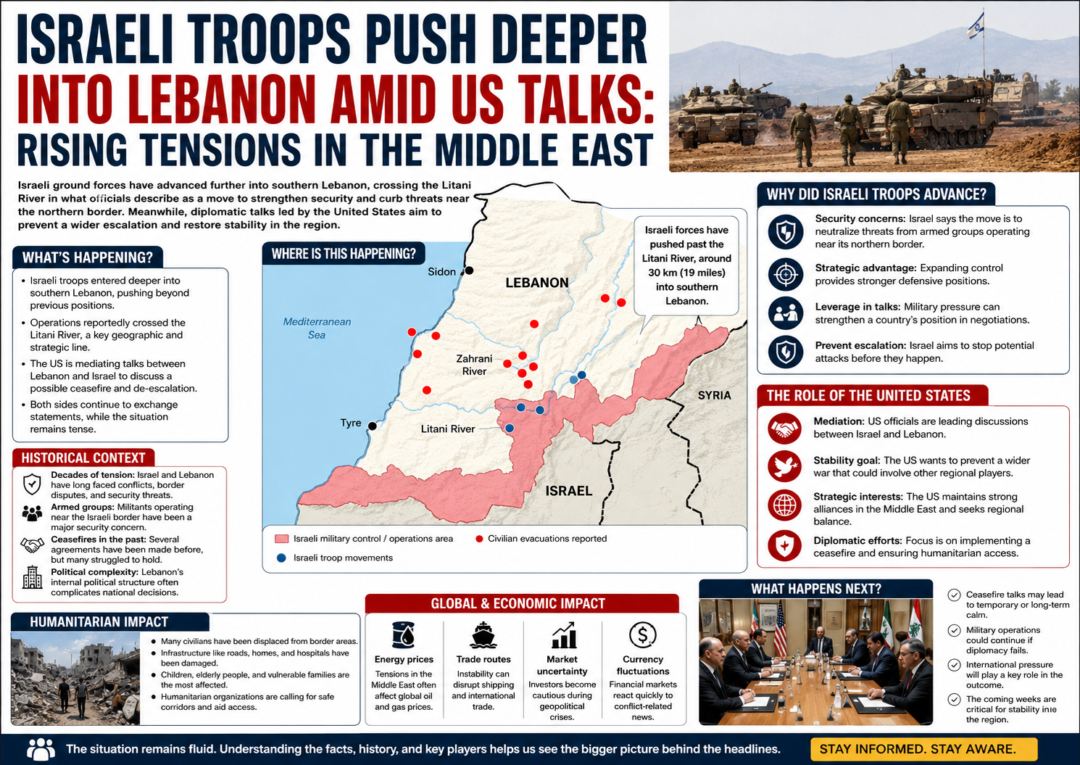
The ground is shifting — literally. Israeli Defence Forces have been pushing deeper into southern Lebanon, and the world is watching closely to see if this is a temporary operation or something with a much longer tail.
At the same time, US diplomats are in the region, trying to hold fragile conversations together. But the gap between what’s happening on the ground and what’s being discussed at the negotiating table has rarely felt this wide.
This isn’t just another round of conflict in a troubled neighbourhood. The 2026 Lebanon escalation sits at the intersection of Israeli security doctrine, Hezbollah’s evolving military posture, Iranian strategic calculations, and American diplomatic credibility — all colliding at once. Let’s break it down properly.
What’s Actually Happening on the Ground
To understand this escalation, you need to drop the idea that this is just “another Israel-Lebanon skirmish.” The 2026 ground push is different in both scope and declared intent.
Israeli forces have moved well past the border towns that defined previous incursions. The stated military objective is to push Hezbollah rocket and missile infrastructure far enough north that northern Israel can no longer be threatened from Lebanese territory. That sounds straightforward. The execution is anything but.
Hezbollah’s response has been layered. They’ve mixed guerrilla resistance with precision strikes on IDF positions — and they’ve been careful not to escalate to the point where a full Iranian entry into the conflict becomes inevitable. That’s a deliberate calculation, not a limitation.
Why This Is Different from 2006
The 2006 Lebanon War lasted 34 days and ended in something close to a stalemate — Hezbollah survived, Israel withdrew, and a ceasefire framework (UNSC 1701) was imposed. That framework has now effectively collapsed.
In 2026, Hezbollah is significantly better armed than it was eighteen years ago. Iranian weapons transfers through Syria have equipped the group with longer-range precision missiles, anti-tank systems, and drone technology that didn’t exist in the 2006 playbook. The IDF has had to adapt its tactics accordingly — more air cover, more careful infantry movement, and significantly more attention to the tunnel networks that cross southern Lebanon.
The US Diplomatic Track — What Washington Actually Wants
American diplomacy in the Middle East has always been complicated. But the 2026 version is especially so — because the US is simultaneously trying to restrain Israel, support Israel, deter Iran, and avoid a regional war that nobody (in Washington at least) wants to fight.
US envoys have been shuttling between Tel Aviv, Beirut, and Riyadh in a pattern that looks frenetic from the outside but has a logic to it. The framework they’re pushing for includes three core elements.
🔑 The US Diplomatic Framework — 2026
- A Sustainable Ceasefire: Not just a pause in fighting, but an arrangement that actually moves Hezbollah’s heavy weapons north of the Litani — something UNSC 1701 required but never achieved. This is the hardest ask, because Hezbollah has little incentive to comply without significant concessions elsewhere.
- Lebanese Army Deployment: Washington wants the Lebanese Armed Forces deployed to the south as the legitimising security presence. The problem is the LAF is under-resourced, politically constrained, and deeply reluctant to put itself between the IDF and Hezbollah.
- An Iran Channel: Quietly — very quietly — US officials are aware that any durable settlement in Lebanon runs through Tehran. Hezbollah doesn’t make strategic decisions independently. That means some form of Iran-adjacent negotiation is essential, even as the official US position remains one of maximum pressure on the Iranian government.
- Israeli Restraint on Timing: The US is pressing Israel not to expand operations into the Bekaa Valley — Hezbollah’s strategic heartland — because that would almost certainly trigger a far broader regional response. This is the red line Washington is most focused on holding right now.
The Escalation Timeline — How We Got Here
Context is everything in Middle East analysis. The 2026 Lebanon situation didn’t emerge from nowhere. Here’s the sequence that brought us to this point.
Who’s Watching — and Why They’re Nervous
The Lebanon conflict doesn’t exist in isolation. Every major regional and global power has a stake in how this plays out — and they’re all nervous for different reasons.
Hezbollah is Iran’s most valuable strategic asset outside its own borders. A serious degradation of Hezbollah’s military capability represents a direct blow to the Iranian “axis of resistance” doctrine. Tehran has to respond enough to maintain credibility — but not so much that it triggers a direct confrontation with Israel or the US it isn’t ready for.
Riyadh watches Lebanon with complicated feelings. A weakened Hezbollah reduces Iranian influence in the Arab world — which Saudis broadly welcome. But instability that sends refugees north and destabilises Jordan or Syria creates different problems. Saudi normalisation with Israel — quietly advancing — also hangs in the balance of how this ends.
Moscow maintains a military presence in Syria and has relationships across the regional spectrum. Russian interest is less in the Lebanon outcome itself and more in ensuring US diplomatic attention and resources remain stretched thin across multiple crises simultaneously. Any Lebanon escalation that demands sustained US attention is, from Moscow’s perspective, strategically convenient.
European capitals are focused on two things: the refugee dimension (Lebanon hosts 1.5 million Syrian refugees already, and a population collapse would send movement towards Turkey and then Europe) and arms supply optics. Several EU members supply components used in IDF equipment, creating domestic political pressure that doesn’t exist for Washington.
Beijing brokered the Saudi-Iran rapprochement in 2023 and has been building regional diplomatic credibility steadily since. A prolonged Lebanon crisis that exhausts US diplomatic bandwidth creates space for China to position itself as a neutral mediator — a role it’s increasingly interested in playing.
“The Lebanon conflict is a proxy test for every regional power relationship simultaneously.”
Middle East Desk — June 2026 Analysis
The Human Cost — What the Numbers Miss
Politics and strategy tend to dominate these analyses. But it’s worth pausing on what this escalation actually looks like for the people living inside it.
Southern Lebanon has been heavily depopulated since October 2023 — many communities were emptied well before the 2026 ground push. The villages that remain are mostly elderly residents who have nowhere else to go, along with active Hezbollah fighters using civilian infrastructure as cover (a documented pattern that also creates significant moral and legal complexity for IDF operations).
On the Israeli side, the return of displaced northern residents to their homes — promised by the Israeli government — has become politically essential. The communities around Kiryat Shmona and the Galilee panhandle have been effectively evacuated for nearly three years. The pressure to deliver a “security achievement” that allows them to return home safely is one of the primary drivers of the ground operation’s stated goals.
The Infrastructure Problem
Lebanon’s infrastructure was already in deep crisis before 2026. The country had been running on rationed electricity, import-dependent fuel, and a banking system that had effectively frozen ordinary people’s savings since 2019.
The conflict has accelerated that collapse. Bridges, roads, and power infrastructure in southern Lebanon have sustained significant damage. Rebuilding — which took years after 2006 — will take longer this time, with a host government (Lebanon) that has less institutional capacity than it did eighteen years ago.
The Scenarios Worth Understanding
Where does this go? There’s genuine uncertainty — which is itself the defining characteristic of this moment. But there are three paths that analysts keep returning to.
- Negotiated Withdrawal with Security Guarantees (~40% probability): US pressure, combined with Hezbollah’s need to preserve its long-term position, produces a framework that allows an IDF withdrawal in exchange for verifiable Hezbollah repositioning north of the Litani. This requires international monitoring with teeth — something that’s been promised and failed before. But the costs of continued escalation may create the necessary pressure for all parties.
- Frozen Conflict / Prolonged Presence (~35% probability): Israel maintains a buffer zone in southern Lebanon indefinitely, similar to the occupation period from 1985 to 2000. Hezbollah conducts low-level resistance operations. The “conflict” becomes a managed situation rather than an acute crisis. This is expensive, internationally unpopular, and historically shown to generate its own long-term problems — but it’s a real possibility given current trajectories.
- Broader Regional Escalation (~25% probability): A miscalculation — an Israeli strike that crosses Iranian red lines, a Hezbollah attack that kills Israeli civilians at scale, or an accidental incident involving international forces — triggers wider involvement. Iran moves from proxy engagement to more direct support. The US is forced to make explicit choices it’s been trying to avoid. Gulf states are dragged into positions they don’t want to hold. This is the scenario everyone is trying to prevent and nobody can fully rule out.
What to Watch Closely in the Coming Weeks
If you’re following this situation seriously, here are the specific signals that will tell you which direction things are moving — before the headlines catch up.
Military Indicators
- Bekaa Valley activity: Any IDF movement towards the Bekaa is the clearest escalation signal. That’s Hezbollah’s strategic depth and Iran’s primary supply corridor. A push there changes the conflict’s character entirely.
- Hezbollah precision strike frequency: If Hezbollah begins using its precision-guided munitions at scale against Israeli population centres (as opposed to military positions), it signals a decision to escalate regardless of diplomatic consequences.
- UNIFIL positioning: The UN peacekeeping force in Lebanon is a useful barometer. If UNIFIL begins withdrawing personnel from forward positions, something serious is being anticipated on the ground.
Diplomatic Indicators
- Saudi-Israeli back-channel activity: Riyadh’s willingness to engage (or disengage) on normalisation talks is one of the clearest signals of whether regional powers see a diplomatic path or have given up on one.
- Lebanese Army movement: Any significant LAF deployment southward — which would require both Lebanese political consensus and IDF cooperation — would be a genuine positive signal.
- US Congressional language: Washington’s domestic politics shape its foreign policy bandwidth more than most analysts admit. Watch Congressional statements on military aid and war powers authorisation as leading indicators of US policy flexibility.
Final Read:
No Easy Exit — But Exits Exist.
What’s clear is that the conflict’s current trajectory isn’t sustainable for anyone. Israel cannot occupy southern Lebanon indefinitely without paying a mounting military and political cost. Hezbollah cannot absorb continued attrition without losing the strategic deterrent it’s spent two decades building. The US cannot sustain credible diplomacy while being seen as unconditionally backing military operations without limits.
That convergence of unsustainability is, historically, what creates space for agreements. It’s not optimism — it’s how these conflicts have ended before. The shape of the exit remains unclear. Whether the parties arrive at it before the costs become catastrophic is the question that defines this moment.
The people who will understand this region in 2027 and beyond are the ones watching it carefully now — not just the headlines, but the structural forces underneath them. That’s the work worth doing.
Geopolitical Analysis — June 2026