🌍 Geopolitics Explained | April 2026
Middle East
Tensions:
Iran’s Accusations
vs Gulf Nations
The Middle East is not a stranger to tension. But right now, in April 2026, something is different. The temperature has gone up — not just in the desert heat, but in the diplomatic space between Iran and its Gulf neighbours. Accusations are flying. Denials are loud. And world powers are watching very carefully.
If you’ve been scrolling past headlines that say “Iran warns Gulf states” or “Saudi Arabia rejects interference claims” — this article is your complete guide to what’s actually happening, why it matters, and what it could mean for the world.
Let’s break it down. No jargon. No taking sides. Just the facts, the context, and the bigger picture — explained like we’re talking over chai.
What Happened? — The Statement That Sparked Tensions
Every major geopolitical flashpoint starts with a moment. In this case, it was a statement — or rather, a series of them — that turned the already-simmering relationship between Iran and its Gulf neighbours into something that had the world sitting up and paying attention.
Senior Iranian officials, including members of the Islamic Revolutionary Guard Corps (IRGC), publicly accused Saudi Arabia and the UAE of funding, arming, and providing logistical support to groups that Iran considers destabilising forces within its own borders and in the wider region — including in Yemen, Iraq, and Syria. Iran didn’t just say this once. It repeated the claim in state media, in diplomatic circles, and in multilateral forums.
At the same time, Iran issued pointed warnings about foreign military presence in the Gulf — specifically American naval forces — and what it described as a coordinated effort to isolate Tehran through economic and security alliances.
Iran’s position, summarised from multiple official statements, is roughly this: Saudi Arabia and the UAE are acting as instruments of Western — especially American — foreign policy. In Iran’s view, Gulf nations allowed foreign military bases to be set up on their soil, are financing opposition movements inside Iran, and are using their global financial influence to enforce economic sanctions that strangle ordinary Iranians. Tehran also accused certain Gulf states of turning a blind eye to what it called terrorist financing flowing through their banking systems.
It’s important to note: these are Iran’s allegations. They have not been independently verified. But the significance lies in the fact that they were said at all — publicly, loudly, and repeatedly. In geopolitics, how something is said often matters as much as what is said.
Iran’s Message — What Are the Accusations?
To understand Iran’s position, you first need to understand how Iran sees itself in the region. Tehran views itself as the natural hegemon — the biggest, oldest, most strategically positioned power in the Persian Gulf. And it sees the Gulf Arab states, especially Saudi Arabia, as upstarts backed by American money and military hardware.
Iran’s core accusations, as articulated through 2025-2026, fall into a few clear categories:
- Proxy Financing: Iran alleges that Gulf nations — particularly Saudi Arabia and UAE — are funding militias, rebel groups, and separatist movements that operate in regions of Iran’s strategic interest, including Yemen’s Houthi conflict (where Iran and Saudi Arabia are on opposite sides) and various factions in Iraq and Lebanon.
- Economic Warfare: Iran accuses Gulf states of actively lobbying Western governments to tighten sanctions, which have hit Iran’s oil exports and economy hard. Tehran frames this as a form of warfare without bullets.
- Military Encirclement: Iran regularly points to the presence of US military bases in Qatar, Bahrain, Saudi Arabia, and the UAE as evidence of a coordinated encirclement strategy directed at Tehran.
- Normalization with Israel: Iran has been vocal in condemning the Abraham Accords — the diplomatic agreements between some Gulf states and Israel — as a strategic betrayal of the broader Islamic and Arab world.
- Destabilization Attempts: Iran has claimed, without presenting public evidence, that Gulf-linked intelligence services are behind cyber attacks, disinformation campaigns, and support for ethnic minority unrest within Iran’s borders.
Now, do all of these claims hold water? That’s genuinely contested — and we’ll get to that. But the reason these accusations matter is not just their content. It’s the escalation in tone. These are not quiet diplomatic grievances. They are being made in front of cameras, at the UN, and in Iranian state media watched by millions.
Gulf Nations’ Response — Denial or Defense?
The Gulf nations did not take Iran’s statements sitting down. The response from Riyadh, Abu Dhabi, Manama, and their allies was swift, coordinated, and — in diplomatic terms — unusually sharp.
Tehran’s Stance
Gulf states are proxies of the US. They fund destabilisation. They support economic siege. Military bases are a threat. Abraham Accords are a betrayal.
Riyadh & Abu Dhabi
Iran is the aggressor. Its nuclear programme threatens the region. IRGC operations in Yemen, Iraq and Lebanon are documented interference. Our sovereignty is non-negotiable.
Saudi Arabia’s Foreign Ministry issued formal statements describing Iran’s accusations as “baseless, inflammatory, and designed to distract from Tehran’s own regional interference.” The UAE went further, calling Iran’s language “irresponsible and inconsistent with the conduct of a state seeking stable relations.”
The Gulf Cooperation Council (GCC) — the six-nation bloc of Saudi Arabia, UAE, Qatar, Kuwait, Bahrain, and Oman — released a joint communiqué urging Iran to “respect the sovereignty of neighbouring states and cease interference in their internal affairs.” That’s diplomatic language for: stop doing what you’re doing, or there will be consequences.
🤔 Why Gulf Nations Feel Legitimately Threatened
- Yemen: The Houthi rebels, backed by Iran, have fired ballistic missiles and drones into Saudi and UAE territory — including Riyadh and Abu Dhabi airports. That’s not alleged. That’s documented.
- Iraq: Iran-linked militias in Iraq have conducted operations that Gulf states describe as destabilising to the region’s security architecture.
- Bahrain: Bahrain has a Shia majority and a Sunni monarchy. Iran is accused of supporting Shia opposition groups there — something Bahrain’s government calls direct interference.
- Nuclear Programme: Iran’s uranium enrichment, which has continued despite international concerns, is a genuine security anxiety for every Gulf neighbour within range of Iranian missiles.
The picture that emerges is complicated. Both sides have legitimate grievances. Both sides have taken actions that the other can reasonably describe as threatening. That’s the nature of a long-running regional rivalry — and it’s why this isn’t a simple story of one villain and one hero.
“In the Middle East, every accusation has a counter-accusation. Every grievance has a longer grievance behind it. Understanding the conflict means understanding both sides of the mirror.”
The essential key to reading this region
Background: Why Is the Middle East Already on Edge?
To understand 2026, you need to understand the last four decades. This didn’t start with a tweet or a speech. It started with history — and a few turning points that shaped everything that came after.
Role of Global Powers — US, Allies & Strategic Interests
Here’s where it gets really complicated. Because the Iran-Gulf tension isn’t just a regional disagreement. It’s a theatre inside a much bigger geopolitical production — one that involves the United States, China, Russia, and a set of competing interests that have nothing to do with the Middle East itself.
The US has military bases in Bahrain (the Fifth Fleet), Qatar (Al Udeid Air Base), the UAE, Kuwait, and Saudi Arabia. It has long-standing security agreements with all Gulf states. For Iran, this is an occupation-by-invitation. For Gulf states, it’s essential protection. The Biden-era nuclear talks with Iran never fully concluded, and the post-2025 US posture has been one of increased pressure through sanctions.
China’s role is fascinating. It brokered the 2023 Saudi-Iran deal and simultaneously is Iran’s biggest oil customer (buying sanctioned Iranian oil at a discount) AND a massive investor in Gulf infrastructure. China wants the region stable — not because it’s idealistic, but because Middle Eastern oil is essential to Chinese industrial growth. Beijing plays all sides, and so far, it’s working.
Russia and Iran are not natural partners, but circumstances have pushed them together — especially after the Ukraine war deepened Russia’s isolation. Russia buys Iranian drones, Iran gets Russian military technology. Gulf states watch this with deep unease. A militarily stronger Iran backed by Russian know-how changes the regional calculus significantly.
Israel’s deepening ties with Gulf states — through the Abraham Accords and quiet security cooperation — is something Iran treats as an existential threat. For Iran, normalisation between Arab states and Israel is not just diplomacy. It’s encirclement. Every statement Iran makes about Gulf nations has this Israel-shaped shadow running behind it.
India imports significant amounts of oil from both the Gulf and (historically) Iran. It has citizens working across the Gulf. Any escalation that affects shipping through the Strait of Hormuz hits Indian oil prices, remittances, and inflation directly. India’s diplomatic position is always to call for dialogue and de-escalation — because India genuinely cannot afford either side winning at the expense of regional stability.
Impact on Oil, Trade & Global Economy
Let’s talk about why people in Tokyo, Mumbai, Berlin, and New York are watching a diplomatic dispute in the Persian Gulf with genuine concern. The answer is one word: oil.
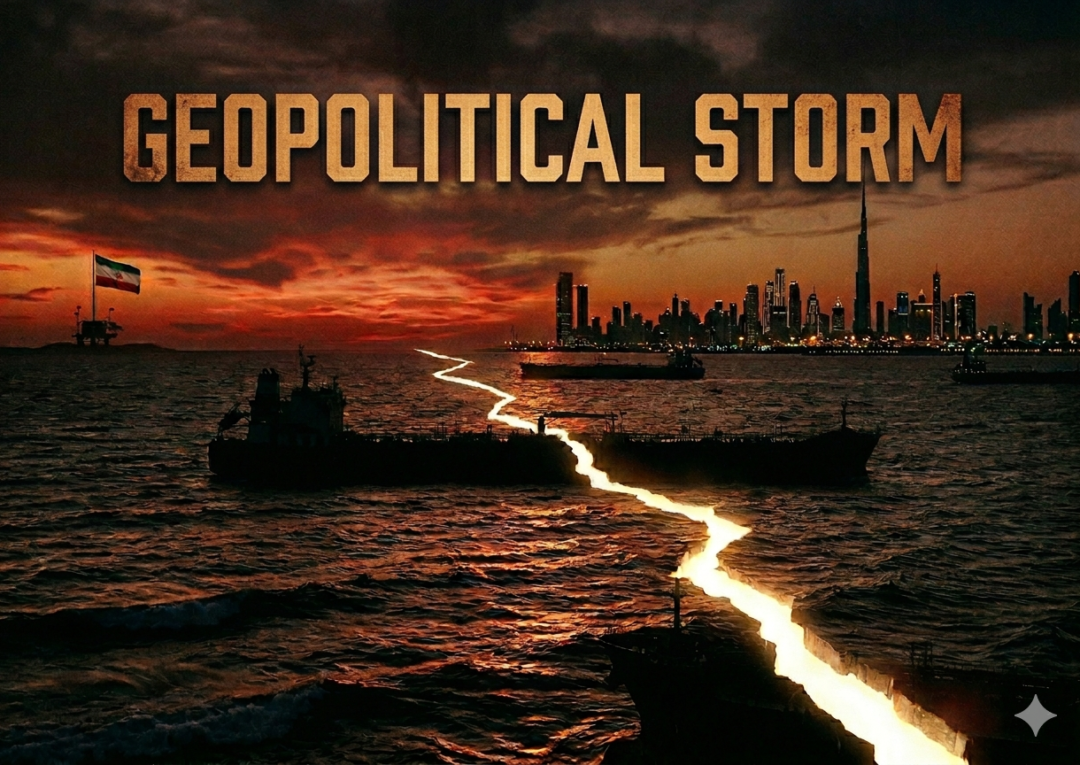
The Strait of Hormuz — a narrow waterway between Iran and the Oman coast — is the single most important maritime chokepoint in the global energy system. About 20% of the world’s oil, and a third of its liquefied natural gas (LNG), passes through this strait every day. Every day.
🌊 What the Strait of Hormuz Means in Real Numbers
- Approximately 18–20 million barrels of oil flow through it daily — making any disruption an immediate global crisis
- If the strait is blocked or even threatened, oil prices historically spike 10–25% within days of credible threat signals
- Japan, South Korea, China, India — all major economies that depend on Gulf oil — are immediately exposed to any conflict there
- In 2019, when Iranian forces seized tankers and there were attacks on Saudi oil facilities, oil prices jumped 15% in a single day
- Global shipping insurance rates for vessels in the region have already risen in early 2026 due to elevated threat perceptions
Beyond oil, the broader economic picture is concerning for several reasons. Global inflation is already elevated. Central banks in the US, Europe, and India are walking a tightrope. An energy price shock from a Middle East escalation could push inflation up, reduce consumer spending, and tip some fragile economies into recession territory.
And there’s the trade route dimension. The Red Sea — where Houthi rebels (backed by Iran) have been attacking commercial vessels since late 2023 — forces shipping companies to reroute around Africa instead. That adds 10–14 days and significant fuel costs to journeys that normally go through the Suez Canal. Consumer goods from Asia to Europe are affected. Electronics, clothing, auto parts — all of it moving through more expensive, longer routes.
Reality vs Claims — What Do Experts Say?
This is where the honest analysis gets harder. Because in geopolitics, the truth is rarely completely on one side. Let’s look at what independent analysts, academic institutions, and think tanks generally agree on — versus what remains genuinely disputed.
✅ What Is Broadly Agreed Upon
- Iran does provide material support to the Houthis in Yemen — weapons, training, and intelligence. This is not seriously disputed by credible independent analysts, UN reports, or Western intelligence assessments, even if the scale is debated.
- Iran-linked militias do operate in Iraq and Lebanon with degrees of Iranian direction and financing. Hezbollah’s relationship with Tehran, for instance, is extensively documented.
- Saudi Arabia and UAE have funded groups in various conflicts — in Libya, Syria, and Yemen — some of which have been described by critics as extremist organisations. Riyadh contests these characterisations.
- Economic sanctions on Iran are severe and have significantly reduced ordinary Iranians’ living standards — a fact acknowledged across the political spectrum, regardless of whether one supports sanctions as a policy tool.
⚠️ What Is Genuinely Contested
- Whether Gulf states actively fund internal Iranian opposition groups, or whether Iran is using this as a political narrative to deflect from domestic discontent
- The degree to which Gulf state-based financial systems knowingly facilitate flows to groups Iran describes as its enemies versus ordinary commercial activity
- Whether Iran’s nuclear programme is genuinely for energy purposes (Iran’s stated position) or weapons-development (US/Israel/Gulf position) — the honest answer is: probably both, to varying degrees
- Whether Chinese-brokered diplomatic normalisation represents genuine rapprochement or a tactical pause by both sides to buy time
What This Means for Global Stability
Here’s the scenario that keeps analysts up at night. Not the current exchanges of accusations — those have been happening for decades. What’s new is the convergence of multiple stressors at the same time.
- Iran’s nuclear programme is closer to weapons capability than at any point in its history. The IAEA has raised serious concerns. Enrichment levels have crossed thresholds that make a military nuclear option possible within a shorter timeframe than before.
- The US is distracted. American political focus on domestic issues, and the ongoing challenges of managing multiple global flashpoints simultaneously (Ukraine, Taiwan Strait, Africa), means US bandwidth for Middle East diplomacy is constrained.
- Regional militaries are better armed than ever. Saudi Arabia and UAE have spent hundreds of billions on advanced Western weapons. Iran has developed significant ballistic missile and drone capabilities. A miscalculation — an accidental incident at sea, a drone strike that hits the wrong target — could escalate faster than diplomatic channels can respond.
- Proxy conflicts are intensifying. The Houthi attacks on Red Sea shipping are not an abstract diplomatic grievance. They are a live, active military operation affecting global commerce right now.
- Public opinion within Iran is a wild card. Domestic economic pressure in Iran is immense. A government under internal pressure sometimes creates external crises to redirect public anger. That is a documented pattern in political science, and it makes the current moment harder to read.
Future Outlook: Escalation or De-escalation?
So what happens next? The honest answer is: nobody knows for certain. But we can map out the most likely trajectories based on what analysts are tracking.
📈 Scenarios for Escalation
- Iran declares it will block or threaten the Strait of Hormuz in response to new sanctions — triggering an immediate global energy crisis and likely a US military response
- A Houthi missile or drone causes significant civilian casualties in Saudi Arabia or UAE, forcing a major military retaliation that Iran feels compelled to answer
- Iran’s nuclear programme crosses a red line Israel has defined, triggering Israeli military strikes — which would almost certainly pull in Iran’s Gulf rivals and the US
- Internal collapse of the current Iranian government leads to an unpredictable nationalist military faction taking harder-line positions
📉 Scenarios for De-escalation
- A new nuclear deal or framework is negotiated — unlikely in the near term but not impossible if economic pressure on Iran intensifies further
- China deepens its economic leverage over both Iran and Gulf states and uses it to maintain stability in the region, which is in Beijing’s direct interest
- A second wave of Gulf-Iran diplomatic engagement, possibly brokered by Oman (which has historically played that role) and backed by quiet US pressure
- Domestic reformist pressure in Iran gains enough traction to push the government toward a more pragmatic foreign policy posture
Most serious analysts believe the most likely short-term outcome is continued managed tension — not all-out war, but not peace either. An uneasy, volatile middle ground where both sides test limits, global powers try to prevent escalation, and the world economy absorbs the discomfort in the form of elevated oil prices and higher shipping costs.
That’s not comfortable. But it’s the most honest assessment of where this seems to be headed.
Conflict, Diplomacy, or Something Bigger?
The Middle East has always been a region where history, religion, oil, and pride collide in ways that make simple explanations impossible. What’s happening between Iran and the Gulf nations in 2026 is not new — it is the latest chapter in a rivalry that has been building for over forty years.
But the stakes feel different now. A more capable Iranian military. A more assertive Gulf. A distracted superpower. A global economy with very little cushion left. When those four things come together, the usual patterns of escalation-and-de-escalation that have kept the peace (of a kind) in the region for decades may not hold as reliably as before.
What should you take away from all of this? That geopolitics is not a spectator sport. Oil prices, shipping costs, global inflation, and regional security decisions made in Riyadh, Tehran, Washington, and Beijing all flow directly into your economy, your household, your future.
Stay informed. Stay curious. And always look for the story behind the headline.
Situation: Active & Developing