PoK & India:
The Delimitation
Debate
Here’s a question that seems simple but goes very, very deep — what happens to a piece of land that legally belongs to you, but someone else physically holds it?
That’s the story of Pakistan-occupied Kashmir — or PoK, as India calls it. And now, layered on top of this decades-old territorial dispute, there’s a new dimension that’s getting louder by the day: the delimitation debate. Specifically, what does India’s own constitution say about PoK’s representation in its legislature — and why does that even matter?
Whether you’re preparing for UPSC, tracking geopolitical news, or just trying to understand why Kashmir keeps coming up in every policy discussion — this one’s for you. No jargon. No fluff. Just the facts, the context, and the real stakes.
First Things First — What Is PoK?
Let’s set the stage clearly, because this part is non-negotiable to understand the rest.
When British India was partitioned in 1947, the princely state of Jammu & Kashmir had a Hindu ruler — Maharaja Hari Singh. He initially wanted to remain independent. But in October 1947, Pakistani tribal militias (backed by the Pakistani army) invaded Kashmir. Cornered and desperate, Hari Singh signed the Instrument of Accession — legally making J&K a part of India.
India sent its troops. Pakistan refused to pull back. The war ended with a UN-mandated ceasefire in January 1949 — and the territory got split. The part under Indian control became Jammu & Kashmir. The part held by Pakistan became what India calls Pakistan-occupied Kashmir, or PoK. Pakistan calls it “Azad Kashmir” (Free Kashmir), which India strongly disputes.
So from India’s legal standpoint, PoK isn’t “disputed territory” — it’s Indian land under illegal occupation. That distinction matters enormously when you get to the delimitation question.
Now — What Is Delimitation?
If you’re new to this term, here’s the simplest way to understand it.
Delimitation is the process of redrawing the boundaries of electoral constituencies — deciding how many seats a legislature will have, and where exactly the boundaries of each seat will fall. It’s done periodically, usually after a census, to ensure that representation stays fair as populations shift.
Think of it like this: if one area of a state doubles its population but still has the same number of seats as it did 30 years ago, its voters are under-represented. Delimitation fixes that.
The J&K Delimitation Commission (2020–2022)
After Article 370 was abrogated in August 2019, Jammu & Kashmir was reorganized into two Union Territories — J&K (with a legislature) and Ladakh (without one). This meant the old delimitation was outdated. A new Delimitation Commission was formed in March 2020, and it submitted its final report in May 2022.
🔢 Key Numbers from the 2022 Delimitation
- Total J&K Assembly seats increased from 83 to 90
- 6 new seats added to Jammu (from 37 to 43) — a significant change that shifted political arithmetic
- 1 new seat added to Kashmir (from 46 to 47)
- 9 seats reserved for Scheduled Tribes for the first time in J&K history
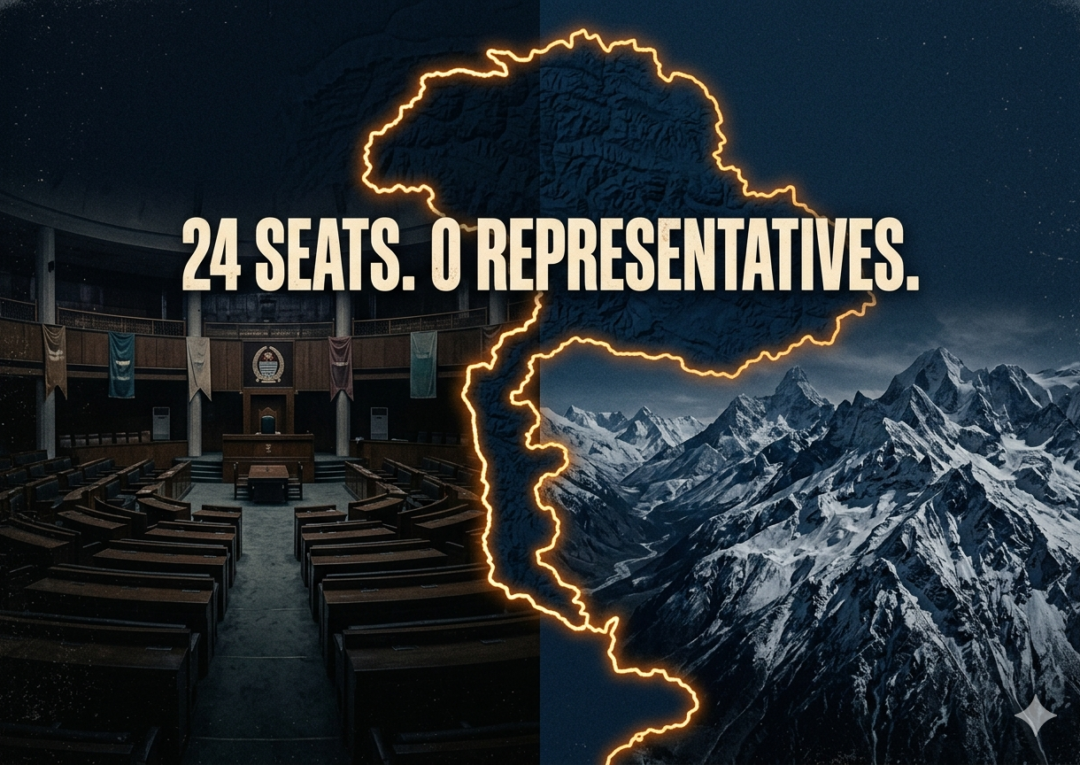
- 24 seats remain reserved for PoK — but they stay vacant, because India doesn’t control that territory
That last point is where things get really interesting.
The 24 Vacant Seats — A Constitutional Statement
Here’s something that doesn’t get talked about enough — India’s J&K legislature has 24 seats that are permanently left vacant. They exist in law. They exist on paper. But they have no elected representatives. Why?
Because those seats are reserved for the day when PoK is — in India’s view, when, not if — reunited with India. They’re not symbolic gestures. They are embedded in the constitutional structure of the J&K Reorganisation Act, 2019.
This is India saying, very quietly but very clearly: we haven’t given up. We’re just waiting.
“India doesn’t just claim PoK in speeches. It has reserved 24 seats for it in its own legislature. That’s a constitutional position, not just a political one.”
The significance of J&K’s 24 vacant seats
For UPSC aspirants in particular — this is a crucial point. The 24 seats aren’t a recent invention. They’ve existed in various forms since the J&K Constituent Assembly era. The 2022 delimitation simply retained and reaffirmed this structure under the new reorganised framework.
Why Does This Debate Matter Now?
You might wonder — if the 24 seats have existed for decades, why is there a debate at all? The answer is: because the context around them keeps changing. Let’s break down the key reasons this conversation is gaining urgency.
After the abrogation of Article 370 and the reorganisation of J&K, every aspect of the region’s governance was reset. The delimitation exercise fundamentally changed which political parties hold leverage in which regions — and the PoK seats, sitting vacant, are a standing reminder of an unresolved chapter.
In 2020, Pakistan held elections in Gilgit-Baltistan — a region India considers its own territory. India protested strongly. Pakistan’s attempt to further integrate these territories into its own constitutional framework has added urgency to India’s position on the broader PoK question.
Multiple senior Indian leaders — including Home Minister Amit Shah — have made unambiguous statements that India will “take back” PoK. These aren’t casual remarks; they’re part of a deliberate shift in how India frames the issue publicly. The delimitation of PoK seats is the constitutional backbone behind those statements.
The CPEC runs through Gilgit-Baltistan — territory India claims. India has consistently objected to CPEC as an “infringement on India’s sovereignty.” This adds an international dimension to what might otherwise seem like a bilateral India-Pakistan issue. The stakes are regional, not just local.
J&K held its first assembly elections in a decade in September–October 2024. A functioning elected government now sits in Srinagar. The 24 vacant PoK seats became part of the political conversation during the campaign season — a reminder that India’s legislature considers itself incomplete without them.
The PoK-delimitation connection appears in GS Paper II (Governance, Polity, International Relations) and Essay papers. It combines constitutional law (reorganisation acts, delimitation process), history (Instrument of Accession), and IR (India-Pakistan relations). Understanding the link between all three is what separates average answers from exceptional ones.
Key Milestones — The Timeline You Need
To really get this issue, you need the timeline. Here’s the chain of events that brought us here.
The Real Arguments on Both Sides
This is not a black-and-white issue. There are serious perspectives on what India should do about PoK — and pretending otherwise doesn’t help anyone understand it. Here are the arguments you’ll encounter in policy discussions and UPSC answers.
🟠 The Case for India’s Strong Claim
Why India’s Position Has Constitutional Teeth
- The Instrument of Accession was legally valid and unconditional — Maharaja Hari Singh signed it under the same terms every other princely state signed theirs
- UN Resolution 47 (1948) required Pakistan to withdraw its forces first as a precondition for a plebiscite — Pakistan never did, making the plebiscite option practically moot
- India’s Parliament has unanimously passed resolutions asserting that PoK is an integral part of India
- The 24 reserved seats are not symbolic — they are a structural feature of India’s constitutional framework for J&K
- Pakistan’s moves to integrate Gilgit-Baltistan into its own constitutional system violate the very UN resolutions it claims to stand behind
⚪ The Practical and Diplomatic Complications
The honest answer is that India’s claim is legally strong but practically complex. The 24 seats reflect that legal strength. What happens next is where political will, diplomacy, and strategic calculus have to take over from constitutional text.
“A claim is only as strong as the will to back it. India has the constitutional foundation. The question is always — what comes next?”
The heart of the PoK policy debate
The UPSC Angle — What You Must Know
If you’re a UPSC aspirant, here’s how to think about this topic across different papers.
- GS Paper II (Polity & Governance): The Delimitation Commission’s powers, process, and legal basis. The J&K Reorganisation Act 2019. Why the 24 seats exist and what they imply constitutionally. The difference between delimitation and reorganisation.
- GS Paper II (International Relations): India-Pakistan relations. The Simla Agreement and its implications. India’s stand on PoK at the UN. How CPEC through Gilgit-Baltistan affects India’s strategic interests.
- GS Paper I (Modern History): Partition and the accession of princely states. The First Kashmir War (1947–48). The role of Sardar Patel and V.P. Menon in the integration of states.
- Essay Paper: Topics like “Unresolved borders and national integrity,” “Territorial claims and diplomacy in South Asia,” or “Constitutional provisions as instruments of foreign policy” all connect to this subject.
- Answer Writing Tip: When writing about PoK, always anchor your answer in the legal framework first (Instrument of Accession, Reorganisation Act), then move to diplomatic and strategic dimensions. This shows the examiner you understand the issue at multiple levels — not just as a news headline.
What Comes Next? The Road Ahead
Honestly, nobody has a simple answer to this. And that’s precisely what makes it such a rich topic for analysis.
The short-term reality is that PoK remains under Pakistani control, and there’s no imminent military or diplomatic resolution in sight. But the medium-to-long-term dynamics are worth watching closely.
🔸 Internal Dynamics in PoK
There’s growing discontent in PoK itself — not necessarily pro-India sentiment, but dissatisfaction with Pakistani governance. Economic underdevelopment, lack of political rights, and the perception that resources are extracted without local benefit have fuelled protests over the years. This is not a uniformly “settled” population.
🔸 India’s Strategic Signalling
India’s rhetoric has hardened noticeably since 2019. Parliamentary statements, military exercises near the Line of Control, and the abrogation of Article 370 itself all signal that India does not consider the status quo permanent. Whether this translates into policy action is a different question — but the direction is unmistakable.
🔸 The CPEC Factor
As China deepens its investment in the CPEC corridor through Gilgit-Baltistan, India faces a compounding challenge — not just a Pakistan problem, but a China-Pakistan alignment problem. This changes the strategic calculus significantly and will continue to shape India’s approach.
🧭 Three Scenarios Worth Thinking About
- Status quo continues: The most likely short-term scenario. The 24 seats stay vacant. India maintains its claim diplomatically. PoK remains under Pakistani administration.
- Diplomatic breakthrough: Unlikely in the current environment, but not impossible. Some form of bilateral dialogue that addresses the territory question — short of full integration either way.
- Gradual integration signals: India continues strengthening governance, connectivity, and development in the J&K UT — making the contrast with PoK sharper and potentially influencing cross-border sentiment over time.
The delimitation debate, in this sense, is not just about drawing electoral lines. It’s about how India signals its intentions — to its own citizens, to Pakistan, and to the international community.
A Claim Written In Law,
A Question Still Open
PoK is one of those issues that looks simple from the outside — “it’s disputed land, complicated history” — until you actually start reading the legal documents, the UN resolutions, the Instrument of Accession, and the J&K Reorganisation Act.
Then you realise it’s not simple at all. India’s claim is legally coherent, constitutionally embedded, and backed by parliamentary consensus spanning decades. The 24 vacant seats in the J&K Assembly aren’t an oversight or a symbolic gesture — they are India’s formal, structural refusal to accept the current situation as permanent.
But legal strength and on-ground reality are two different things. The gap between them is exactly where policy has to live. And that gap — the distance between what India’s constitution says and what the map currently shows — is the real subject of the delimitation debate.
The 24 seats will stay vacant until something changes. When and how that change comes — that’s the question that will define South Asian geopolitics for the next generation.
Unresolved Since 1947
Constitutionally Embedded