⚡ Auto & EV | May 2026
Tata Sierra
EV:
Electrifying
the Legend.
If you grew up in India in the 90s, you know the feeling. That boxy silhouette pulling into a dusty lane, the distinctive wraparound rear glass catching the afternoon sun. The original Tata Sierra wasn’t just a car — it was a statement. India had never seen anything quite like it.
Now Tata Motors is bringing that name back. But this time, it’s carrying an entirely different kind of power under the hood — electric. The Tata Sierra EV is Tata’s boldest bet yet: a fusion of 30-year-old nostalgia and next-generation EV technology, aimed squarely at a market that’s finally ready for it.
Whether you’re a die-hard Sierra loyalist, an EV early adopter, or simply someone watching the Indian auto space closely — this one deserves your full attention.
Why the Sierra Name Still Carries Weight
Let’s be honest — most car revivals are just brand nostalgia dressed up as innovation. They slap an old name on a new body and hope the sentiment does the selling. Tata knows this risk better than anyone.
But the original Sierra earned its reputation the hard way. Launched in 1991, it was India’s first monocoque body SUV — genuinely ahead of its time. That three-door layout, the rear panoramic glass, the elevated driving position — it stood out on roads that hadn’t seen anything remotely like it. It wasn’t perfect, but it was distinctive. And in the auto world, distinctive is everything.
The market has changed dramatically too. India’s EV penetration, while still single-digit overall, is accelerating in the premium SUV space — exactly where the Sierra EV is positioned. Tata already owns the narrative in affordable EVs with Nexon and Tiago. Sierra is their play for the upper tier.
The Design: Retro Soul, Modern Bones
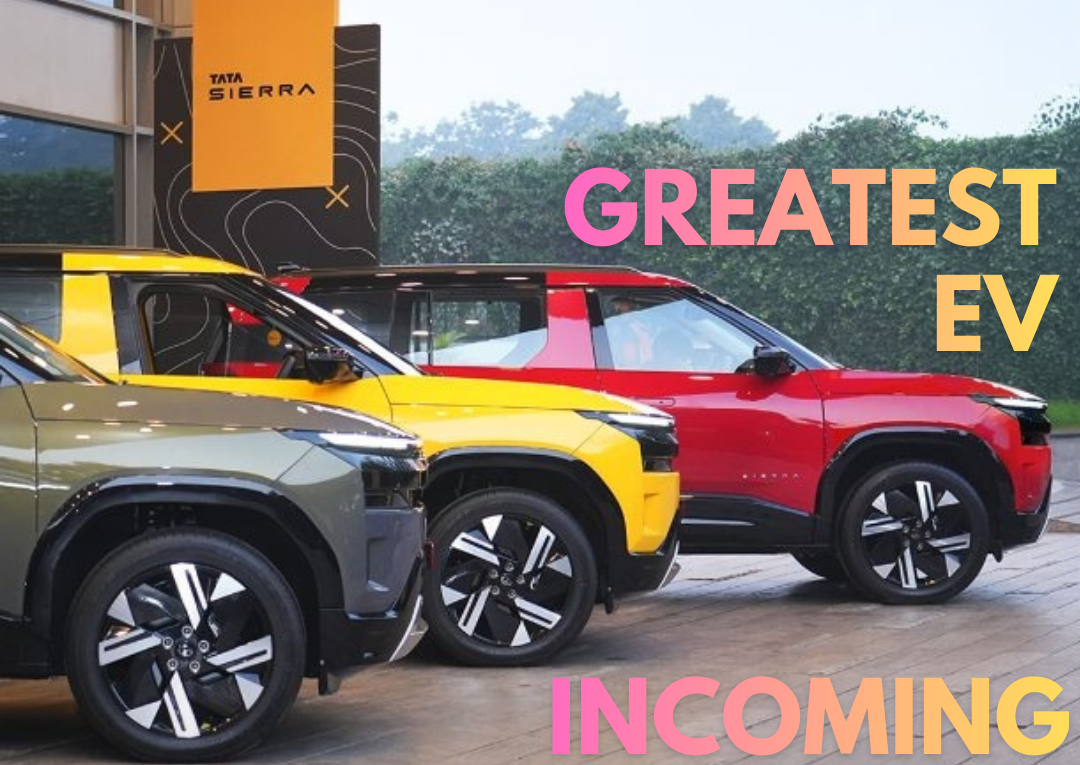
Walk around the Sierra EV and you immediately feel the tension — in the best possible way. Tata’s designers have done something genuinely difficult: they’ve made it feel new and familiar at the same time.
The silhouette nods hard to the original. The upright stance is there. The distinctive roofline is there. But everything is cleaned up, sharpened, and given a contemporary edge that makes it look at home next to a Hyundai Ioniq 5 or Mahindra BE 6e.
The rear? That’s where the nostalgia really hits. Tata has reinterpreted the iconic wraparound rear glass — one of the most recognizable design elements of the original — and brought it into 2025. It doesn’t look like a tribute. It looks like an evolution.
The wraparound rear quarter glass that made the original Sierra unmistakable is back — reinterpreted for a modern fastback profile. It’s the kind of detail that rewards people who know the history, while looking completely fresh to those who don’t.
The front fascia features a full-width illuminated light bar — a design language Tata is pushing across its premium lineup. It gives the Sierra EV a commanding, assertive presence at night that the original simply couldn’t achieve.
Where most EVs go sleek and aerodynamically conservative, the Sierra EV deliberately stays tall and boxy-ish. It’s a confidence move — saying we don’t need to chase range by compromising character.
Tata is offering dual-tone options that accentuate the Sierra’s distinct roof profile. These aren’t afterthoughts — they’re designed to reinforce the sculptural quality of the body, especially when viewed from behind.
Inside, it’s a significant step up from anything Tata has done before — a panoramic sunroof, a horizontally oriented dashboard, large touch screens, and a floating centre console. The cabin aims at the same buyers considering a Jeep Meridian or Compass.
“It doesn’t look like a tribute. It looks like what the Sierra would have become if it never stopped evolving.”
Auto Design Perspective — 2025
The Tech: What’s Under the Shell
Design gets people through the door. Technology is what keeps them there — and closes the deal. Here’s where the Sierra EV makes its serious case.
Tata has built the Sierra EV on its acti.ev platform — the same architecture underpinning the Curvv EV and the next generation of Tata electrics. This isn’t a converted ICE platform with a battery shoved in. It’s a ground-up EV architecture, which means the engineers had actual freedom in how they packaged the battery, motors, and cabin space.
⚡ Sierra EV — Technical Highlights
- Battery: ~60 kWh pack (larger variant expected), with cell chemistry optimised for Indian temperature ranges — a detail that matters more than most buyers realise.
- Range: Claimed ~450 km under standard test conditions. Real-world highway range on Indian roads is likely to be in the 360–400 km range — still class-competitive.
- Charging: DC fast charging support up to 150 kW means you’re looking at roughly 30–35 minutes from 10–80% on a fast charger. AC charging at 7.2 kW for home use.
- Powertrain: Single motor RWD configuration as standard; AWD dual-motor variant expected in the lineup for performance buyers.
- V2L (Vehicle to Load): One of the more practical inclusions — the Sierra EV can power external devices and appliances, making it genuinely useful in a power-cut-prone country like India.
- ADAS: Tata is pushing Level 2 ADAS features — adaptive cruise, lane keep assist, auto emergency braking — into the Sierra to compete with the Hyundai Creta EV’s feature set.
- OTA Updates: Software-driven feature additions over the air — a first for Tata at this price point.
The Journey Back: A Timeline
How It Stacks Up Against the Competition
The Sierra EV doesn’t exist in a vacuum. This is one of the most competitive segments in Indian EVs right now — and the Sierra will have to earn every sale.
Direct Competitors
- Hyundai Creta EV (~₹17–23 lakh): The current benchmark. Hyundai’s brand trust, ADAS suite, and 473 km claimed range have made it the default choice for EV converts. Sierra will need to beat it on character, not just specs.
- Mahindra BE 6e / XEV 9e: Mahindra’s aggressive EV push with INGLO platform-based products — striking design, strong performance numbers, and a pricing that challenges everyone. Sierra’s direct counter needs to be emotional resonance + tech parity.
- MG ZS EV (2025 edition): Value play with feature loading. Not the same emotional market, but competes on price-per-feature for practical buyers.
- BYD Atto 3: The range and charging speed benchmark. Chinese competition that Tata has to take seriously as BYD deepens its India presence.
Where the Sierra Has to Prove Itself
- Real-world range consistency: Indian summers are brutal on battery performance. Tata’s claimed range needs to hold up in 45-degree conditions before buyers trust it fully.
- Service network depth: As the Sierra moves into Tier 2 and Tier 3 cities, Tata’s EV service infrastructure needs to match its product ambition.
- Software maturity: OTA updates are only useful if the underlying software is stable. Tata’s earlier EVs had some early-adopter issues that the brand needs to have resolved by now.
What It Means for India’s EV Story
The Sierra EV isn’t just a product launch. It’s a signal about where the Indian auto industry is headed — and how fast.
Five years ago, “premium Indian EV” sounded like an oxymoron. Today, Tata, Mahindra, and increasingly others are building genuinely competitive products that don’t ask buyers to compromise on design, technology, or status. That’s a fundamental shift in what Indian manufacturing can deliver.
The Sierra EV specifically matters for a few reasons beyond its own segment:
- It normalises premium Indian EVs: When an aspirational, emotionally resonant nameplate goes electric, it shifts the perception that EVs are only for practical, value-conscious buyers. The Sierra says EVs can be desirable.
- It tests Tata’s upper-end ambitions: Tata’s Avinya concept hints at a ₹30–40 lakh EV future. The Sierra EV at its expected ₹25–30 lakh bracket is the stepping stone that validates whether buyers will pay that premium for a Tata badge.
- It builds the charging confidence narrative: Every Sierra EV sold is a buyer choosing to live with fast-charging infrastructure. As the buyer base grows, pressure on charging network buildout increases — a virtuous cycle the entire EV ecosystem benefits from.
Should You Actually Buy One?
Let’s cut through the enthusiasm for a second and talk practically. The Sierra EV is genuinely exciting — but it’s not right for everyone.
Buy It If:
- You have access to home charging (even a basic 15A socket works, though a 7.2 kW wallbox is better). The ownership experience is dramatically smoother when you start every day with a “full tank.”
- You’re in a metro or large city with a decent fast-charger network. TATA Power, Zeon, Statiq, and others are building fast — but Tier 2 and beyond still needs work.
- The 90% of your driving is within the real-world range comfort zone (~350 km). Long highway trips are manageable with planning, but they require a different mindset than petrol.
- The design and the story genuinely matter to you. You’ll be paying a small premium over a purely rational spec comparison with Korean competition — that premium has to make emotional sense.
Wait If:
- You’re in a Tier 3 city or rural area without reliable home charging and minimal public infrastructure. The Sierra EV, like all premium EVs, rewards charging infrastructure access.
- You frequently drive 400+ km in a single day. This is niche, but it’s real. Until charging stops become as quick and reliable as petrol pumps, long-haul heavy users have a genuine inconvenience to manage.
- You’re torn between this and the AWD Mahindra offerings on pure performance grounds. Wait for Tata’s AWD dual-motor variant — expected to come post initial launch.
Final Thought:
The Legend Deserves the Charge.
But here’s what’s different this time: the product is genuinely good. The design is distinctive without being derivative. The technology is competitive. The platform is modern. And the name still carries real weight with a demographic that is now in their 40s and 50s — with the income to buy what they always remembered.
Whether the Sierra EV becomes a sales phenomenon or a beloved niche product, it represents something important: proof that Indian brands can build emotionally resonant, technologically serious EVs that don’t ask you to apologise for buying local.
The original Sierra was ahead of its time. The Sierra EV might just be right on time.
Auto Analysis — May 2026