🗳️ BREAKING — Election Results | 4 May 2026
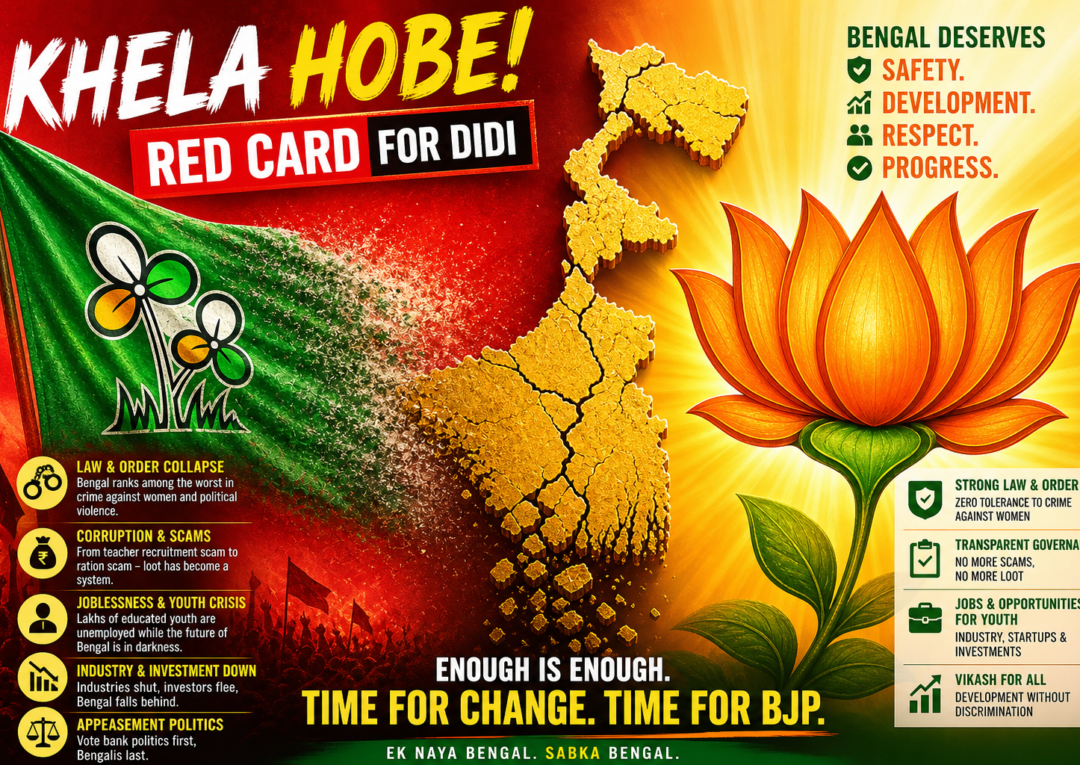
KHELA HOBE!
BJP
Wins Bengal.
They said it wouldn’t happen. Analysts had their caveats. Political veterans said Mamata Banerjee had seen worse and survived. Even some BJP insiders quietly admitted that the booth machine was still formidable. They were all wrong.
On 4 May 2026 — counting day — West Bengal delivered its most stunning electoral verdict in a generation. The BJP crossed the majority mark of 148 seats comfortably, ending Mamata Banerjee’s 15-year unbroken grip on the state. The woman who had introduced the country to the battle cry “khela hobe” — let the game begin — found herself on the wrong side of history. The game is over. And she lost it.
What makes this result remarkable isn’t just the seat count. It’s the context. Mamata had defeated the BJP’s most aggressive national campaign in 2021, winning 213 seats and becoming a symbol of regional defiance. Five years later, the same state gave a majority to the same BJP. Something fundamental changed in Bengal between 2021 and 2026 — and this piece is the complete story of what that was.
Whether you’re a first-time political reader or a seasoned observer, this breakdown covers everything — the numbers, the turning points, the vote bank shifts, the reasons, and what happens next for one of India’s most politically important states.
What Happened on Counting Day
By 10 AM on 4 May, it was already clear this wasn’t going to be a close result. Early trends placed BJP ahead in 167 constituencies — well past the 148 halfway mark. By noon, the number had crossed 180. By mid-afternoon, the tally was approaching 200. The BJP hadn’t just won. It had won convincingly.
The vote share told the story most cleanly. BJP finished at 45.13% versus TMC’s 40.97%. On paper, that’s a gap of just over 4 points. But in a first-past-the-post system where hundreds of individual constituencies are decided by narrow margins, a uniform 4-point swing cascades across the seat map with devastating effect. TMC didn’t just lose — it was wiped out in belt after belt where it had comfortably won just five years ago.
The voter turnout had already signalled something unusual even before results day. At 92.93%, this was the highest turnout ever recorded in a West Bengal assembly election — higher even than the 2011 election that ended 34 years of Left rule and brought Mamata to power for the first time. High turnout in a state with visible anti-incumbency sentiment is never good news for the sitting government. When voters who normally stay home start showing up, they’re usually not showing up to endorse the status quo.
The Five-Year Road That Led Here
Elections are decided long before counting day. They’re decided in the months and years of small decisions, quiet failures, public outrages, and eroding trust that accumulate over time. Here is the sequence that set this result up — and why each moment mattered more than it seemed at the time.
How the Vote Actually Split
A result this large doesn’t come from one community voting differently. It comes from multiple groups shifting simultaneously — some dramatically, some just enough at the margins to flip close seats. Here’s the community-level breakdown of what actually happened.
Historically TMC’s most reliable bloc — but the deletion of roughly 9 million voters from the rolls, with 65% of unresolved cases being Muslim, likely meant that a significant portion of TMC loyalists simply couldn’t vote. Add to this the Left-Congress-ISF alliance managing to peel away a section of minority votes in Murshidabad, Malda, and parts of South Bengal — and you have TMC’s bedrock vote bank delivering at meaningfully lower volumes than 2021.
Lakshmir Bhandar — Mamata’s direct cash transfer scheme for women — was supposed to be the lock on this group. And it held in some areas. But post-RG Kar and Sandeshkhali, a significant section of urban and semi-urban women — particularly educated, employed women in towns and cities — voted against TMC. The group that anchored TMC’s dominance in 2016 and 2021 fractured silently. Enough to matter in dozens of close constituencies.
Kolkata’s satellite towns, educated professionals, and the middle class that participated in RG Kar protests voted heavily against TMC. These voters rarely take to the streets. But they vote — and they voted. Constituencies in Howrah, South Kolkata, parts of Hooghly, and Nadia swung sharply saffron. This was the “quiet vote” — people who post on Instagram about injustice and then actually show up at the booth.
Cooch Behar, Alipurduar, Jalpaiguri — this has been BJP territory for several cycles now. They swept these seats as expected, building an early lead cushion that gave the party room to fight closer battles in Central Bengal. The tribal and hill constituencies also largely stayed saffron, depriving TMC of the geographic diversity it needed to offset losses elsewhere.
This is where analysts got it most wrong. Welfare schemes were supposed to be impenetrable in villages. And they held in some belts. But in others — particularly in the industrial belt around Howrah and Hooghly, and in rural areas with high youth unemployment — the accumulated frustration finally converted to booth-level action. The “cut money” resentment, first publicly aired in 2019, had never really gone away. In 2026, it went to the ballot box.
The Left-Congress alliance likely won far fewer seats than their vote share warranted — a classic first-past-the-post outcome. But in dozens of constituencies, their presence split the anti-BJP vote, allowing TMC to hold on. Simultaneously, in many seats where Left-Congress ran competitive campaigns, their voters strategically shifted to BJP — the more viable anti-TMC option. It’s possible the alliance unintentionally accelerated TMC’s defeat in key constituencies.
“4 May, Didi Gayi — the headline even BJP didn’t dare write six months ago.”
India TV News — Election Results Live, 4 May 2026
The Real Reasons BJP Won This Big
A result of this scale doesn’t emerge from a single cause. It’s always a convergence — multiple pressure lines cracking simultaneously. Here’s the honest breakdown of what actually drove this outcome.
🔑 Why BJP Won — The Complete Breakdown
- Hindu Consolidation at Unprecedented Scale: Suvendu Adhikari himself described the result as a product of “Hindu consolidation.” This was BJP’s deliberate strategic frame — and it delivered at a scale never seen in Bengal before. Cross-caste Hindu voting solidarity, combined with the voter roll reductions affecting the minority electorate, created a structural arithmetic advantage that no amount of welfare spending could overcome. This is the single largest factor in the result.
- RG Kar Was a Wound That Never Healed: The trainee doctor’s murder at RG Kar Medical College was not just a crime story — it became a symbol. A symbol of institutional failure, of a government that prioritised protecting its image over protecting its citizens, of the specific vulnerability of women inside a system that was supposed to serve them. Mamata never fully recovered her moral authority after August 2024. By election day 2026, it had been 20 months — and the memory hadn’t faded.
- Fifteen Years of Accumulated Fatigue: This is the factor that’s hardest to measure but most politically significant. No government — however good — survives 15 years without a layer of the electorate simply wanting change. In Bengal’s case, the fatigue wasn’t just emotional. It was structural. Jobs hadn’t come. Industrial investment hadn’t materialised. Corruption at the local panchayat and municipality level had become so normalised it had its own slang: “cut money.” That accumulation doesn’t show up in any single poll or survey. It shows up on counting day.
- The Modi-Shah Machinery — Better Calibrated This Time: Unlike 2021, where BJP’s campaign felt externally imposed and culturally tone-deaf in places, the 2026 campaign was more tightly coordinated with ground realities. The messaging — built around governance failures, women’s safety, and a promise of direct development investment — was more targeted. Modi and Amit Shah’s rally schedule was denser and more strategic. And the contrast with 2021’s overreach made this campaign feel, paradoxically, more credible.
- Suvendu Adhikari — The Ultimate Inside Advantage: You can’t overstate what it means to have a leader who built TMC’s booth-management infrastructure for over a decade. Suvendu knew where the weaknesses were. He knew which local leaders were unhappy. He knew which booths were vulnerable. His defection in 2020 was painful for TMC; by 2026, it proved fatal. Having someone who understands your opponent’s machine from the inside is an advantage that campaign spending cannot replicate.
- The 92.93% Turnout Was the Signal: When turnout breaks historical records in an election characterised by anti-incumbency sentiment, the surplus votes — the voters who showed up specifically because something motivated them to — almost never break for the sitting government. In Bengal’s case, that means tens of thousands of additional voters per constituency, in a state where many seats are decided by fewer than 5,000 votes. The math was already pointing to a BJP surge before a single result was declared.
What Happens Now — Bengal’s Next Chapter
Results day is always only the beginning of the real political story. Here’s what the next chapter looks like for each of the key players.
For Mamata Banerjee — Political Near-Death, Not Political Death
Mamata Banerjee is not the kind of politician who retires quietly after a loss. She built TMC from scratch, defeated 34 years of Left rule, and twice repelled BJP at its most aggressive. A leader with that track record doesn’t simply walk away. Expect her to challenge the results legally, rebuild the TMC organisation from the opposition benches, and position herself as the voice of resistance against a BJP government in Kolkata.
But the road back is genuinely steep. She may have lost her own seat. Her party’s grassroots cadre — which in many areas was built on access to local power and resources — will face significant defections now that it’s out of government. And the narrative of invincibility that sustained her through 2016 and 2021 is now broken. Whether she makes it back in 2031 is a genuinely open question — not a foregone conclusion either way.
For BJP — The Governance Test Begins Immediately
- Inheriting a complex state: Bengal has layered welfare dependencies, an administration that has been TMC-aligned for 15 years, and a fractured police force. Delivering on the promises of jobs, safety, and institutional reform won’t happen in the first six months. The question is whether BJP governs or merely administers.
- Post-poll violence watch: Bengal’s transitions of power have historically been accompanied by targeted violence against the losing party’s workers. BJP has already flagged concerns for its own members’ safety during the transition. Central forces will need to stay deployed carefully. The optics of the first weeks matter enormously.
- Suvendu as Chief Minister: He is the most likely pick. Capable, experienced, and deeply familiar with Bengal’s political structure. But governing a state is different from campaigning in one — and his relationship with PM Modi’s central government will define the texture of what Bengal gets in the next five years.
For the Left-Congress Alliance — A Complicated Post-Mortem
The Left-Congress alliance’s seat tally will likely disappoint relative to their vote share — a structural outcome in a polarised election. They may find themselves being blamed by TMC for splitting the anti-BJP vote in certain constituencies, and simultaneously credited by BJP analysts for contributing to TMC’s collapse in others. Neither narrative is entirely true or false. Their 2024 Lok Sabha momentum in Bengal has stalled — and the internal debate about strategy will be fierce.
Final Read:
Khela Shesh.
A New Bengal Begins.
Fifteen years is a long time to run any state. And Mamata built something remarkable in those fifteen years — a political machine of genuine sophistication, a welfare architecture that reached crores of voters directly, and a personal brand that made her one of the most formidable regional leaders in Indian politics. That should be acknowledged honestly, even in the context of a historic defeat.
But fifteen years is also a long time for trust to erode. For local power to corrupt. For grievances to accumulate without outlet. For the electorate to wonder whether things can be different. Bengal’s voters answered that question clearly on 4 May — and in doing so, they rewrote India’s political map in a single day.
The real story of 2026 isn’t Mamata’s defeat. It’s what comes after. Can BJP actually govern this complicated, historically exceptional state — or will it settle for the symbolism of having won it? Can Mamata rebuild from the ruins — or has the electorate made a more permanent judgment? And can Bengal, which has always been politically exceptional, find a new equilibrium that serves its people better than the last fifteen years did? Those answers will take five years to write. Counting started today.
Breaking Results — 4 May 2026