📊 Market Intelligence | May 2026
West Asia
Under Pressure:
The Era of Strategic Change
Here’s a phrase your fund manager might start using more often: force majeure. It’s a legal term — literally “superior force” in French — that companies use to say a contract can’t be fulfilled because of something extraordinary and unforeseeable. A natural disaster. A war. A blockade. An act of God.
The 2026 stock market has been navigating exactly this kind of environment. West Asia tensions — escalating through late 2025 and into 2026 — have introduced a category of risk that traditional financial models weren’t built to price cleanly. And that creates both danger and opportunity, depending entirely on how you’re positioned.
This isn’t just an oil story. It’s a story about how geopolitical shock reshapes everything — supply chains, energy costs, defense spending, safe haven flows, and the way professional investors think about “black swan” scenarios that suddenly don’t feel so rare anymore.
What “Force Majeure” Actually Means for Markets
In legal contracts, force majeure is a clause that essentially says: if something completely beyond our control happens, the obligation is suspended or cancelled. Shipping companies use it. Energy suppliers use it. Defence contractors use it.
But in the market context, force majeure risk is something different — it’s the pricing of the unknown. It’s what happens when investors realize that an event isn’t just volatile, it’s genuinely unpredictable in scope and duration. And that’s exactly what West Asia tensions have introduced into 2026 markets.
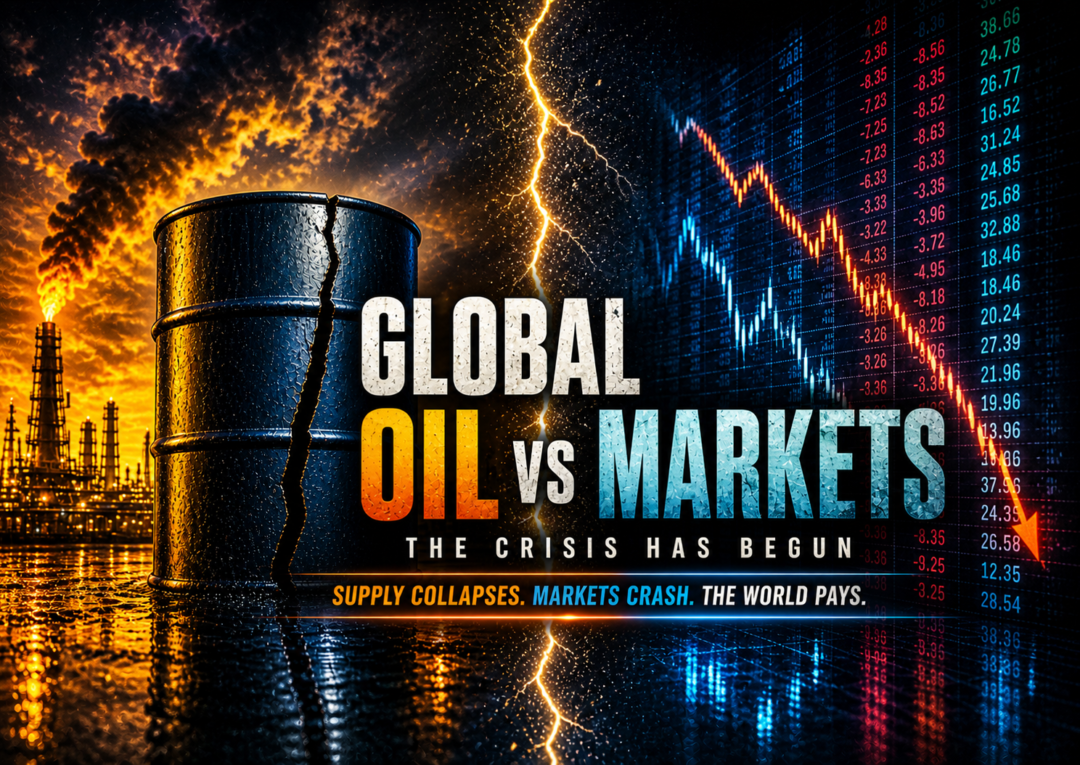
The Strait of Hormuz — through which roughly 20% of the world’s oil passes — sits at the center of this risk calculus. Any meaningful disruption there doesn’t just spike oil prices. It cascades: shipping costs rise, inflation rebounds, central banks reconsider rate paths, and equity valuations compress. It’s a chain reaction, and every link matters.
Why This Cycle Is Different from 2022 or 2003
In 2003, the Iraq War sent oil briefly higher but markets recovered quickly because the conflict was geographically bounded and U.S. strategic control was assumed. In 2022, the Russia-Ukraine war sent energy prices surging — but Europe was the primary exposure, not the global energy transit system.
2026 is structurally different. The Red Sea disruptions have already rerouted significant shipping volume. Insurance premiums for tankers operating in certain Gulf corridors have surged. And critically — this is happening against a backdrop where global oil inventories are already lean after years of underinvestment in new production capacity.
How Markets Are Actually Responding
Let’s be specific. Because the market response to West Asia tensions in 2026 isn’t uniform — it’s bifurcated. Some sectors are getting crushed. Others are quietly posting the best returns of the decade. Understanding the split is where professional strategy lives.
Integrated oil majors and upstream E&P companies have been among the strongest performers. Brent in the $90–100 range turns marginal projects into highly profitable ones. Companies with Gulf-adjacent operations and locked-in long-term supply contracts are printing cash. Not a surprise — but the magnitude is notable.
Global defense stocks have been on a near-vertical trajectory. NATO rearmament, Gulf state procurement, Israeli defense budget expansion, and U.S. military aid flows have all driven order books for Lockheed, Raytheon, BAE Systems, and their tier-2 suppliers. The Indian defense sector — HAL, BEL, Bharat Forge — has also benefited from accelerated procurement timelines.
Gold is near all-time highs. Swiss franc and Japanese yen have seen safe haven demand despite Japan’s own monetary complexities. U.S. Treasuries have had a complicated story — geopolitical demand pulling yields down, while sticky inflation pulls them up. Net result: more volatility in the “safe” asset than many professionals expected.
Airlines with significant Middle East routes and logistics companies rerouting cargo around the Red Sea have faced meaningful margin pressure. Maersk and Hapag-Lloyd have both flagged increased costs from longer Cape of Good Hope routing. The compounding effect on just-in-time supply chains is becoming a genuine operational issue.
Large-cap tech has been somewhat insulated due to low direct commodity exposure. But semiconductor supply chains with Gulf-adjacent logistics, and the broader rate environment effect (oil → inflation → rates → growth multiples compress) creates indirect pressure. This is where a lot of the valuation debate is concentrated in 2026.
India imports ~85% of its crude oil. Higher oil is directly inflationary — it widens the current account deficit and pressures the rupee. But India’s domestic demand story remains intact, its defense sector is booming, and its diplomatic positioning — maintaining ties with both Gulf states and Western allies — has given it unusual flexibility. Nifty has shown resilience despite the macro headwind.
“The market isn’t afraid of the war. It’s afraid of not knowing where the ceiling is.”
Geopolitical Risk Desk — May 2026 Perspective
The Strategic Frameworks Professionals Are Using
When force majeure risk is elevated, conventional portfolio construction needs adjustment. Here are the frameworks that serious investors are actually applying — not the generic “buy gold, avoid risk” advice you’ll find in mainstream financial media.
🔑 Core Professional Frameworks — 2026 Geopolitical Risk
- Scenario-Weighted Positioning: Rather than making binary calls (conflict escalates / de-escalates), experienced fund managers are holding positions that perform across a range of scenarios. This typically means partial exposure to energy upside, partial safe-haven allocation, and careful hedging on the tail scenarios. It’s less about predicting the outcome and more about surviving any of them.
- The Oil-Inflation-Rate Linkage: Every $10 rise in sustained Brent crude adds roughly 0.3–0.5% to headline CPI in major economies. In 2026, with central banks still in a delicate post-tightening phase, that’s not trivial. The professional read isn’t just “buy oil stocks” — it’s modelling how persistent oil pressure changes the rate trajectory and what that does to duration-sensitive assets.
- Choke-Point Premium: The Strait of Hormuz premium is real and quantifiable. Options market pricing on energy futures, shipping insurance rates, and tanker charter rates all embed a “disruption probability” that you can actually read. Sophisticated desks use these as leading indicators of market stress before it shows up in equity prices.
- Supply Chain Re-mapping: The companies that win in a sustained disruption aren’t always the obvious ones. Logistics companies with alternative routing capacity, pipeline operators with overland routes, LNG terminal operators positioned outside conflict zones — these are the picks that require deeper analysis but carry differentiated returns.
- Currency Hedge Prioritisation: For emerging market allocators — particularly those with India, Turkey, or Egypt exposure — currency hedging has become more expensive and more essential simultaneously. The professional calculus now includes hedging cost as a core component of expected return, not an afterthought.
- Liquidity Buffer Sizing: Force majeure events can create sudden, violent liquidity events — not because of fundamentals, but because of forced selling as margin calls, redemptions, or risk-limit breaches cascade. Holding more liquidity than normal isn’t being cautious — it’s being positioned to buy when others can’t.
The Escalation Timeline — What’s Already Happened
Context matters for risk assessment. Here’s the sequence of events that has shaped the current market environment.
What Professionals Should Actually Do Now
Generic advice is useless in a force majeure environment. Here’s specific, actionable thinking for different professional contexts.
For Equity Portfolio Managers
- Tilt — don’t pivot — toward energy: A full rotation into energy is a directional bet, not a hedge. A tilt — moving energy from underweight to neutral or slight overweight — captures upside without concentration risk if oil reverses on a diplomatic breakthrough.
- Defense as structural, not cyclical: The rearmament cycle triggered by 2022–2026 events is a decade-long trend, not a trade. Defense allocation should be sized accordingly — not as a geopolitical hedge but as a secular growth position.
- Avoid airlines and cruise companies as “cheap” plays: Fuel cost pressure plus potential demand hit from instability makes these value traps in the current environment. The cheap multiple is deserved.
- Screen for pricing power: Companies that can pass through input cost increases — particularly in the energy, industrials, and materials space — are structurally advantaged. Those with fixed-price contracts are structurally exposed.
For Fixed Income Professionals
- Short duration bias: With oil-driven inflation persistence, central banks have less room to cut than the consensus expected 12 months ago. Locking into long duration now means absorbing that reset.
- Inflation-linked bonds deserve a second look: TIPS (U.S.) and similar instruments in other markets are real hedges against the oil-inflation linkage — not just as a trading position but as a portfolio insurance mechanism.
- Gulf sovereign credit — nuanced: Gulf states with diversified revenue streams and strong reserves (UAE, Saudi Arabia) are actually credit-strengthened by high oil. But regional contagion risk means spreads can blow out on headline risk regardless of fundamentals.
For Indian Market Participants
- Hedge currency exposure on U.S.-denominated positions: A weaker rupee from current account pressure is the most direct market transmission mechanism for India. Dollar-hedged returns matter more than they did two years ago.
- Indian defence and aerospace — structural opportunity: HAL, BEL, Mazagon Dock, and the broader indigenisation pipeline benefit from both domestic procurement acceleration and export opportunity to Gulf markets. This is a multi-year theme, not a 2026 trade.
- Watch OMC margins carefully: IOCL, BPCL, HPCL face the perennial refinement margin squeeze when crude is high and retail fuel prices face political resistance to full passthrough. These are period-specific headwinds, not structural damage — but the timing matters for entry points.
The Scenarios Worth Modelling
Any professional stress-testing framework right now should at minimum model three scenarios, not two.
- Contained Escalation (Base Case ~50% probability): Tensions remain elevated but full-scale Hormuz disruption is avoided. Oil trades $85–100, inflation stays sticky but manageable, markets grind with elevated volatility. Defense and energy outperform, rest of market rangebound.
- Diplomatic Breakthrough (~25% probability): Backchannel agreements or U.S.-brokered ceasefire leads to meaningful de-escalation. Oil falls sharply to $70s range. Relief rally in equities broadly, sharp reversal in recent energy and defense gains. Bond yields fall. Classic “buy the rumour, sell the fact” setup.
- Escalation / Hormuz Disruption (~25% probability): Any meaningful closure or serious disruption of Hormuz oil transit. Oil spikes to $120+, global recession risk repriced sharply, equity markets see 15–25% correction, central banks face impossible stagflation tradeoff. Safe havens surge. This is the tail risk that should be hedged, not the base case.
Final Read:
The Shield Doesn’t Protect Everything.
What you do get is the chance to be better positioned than the crowd — to have thought through the scenarios before they play out, to hold the hedges before they’re expensive, and to identify the opportunities that emerge when others are reacting rather than executing.
West Asia tensions have made the 2026 market environment genuinely harder to navigate. The range of outcomes is wide. The transmission mechanisms are real. And the conventional playbook — diversify across geographies, hold some bonds, own some equities — doesn’t cleanly handle a force majeure scenario.
The professionals who will look back at 2026 as a good year are the ones who mapped the scenarios early, positioned for optionality across outcomes, and didn’t let the noise of daily headlines drive their allocation decisions. The shield isn’t perfect. But the right framework gets you close.
Market Analysis — May 2026