⚡ EV Technology | May 2026
Tesla Says
Goodbye
to the
Cable.
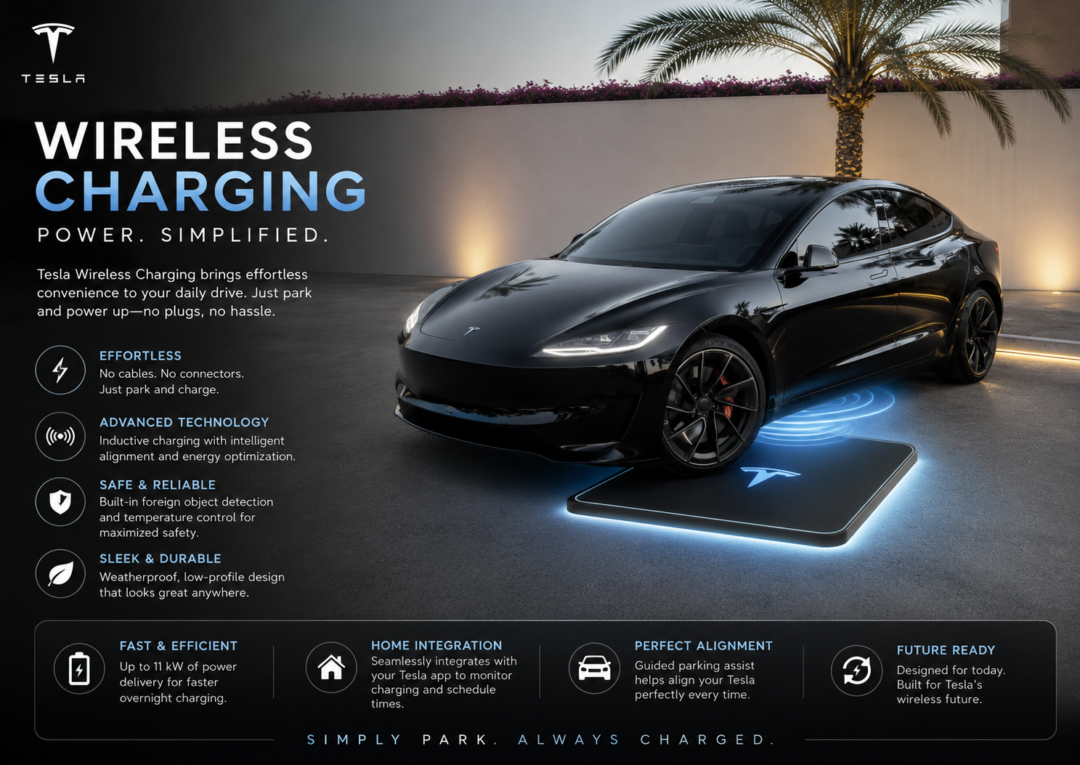
Imagine pulling into your garage after a long day. No cable to dig out. No port to fumble with in the dark. You just park — and your Tesla starts charging on its own. That’s not science fiction anymore. Tesla has officially approved wireless EV charging.
This is one of those moments where you realise the future isn’t coming — it already arrived while we were looking the other way. For Tesla owners, it removes the last genuine friction point in owning an electric vehicle. For investors, it’s a new moat in an increasingly competitive EV landscape. And for the broader EV industry? It changes what “convenience” means entirely.
Let’s break down exactly what’s happening, how the technology actually works, what it means for your daily life, and why Wall Street is paying very close attention to this move.
Wait — How Does Wireless Charging Even Work on a Car?
Most people are familiar with wireless charging on phones. You place your device on a pad and it charges through magnetic induction. Tesla’s approach for EVs works on the same core principle — but scaled up dramatically to handle the power requirements of a large battery pack.
The system uses a charging pad installed in your garage floor or parking spot. Your Tesla has a receiver built into its underbody. When you park over the pad, the two coils align and energy transfers wirelessly. No physical contact required.
The claimed efficiency is around 90%, which is important. Earlier wireless charging concepts for EVs lost too much energy as heat — making them impractical. Tesla’s resonant system brings that loss down to a point where it’s comparable to a standard Level 2 cable charge. That’s the technical breakthrough that makes this real rather than just a demo.
What About Charging Speed?
Here’s where it gets interesting. The wireless system in its current form supports up to 25 kW of power delivery. That’s not as fast as Tesla’s Supercharger network, but it’s comfortably in Level 2 territory — which is exactly what most people use at home overnight.
For context: at 25 kW, a Tesla Model 3 Long Range can recover roughly 150–170 km of range in a single hour. Park at 10 PM, wake up at 7 AM — you’re fully charged without touching a single cable.
What This Actually Means for Tesla Owners
If you own a Tesla — or you’re thinking about buying one — this matters to you in a very direct, everyday way. Let’s be honest about what the ownership experience has been like until now.
The charging cable isn’t exactly painful. But it’s friction. It’s the one task that reminds you every single day that you drive an EV rather than a petrol car. You park, you grab the cable, you plug in. Maybe it’s raining. Maybe you’re tired. Maybe you forget and wake up to a half-charged car.
Wireless charging eliminates that entirely. You just park. That’s it.
The garage pad installs like a standard Level 2 charger — electrician visit, one-time setup. After that, every time you park, charging is automatic. No routine to build. No cable to remember. Just done.
Tesla is already talking to commercial real estate developers and workplace parking operators. A future where you charge at the office without thinking about it — parking is the act of charging — is closer than most people realise.
Once FSD handles the parking itself, the entire charging process becomes invisible. You get out of the car. It parks. It charges. You come back to a full battery. This isn’t a feature — it’s a lifestyle shift.
This one doesn’t get talked about enough. For elderly drivers and people with mobility challenges, plugging in a charging cable can be genuinely difficult. Wireless charging removes that barrier completely — an important step toward universal EV adoption.
Rain, cold, snow — the charging cable is always awkward in bad weather. With wireless, none of that matters. You park indoors or out, and the car handles it. One less reason to hesitate about EV ownership.
No exposed cable means no cable theft — a surprisingly common issue in some markets. And the system only activates for authenticated Tesla vehicles, so you’re not accidentally charging your neighbour’s car either.
“The best technology is the kind you stop thinking about. Wireless charging makes the EV experience invisible — and that’s exactly the point.”
EV Technology Desk — May 2026
The Investor Angle: Why This Is Bigger Than It Looks
If you hold Tesla stock — or you’re watching TSLA from the sidelines — wireless charging isn’t just a product feature. It’s a strategic signal about where Tesla’s business is heading, and what kind of moat it’s building around itself.
Here’s the way to think about it. Tesla has always been a hardware-plus-software-plus-ecosystem play, not a pure car company. Every time Tesla adds a layer to that ecosystem that competitors can’t easily replicate, the moat deepens. Wireless charging is exactly that kind of layer.
💹 Why Investors Should Pay Attention
- New hardware revenue stream: The wireless charging pad is a Tesla-sold product. It integrates with the Tesla app, authenticates through Tesla’s systems, and will likely require Tesla-certified installation. That’s recurring hardware revenue at high margins — separate from the vehicle sale itself.
- Licensing potential: Tesla’s resonant induction IP, if patented aggressively, could become a licensing business for the broader EV industry — similar to how Qualcomm monetised wireless standards in mobile. It’s early, but the structure is there.
- Stickiness and loyalty: Every ecosystem feature Tesla adds makes it harder for an owner to switch brands. Wireless charging that’s seamlessly integrated with FSD, the Tesla app, and home energy management (Powerwall) creates friction against defection — exactly what analysts mean when they talk about customer lifetime value.
- Energy division synergy: Tesla’s Powerwall and solar roof products already talk to each other. Wireless charging adds another node to the home energy ecosystem — potentially enabling smart charging that draws from solar, stores in Powerwall, and charges the car automatically during off-peak or renewable windows. That’s a genuinely differentiated value proposition.
- Commercial real estate opportunity: Workplace and retail parking with embedded wireless charging pads is a B2B business Tesla hasn’t fully tapped. Think about the recurring revenue from commercial property operators paying for Tesla-branded charging infrastructure.
- Competition is behind: No major EV competitor has an approved, commercially-ready wireless charging system at this power level. BMW, Ford, and GM have all run pilots — but Tesla’s scale, vertical integration, and software layer give it a significant head start to execute a real product, not just a concept.
The Bigger Picture: What Changes for the EV Industry
Tesla’s move doesn’t just matter for Tesla. It matters for the entire EV adoption curve — and that affects everyone from auto manufacturers to grid operators to property developers.
The single most cited barrier to EV adoption, after upfront cost, is charging inconvenience. Not range anxiety (that’s mostly solved for daily driving) — but the perceived hassle of actively managing charging. Wireless charging attacks that perception directly.
The Adoption Domino Effect
- The “it’s just like parking” narrative becomes real: The biggest mental hurdle for potential EV buyers is the behaviour change around charging. Wireless makes the behaviour identical to a petrol car — you park, and energy management happens invisibly. That removes a genuine psychological barrier.
- Multi-EV households get simpler: Families with two EVs and one charger currently need to actively manage who charges when. A wireless pad in each parking spot — eventually — makes that coordination invisible.
- Urban apartment charging unlocks: Wireless pads embedded in underground parking bays could finally solve the charging access problem for apartment dwellers — the segment that conventional home charging (which requires a dedicated outlet) struggles to serve.
- Fleet operators benefit most: Rideshare and delivery fleets — where a human has to physically connect every vehicle at the end of a shift — see dramatic operational savings if parking is sufficient for charging. Tesla’s commercial push here could be significant.
- Competitors are forced to respond: Once Tesla deploys this at scale, every other EV manufacturer faces pressure to match. That means faster standardisation of wireless protocols, which is ultimately good for the industry overall — but painful for companies without Tesla’s integration advantage.
What Should You Actually Do With This Information?
Whether you’re a Tesla owner, a prospective buyer, or an investor — here’s actionable thinking, not generic hype.
If You Own a Tesla
- Don’t rush the hardware upgrade immediately: Pilot phase means first-generation hardware. If you can wait 12–18 months, the second-generation product will likely be more refined, more efficient, and better priced. Watch the rollout closely but don’t be first-gen guinea pig unless convenience is worth the premium to you.
- Check your home setup first: Wireless charging still requires proper electrical infrastructure — a dedicated 240V circuit at minimum. If you’re already set up for Level 2 charging, the transition is straightforward. If not, combine the wireless pad installation with the electrical upgrade to save on installation costs.
- Watch the Tesla app updates: The wireless charging system integrates deeply with the app. New features — scheduled charging, solar-optimised charging, FSD parking-and-charge — will roll out via software, not hardware upgrades. This is the Tesla model: buy the hardware once, unlock features over time.
If You’re Considering Buying a Tesla
- This changes the value calculation: If charging convenience was a concern, that concern is now materially reduced. Factor the wireless pad installation cost into your total ownership cost — it’s a one-time expense that changes the daily experience permanently.
- Ask about retrofit compatibility: Tesla has historically been good about backward compatibility for major features. Confirm whether your target model (and production year) will support the wireless receiver hardware — either factory-fitted or via retrofit.
If You’re an Investor Watching TSLA
- Size it as an ecosystem signal, not a product catalyst: Wireless charging alone won’t move Tesla’s quarterly numbers dramatically. But as a signal that Tesla is continuing to build an integrated ownership ecosystem with multiple monetisation layers, it’s directionally significant. It’s the kind of move that compounds over five years, not five weeks.
- Watch the commercial rollout: Fleet operators and commercial real estate are the near-term revenue opportunity. If Tesla announces partnerships with major workplace campuses or parking operators in H2 2026, that’s a real business unit forming.
- Monitor competitor response: How quickly other EV manufacturers respond tells you a lot about how seriously the industry views this. Fast, credible competitive responses suggest the market opportunity is large. Slow responses suggest Tesla has more of a head start than the market currently prices.
Final Read:
Parking IS the New Fuelling.
It changes EV ownership from a conscious daily act into a passive background process. And that distinction — between actively managing something and not having to think about it at all — is what separates technologies that stay niche from technologies that go mainstream.
Tesla has long understood that the competition isn’t other EV makers. It’s the petrol car’s decade-long head start on familiarity and convenience. Every feature that closes that convenience gap moves the needle on adoption.
Wireless charging is one of those features. Not the flashiest. Not the most talked-about. But quietly — the kind of change that, five years from now, people will find it hard to imagine living without. That’s usually how the best technology works.
EV Technology — May 2026