🇮🇳 India Today — May 15, 2026
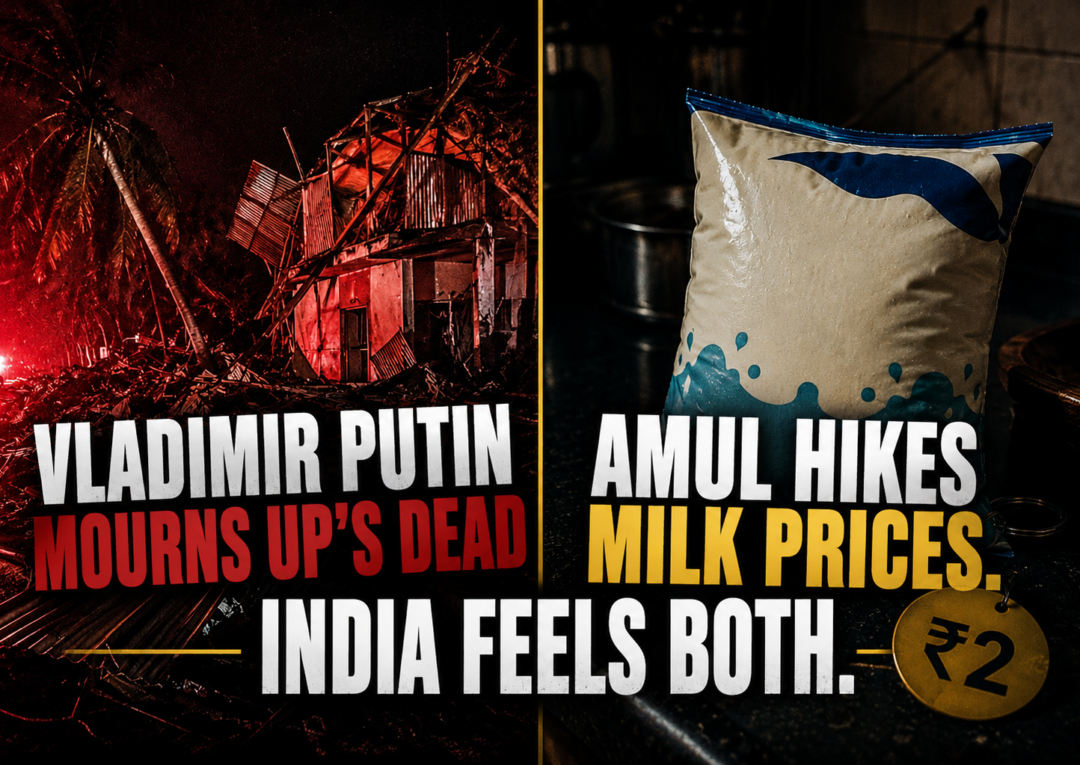
Russia Mourns UP’s Dead.
Amul Hikes Milk’s Prices.
India Feels Both.
On the evening of May 13–14, 2026, Uttar Pradesh was hit by one of its most devastating storm systems in recent memory. Thunderstorms, hailstorms, heavy rain and lightning strikes swept across several districts, leaving more than a hundred people dead, dozens injured, and thousands of homes and crops in ruins.
Within hours of the disaster making global headlines, Russian President Vladimir Putin sent personal condolence messages to President Droupadi Murmu and Prime Minister Narendra Modi — a gesture that speaks both to the scale of the tragedy and to the depth of India-Russia diplomatic ties.
This article covers the human cost of the cyclone, what Putin actually said, what it means diplomatically, and how India’s disaster response machinery has kicked in.
The Night Uttar Pradesh Couldn’t Sleep
Wednesday evening started like any other spring night across Uttar Pradesh. But around sunset, the sky changed. A fast-moving storm system — carrying extreme winds, relentless rainfall, and intense lightning — tore through multiple districts without much warning.
Trees were uprooted. Mud houses collapsed. Power lines went down. And in the chaos that followed, families found themselves pulling relatives from debris – some injured, some worse off.
By the time UP Relief Commissioner Harikesh Bhaskar issued his statement the following day, the death toll stood at over 104 — confirmed across roughly 36–48 hours of continuous storm activity. The numbers may still rise as rescue teams reach more remote areas.
📍 Districts Hit Hardest
-
- Prayagraj — 21 deaths reported. The district, home to the Sangam, saw structural collapses across older housing colonies.
Fatehpur — 15 fatalities. Farming communities bore the brunt of lightning strikes in open fields.
Bhadohi (Sant Ravidas Nagar) — Between 13 and 16 deaths. Carpentry and weaving communities in the region suffered significant property loss.
Mirzapur — Around 12 deaths. Stone quarry workers and rural households are among the worst affected.
Multiple other districts reported scattered fatalities, livestock deaths, and crop damage — particularly for farmers already managing a difficult growing season.
Putin’s Message: What He Actually Said
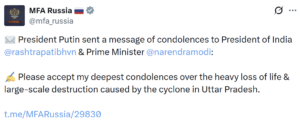
Within a day of the storm, the Russian Ministry of Foreign Affairs (MFA) officially posted the condolence messages that President Putin sent to India’s two top constitutional offices.
“
The message was addressed separately to President Droupadi Murmu and Prime Minister Narendra Modi — which is a diplomatic formality, yes, but also a signal of respect. Russia didn’t send a single generic statement. Two separate messages to both heads of state.
This isn’t the first time Putin has reached out after an Indian tragedy. He sent condolences after the Air India plane crash in Ahmedabad in June 2025, condemned the Pahalgam terrorist attack in April 2025, and had previously expressed grief after the Uttar Pradesh stampede in July 2024 that killed 121 people.
The pattern matters. It shows that Russia’s diplomatic engagement with India goes beyond trade deals and arms agreements. It extends to moments of grief – which, in diplomatic language, carry real weight.
What This Means for India-Russia Relations
Some people might read Putin’s condolence message and think: “It’s just words.” And in isolation, they’d have a point. But diplomatic gestures don’t exist in isolation — they’re part of a larger pattern of relationship-building.
India and Russia have had a complex, evolving relationship since the Cold War era. In recent years — especially post-2022 — India has maintained strategic autonomy, refusing to take clear sides even as Western nations pressured it. Russia, for its part, has continued supplying defence equipment, oil, and fertiliser to India at a time when global supply chains were fractured.
-
- Diplomatic signalling: Reaching out during national tragedies is one of the strongest signals in diplomacy. It says, “We’re not just business partners. We acknowledge your pain.”
Consistent pattern: Putin’s repeated condolences — across at least three separate Indian tragedies in 2024–2026 — reflect institutional consistency, not just opportunism.
India’s global standing: When a world power like Russia publicly expresses sympathy for a state-level disaster in Uttar Pradesh, it underscores India’s growing global footprint. The world watches when India mourns.
Mutual respect, not alignment: This should not be misread as India moving closer to Russia politically. India’s foreign policy remains multi-aligned. But mutual respect, maintained through consistent communication, is the foundation of any durable relationship.
“When Russia mourns with India, it’s not just sentiment. It’s statecraft wrapped in sympathy.”
India Threads Editorial — May 2026
On the Ground: How UP is Responding
Chief Minister Yogi Adityanath took swift cognisance of the disaster and immediately directed district officials to initiate relief and rescue operations. The response, by most accounts, has been more systematic than previous disaster responses in the state.
What the Families Need Right Now
Beyond the politics and the diplomatic messaging, 104+ families in Uttar Pradesh are sitting with an empty chair at their table today. Children have lost parents. Parents have lost children. Farmers have lost their animals — the living savings of a rural household.
The compensation process — for lives lost, livestock killed, crops destroyed, and homes collapsed — must move faster than Indian bureaucracy typically allows. Ex gratia payments announced from Lucknow mean nothing until they physically reach the household in Bhadohi or Mirzapur.
Putin’s words were sincere and welcome. But India’s own government – at the state and central levels – must back those words with money, speed, and accountability on the ground.
The same day Uttar Pradesh was counting its storm dead, another headline quietly entered millions of Indian homes: Amul milk just got more expensive.
Starting May 14, 2026, the Gujarat Cooperative Milk Marketing Federation (GCMMF) — the federation behind the Amul brand — hiked fresh pouch milk prices by ₹2 per litre across India. Mother Dairy followed with similar revisions across its SKUs.
For a family that buys a litre of milk every day, that’s ₹60 more a month. For families buying two or three litres daily — which is common in households with children, the elderly, or those running small tea stalls — the impact is two to three times that. Not a huge number on paper. A very real number in a monthly budget that’s already stretched.
The New Price List — What You’re Paying Now
Here’s what the revised prices look like, specifically for Amul in Gujarat (prices vary slightly by state due to logistics):
| Variant | Old Price (500ml) | New Price (500ml) | Change |
|---|---|---|---|
| Amul Gold (Full Cream) | ₹33 | ₹35 | +₹2 |
| Amul Shakti (Toned) | ₹30 | ₹32 | +₹2 |
| Amul Slim & Trim (Double Toned) | ₹24 | ₹26 | +₹2 |
| Amul Taaza (Toned) | ₹27 | ₹29 | +₹2 |
| Amul Cow Milk | ₹30 | ₹32 | +₹2 |
The hike translates to approximately 2.5–3.5% per litre depending on the variant – which GCMMF itself noted is lower than average food inflation. That’s technically true. But “lower than average inflation” doesn’t mean “not noticeable in the kitchen”.
Why Did Amul Raise Prices?
Amul’s official statement says the increase is due to “an increase in the overall cost of operation and production of milk”. That’s the official version. Here’s what it actually breaks down to:
The cost of animal feed — including concentrated feed, green fodder, and dry roughage — has been rising steadily. This is partly driven by fuel costs (transporting feed) and partly by broader agricultural input inflation. When it costs more to feed a cow, the milk she produces becomes more expensive to produce.
From the village collection van to the processing plant to the refrigerated truck to the retail store, milk touches food at every stage. With diesel prices remaining elevated across India, the distribution cost of every litre of milk has climbed. That cost has to go somewhere.
The plastic pouches that hold your milk aren’t free. Polymer prices — tied to crude oil — have pushed packaging costs up for FMCG companies across the board. Amul isn’t alone here; every dairy brand faces the same packaging squeeze.
Amul is a cooperative — it exists to serve farmers, not just consumers. As a cooperative’s input costs rise, so does the procurement price it pays to member farmers. This is actually the system working correctly. But it means price increases flow upward into consumer pricing.
Liquid milk has always been a low-margin business for dairy cooperatives. GCMMF’s turnover crossed ₹1 lakh crore in FY26, but margins on liquid milk remain slim. Even small cost increases require price adjustments to maintain operational viability — including paying farmers fairly.
What This Does to the Middle Class
Let’s get specific, because “impact on household budgets” is a phrase that gets used so often it stops meaning anything.
Take a family of four in a Tier-2 city — say, Lucknow, Jaipur, or Nagpur. They buy about 1.5 litres of milk daily. That’s roughly 45 litres a month. At ₹2 more per litre, that’s ₹90 extra per month — just on milk.
Now add the ripple effects. Because milk doesn’t stay milk:
-
- Tea and coffee: Every cup of chai at home – which for most Indian families is 2–4 cups daily – uses milk. Cost goes up. Not dramatically, but noticeably.
Paneer, curd, ghee, and butter: These are all downstream dairy products. Analysts already expect prices of paneer and ghee to follow milk prices upward in coming weeks. A 250g paneer block could see ₹10–20 increases.
Restaurants and dhabas: Every establishment that uses dairy — which is most of them — will quietly absorb higher costs and eventually pass them on in portion sizes or prices. The ₹80 paneer tikka becomes ₹90.
- Sweet shops: Mithai is a dairy-intensive business. Milk-based sweets – kheer, rasgulla, and barfi – will get pricier. Festivals will feel slightly more expensive.
Other dairy brands following are Market analysts widely expect regional dairy cooperatives and private brands to announce similar revisions in the coming weeks. Amul sets the benchmark; others follow.
“When milk gets more expensive, everything made from milk gets more expensive. That’s not inflation — that’s arithmetic.”
India Threads Editorial — May 2026
The Lower-Class Squeeze — Harder Than It Looks
For middle-class families, a ₹90-month increase in milk is annoying but manageable. They adjust something else in the budget. But for lower-income households, the maths is different – and harder.
Milk is not optional for a family with young children or an elderly parent. It’s not a luxury. For households earning ₹15,000–₹20,000 a month, every rupee of essential-item inflation directly compresses the margin available for everything else – education fees, medicine, transport, and savings.
And it’s not just milk. This hike comes alongside the following:
- Ongoing food inflation across vegetables, pulses, and edible oils
- Transport costs rising due to elevated fuel prices
- No meaningful increase in minimum wages keeping pace with actual CPI in many states
- FMCG companies broadly signalling further price increases across product categories in Q1-Q2 FY27
The Other Side: Farmers Actually Benefit
Here’s the part that doesn’t make headlines as loudly: this price hike isn’t coming at the expense of farmers. Amul’s cooperative model is designed so that when consumer prices go up, more of that flows back to the milk producers — the 36 lakh-plus farmer families across Gujarat and beyond who supply GCMMF daily.
India’s dairy sector is one of the world’s largest — and the cooperative model is its backbone. When the cooperative can raise consumer prices, it can afford to pay higher procurement prices to farmers. That’s not a corporate story. It’s a rural livelihood story.
Will Prices Come Down?
Unlikely in the short term. The structural factors – fuel costs, feed costs, and packaging – are not going away quickly. The last hike before this one was in May 2025, so Amul has historically spaced increases roughly 12–13 months apart. Whether the next one comes in mid-2027 or earlier depends heavily on monsoon performance (which affects crop prices and fodder availability) and global crude oil trends.
A good monsoon in 2026 could ease some pressure. But if West Asia tensions keep oil prices elevated — as covered in our previous feature — the fuel cost component of milk production won’t ease anytime soon.
Two Stories.
One India.
Vladimir Putin’s condolence message was a reminder that India’s tragedies don’t go unnoticed by the world. The international community watches. Diplomatic relationships are built and tested in moments of crisis—not just in boardrooms.
And Amul’s price hike was a reminder that for most Indian families, the real tests aren’t geopolitical. They’re at the kitchen table — where every price change in an essential item forces a quiet recalculation of the month’s budget.
The victims of the UP cyclone deserve faster, more accountable compensation — not just statements from Lucknow or Moscow. And India’s middle and lower classes deserve economic policies that recognise inflation isn’t just a number on an RBI chart. It’s a daily lived reality for hundreds of millions of people.
IndiaThreads covers the stories that matter. Stay with us.
News Analysis — May 15, 2026