🕊 Geopolitics & Markets | May 2026
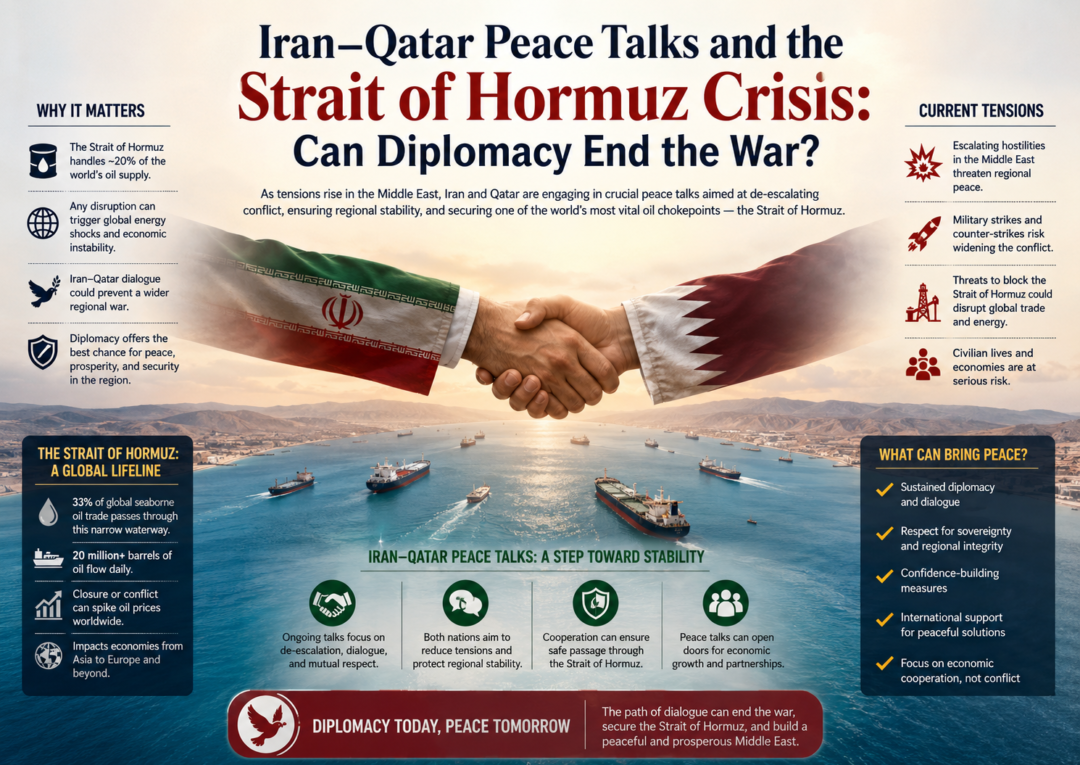
Iran–Peace Talks
& the Hormuz
Crisis.
Think about what it takes to keep the lights on. Not just in your city — but in half the world. Every oil tanker moving through the Strait of Hormuz is, in a very real way, carrying the price of energy for billions of people. And right now, that narrow 21-mile channel sits at the centre of one of the most consequential diplomatic standoffs of the decade.
Iran and Qatar are talking. But what exactly are they talking about — and can those conversations actually stop a crisis that has already rattled oil markets, rerouted shipping lanes, and pushed defence spending to multi-year highs? That’s the question every institutional investor, energy strategist, and foreign policy analyst is asking in mid-2026.
The answer isn’t simple. Qatar’s role as a back-channel diplomat is well established — it has brokered talks between parties who refuse to sit at the same table with remarkable consistency over two decades. But the Hormuz crisis isn’t just a bilateral tension between two states. It’s a layered, multi-actor conflict with economic, nuclear, and regional power dimensions all running simultaneously. Diplomacy can de-escalate. Whether it can resolve — that’s an entirely different question.
Why the Strait of Hormuz Is the World’s Most Dangerous Bottleneck
Geography doesn’t care about politics. The Strait of Hormuz — sitting between Iran to the north and Oman and the UAE to the south — is one of those places where physical reality and geopolitical risk collide in a way that no amount of financial engineering can fully hedge away.
Every single day, roughly 17–21 million barrels of oil move through this channel. That’s the combined output of Saudi Arabia and Iraq. It’s the energy lifeline for Japan, South Korea, India, and much of Europe. There is no quick alternative. The overland pipelines through Saudi Arabia and the UAE carry a fraction of that volume. The Cape of Good Hope reroute adds weeks and costs that compound directly into global inflation.
This is the backdrop against which Qatar’s diplomatic engagement with Tehran is happening. It’s not a quiet back-channel nudge. It’s an active, high-stakes attempt to pull one of the world’s most strategically positioned nations back from an escalation trajectory that markets are pricing as genuinely open-ended.
What’s Actually Being Discussed
Public reporting as of mid-2026 points to a multi-track conversation. There are direct economic threads — Qatar has historically maintained working relationships with Iran despite the 2017–2021 Gulf blockade, during which Iran kept Qatari airspace and ports open. There’s a nuclear dimension, with Qatar acting as a conduit for informal U.S.-Iran messaging about enrichment thresholds and sanctions relief. And there’s a regional security thread focused on Houthi operations and the conditions under which Iranian proxies in Yemen might scale down attacks on Gulf shipping.
None of these tracks are clean. All of them overlap with domestic Iranian politics, where hardliners view any concession as capitulation, and moderate factions face severe institutional constraints on what they can agree to, even informally. Qatar’s leverage is real but limited. It can open doors. It cannot force anyone to walk through them.
Qatar’s Diplomatic Playbook — And Why It Works
If you want to understand why Qatar is at the centre of these talks, you need to understand what makes it different from every other Gulf state. It’s small. Its population is tiny. Its military is negligible by regional standards. And yet, consistently for the past 25 years, Qatar has punched so far above its weight in international diplomacy that the discrepancy itself has become its main geopolitical asset.
Doha has hosted Taliban negotiations, Hamas political leadership, and Iranian back-channel contacts simultaneously — often without these parties knowing the full extent of Qatar’s multi-directional engagement. It has kept formal diplomatic relations with Iran intact even when Saudi Arabia, Bahrain, Egypt, and the UAE severed theirs. And critically, it has maintained a U.S. military base — Al Udeid, the largest American air base in the Middle East — which gives it credibility as a channel that Washington actually trusts.
🔑 Why Qatar Has Leverage With Iran — Specifically
- Economic ties that survived the blockade: During the 2017–2021 Saudi-led blockade of Qatar, Iran opened its airspace and ports to Qatari traffic, creating a genuine debt of goodwill that Tehran periodically cashes in through diplomatic channels.
- Shared gas field: Qatar and Iran share the world’s largest natural gas field — the North Dome / South Pars field. This isn’t symbolic; it’s a multi-trillion-dollar economic interdependency that creates a direct structural incentive for both sides to maintain functional relations.
- No military threat to Iran: Unlike Saudi Arabia, Israel, or the U.S., Qatar poses zero military threat to Tehran. This makes Qatari interlocutors uniquely trusted in Iranian diplomatic circles — they can say things that no other actor can say without triggering defensiveness.
- Track record of delivery: Qatar’s role in the Afghanistan talks, the 2023 Gaza prisoner exchange negotiations, and various indirect Iran-U.S. financial channels gives it a credibility that many larger states simply lack. It has a reputation for following through.
- Al Jazeera as soft power: Love it or hate it, Al Jazeera gives Qatar a media presence across the Arab world that is unmatched by any other Gulf state. This creates narrative power — the ability to shape how diplomatic progress (or failure) is perceived across the region.
This combination — economic interdependency, no threat perception, and genuine delivery track record — is what makes Qatar’s engagement with Iran in 2026 more than just diplomatic optics. There’s a real mechanism here. The question is whether the mechanism has enough force to shift the current trajectory.
How Markets Are Reading the Talks
Markets don’t wait for diplomatic outcomes. They price probabilities — and right now, the probability distribution is unusually wide, which is itself a market signal.
Every credible signal of diplomatic progress triggers a measurable response in Brent crude futures: a drop of $3–6 per barrel in the immediate session, followed by a partial reversal as traders reassess whether the signal is substantive or theatrical. Similarly, any breakdown in talks, or any new maritime incident in the Gulf, triggers a $5–10 spike within hours. This pattern — sharp reactions, partial reversals — is the market telling you it doesn’t know which direction things are heading, but it knows the stakes are high in both directions.
The oil market in 2026 is pricing a persistent “diplomacy discount” that disappears instantly on bad news. Brent above $90 reflects a base case of ongoing tension, not resolution. Any meaningful de-escalation signal would see a sharp $8–12 drop in crude almost immediately.
Defense stocks are at multi-year highs, but here’s the interesting thing — significant diplomatic progress wouldn’t necessarily crash them. The rearmament cycle that began in 2022 is now a structural trend driven by NATO commitments, Gulf state procurement, and indigenisation programs. It doesn’t reverse on one peace deal.
Saudi, UAE, and Qatari sovereign wealth funds have been quietly diversifying away from direct Gulf energy exposure over the past 18 months. That’s not panic — it’s professional portfolio management. But it signals that even the biggest Gulf players are hedging against continued regional instability at the portfolio level.
India imports ~85% of its crude and has significant LNG supply contracts routed through Qatar. A successful Iran-Qatar diplomatic track is genuinely positive for India’s energy cost structure. But India also has deepening defense relationships with several Gulf states — meaning the strategic calculus cuts both ways.
The Iranian rial’s behavior against the dollar and the euro is one of the best real-time indicators of how Iran’s internal stakeholders are reading the diplomatic process. Unofficial rate movements in Tehran’s currency market often precede formal signals by days. It’s not a mainstream indicator — but it’s the one that sophisticated desks are watching.
“Diplomacy doesn’t close the Strait. It just lowers the probability that someone does.”
Geopolitical Risk Desk — India Threads Market Analysis, May 2026
The Diplomatic Timeline — Where Things Stand
The Real Obstacles — Why This Is Harder Than It Looks
Qatar’s credibility is real. The mechanism is real. So why isn’t a deal happening? Because diplomacy — especially in this region, with these specific actors — faces structural obstacles that no amount of goodwill or shuttle diplomacy can fully overcome on a short timeline.
The Iranian Domestic Politics Problem
Iran’s decision-making structure is genuinely complex. The Supreme Leader sets the ultimate direction, but the Revolutionary Guard Corps has operational autonomy that often runs ahead of — or in direct contradiction to — formal diplomatic positions. A foreign minister can signal flexibility in Doha while IRGC naval units conduct exercises in the Strait that send the opposite message. This isn’t hypocrisy — it’s structural incoherence, and Qatar has to manage it simultaneously.
The Nuclear Linkage
Western interlocutors — including the U.S. — are unwilling to offer meaningful sanctions relief without concrete nuclear concessions. Iran’s enrichment levels in 2026 are at their highest-ever reported levels. The gap between what Iran will accept on enrichment and what the West will accept on sanctions is still significant. Qatar can carry messages across this gap. It cannot close it.
The Houthi Complication
Iran’s relationship with Houthi leadership is real but not direct command-and-control. Telling the Houthis to stand down — even assuming Iran wanted to — is not a simple instruction that produces a simple result. The Houthis have their own political leadership, their own territorial control in Yemen, and their own strategic calculations. Any diplomatic arrangement that requires “delivering” Houthi de-escalation is depending on a commitment that Iran may genuinely not be able to keep fully.
What the Three Scenarios Mean for Your Portfolio
Any serious professional framework has to model at least three outcomes — because binary thinking in this environment leads to portfolios that are either over-hedged or dangerously exposed at exactly the wrong moment.
- Scenario A — Partial De-escalation (~35% probability): Qatar brokers a limited agreement — maritime incident protocols, Houthi operational pause, informal nuclear freeze — that reduces immediate disruption risk without resolving underlying tensions. Oil falls to the $75–85 range. Markets rally on relief. Defense stocks hold gains — the rearmament cycle is structural and doesn’t reverse on one agreement. Indian markets benefit significantly from lower crude costs.
- Scenario B — Stalemate / Continued Grinding (~45% probability): Talks continue without breakthrough. Oil stays in the $88–100 band. Markets oscillate on each headline. This is the most likely scenario and the hardest to position for, because it rewards patience and liquidity over directional calls. Professional strategy here is wide scenario coverage, not concentrated bets.
- Scenario C — Talks Collapse / Escalation (~20% probability): Diplomatic channels break down following a major incident — a tanker seizure, naval confrontation, or dramatic enrichment announcement. Oil spikes above $110. Equity markets sell off 15–20% on growth repricing. Gold surges. This is the tail risk that justifies hedges that look expensive in a base-case environment.
Specific Calls by Asset Class
- Energy equities: Stay neutral-to-slight-overweight. Don’t make a full directional rotation until there’s a concrete diplomatic signal with implementation detail, not just a headline.
- Gold: Maintain as a structural position, not a trade. In all three scenarios above, gold holds value — in Scenario A it might dip slightly, but the broader uncertainty environment justifies holding it.
- Indian defense stocks: HAL, BEL, Mazagon Dock — remain compelling regardless of diplomatic outcome. Domestic procurement acceleration and export pipeline don’t depend on Hormuz resolution.
- Indian OMCs: Watch for entry points if Scenario A becomes more likely — IOCL, BPCL margins improve significantly with oil back in the $75–80 range, but the political complexity around fuel pricing creates timing risk.
- Short-duration fixed income: Maintain in all three scenarios. Oil-driven inflation persistence is real regardless of diplomatic progress, and central banks will remain cautious about rate cut timelines until the energy picture clarifies.
Final Read:
Diplomacy Is Real. So Is the Uncertainty.
But here’s the honest professional read: in 2026, the Strait of Hormuz crisis isn’t going to be resolved by a single diplomatic breakthrough. The underlying tensions — nuclear, economic, regional proxy — are structural and multi-actor. Qatar can lower the temperature. It can facilitate agreements on specific, bounded issues. It can keep the channel open when other channels close. That’s genuinely valuable. But it’s not the same as ending the crisis.
What this means for markets is that the disruption premium in oil isn’t going away completely, even if diplomacy makes progress. The rearmament cycle isn’t reversing. The need for portfolio tail protection isn’t disappearing. And the professionals who are building positions with optionality across multiple scenarios — rather than betting on one outcome — are the ones who will look back at 2026 as a year they navigated well.
The Strait of Hormuz remains the world’s most consequential maritime chokepoint. Diplomacy can reduce the probability of closure. It cannot make the geography disappear. Position accordingly.
Market Analysis — May 2026