🚗 Ultra-Luxury EV | May 2026
The Car That Dethroned
Maybach.
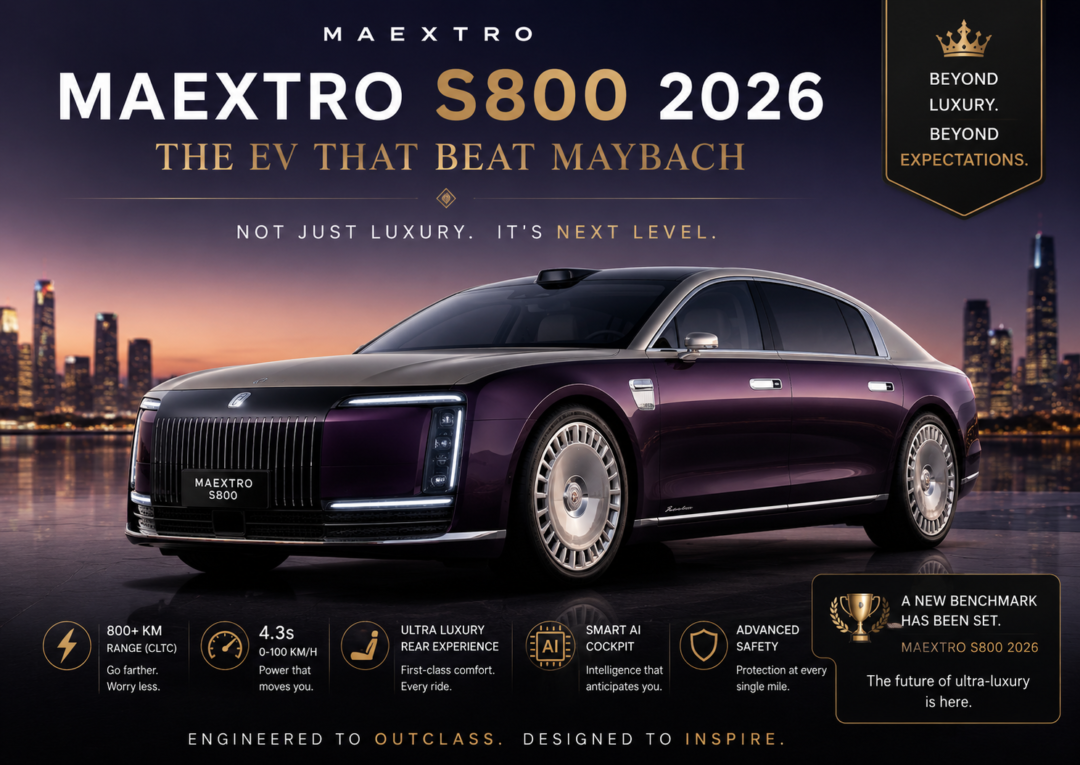
At some point in January 2026, something remarkable happened in the luxury car market. A Chinese electric sedan — barely seven months old — outsold the BMW 7 Series and the Mercedes-Benz Maybach S-Class combined. In the segment above 700,000 yuan. In a single month.
That car is the Maextro S800. And if you haven’t heard of it yet, you’re not alone — but that’s about to change. Built by a joint venture between Huawei and JAC Group under the HIMA alliance, the S800 isn’t just a new luxury EV. It’s a direct challenge to the established order — to Stuttgart, to Munich, to every legacy badge that’s spent decades defining what a flagship sedan is supposed to feel like.
This is the story of what the S800 actually is, what it does that rivals don’t, and why it matters for anyone serious about where ultra-luxury mobility is going in the next decade.
What the Maextro S800 Actually Is
The Maextro name comes from “Maestro” — a nod to mastery and orchestration. The S800 is the brand’s debut vehicle and, by most measures, an extraordinarily ambitious one. It’s a full-size ultra-luxury sedan developed by JAC Group’s manufacturing arm working in close partnership with Huawei’s automotive division, marketed and sold through Huawei’s HIMA (Harmony Intelligent Mobility Alliance) retail network — the same stores that carry Aito, Stelato, and Luxeed vehicles.
At 5,480mm long, 2,000mm wide, and riding on a 3,370mm wheelbase, the S800 isn’t trying to be subtle about its ambitions. Those dimensions place it squarely in the space occupied by executive limousines — longer than a standard BMW 7 Series, comparable to the Maybach S-Class in sheer physical presence.
The S800 comes in two distinct powertrain configurations — and the choice reveals a lot about the buyer profile Huawei is targeting.
BEV (Pure Electric): Dual or triple motor. The tri-motor BEV produces 852 HP and 850 lb-ft of torque. It sprints 0–62 mph in around 4.3 seconds. Range is 700 km under CLTC. Battery is a 97 kWh CATL Qilin unit capable of 5C fast charging — meaning significant charge in roughly 12 minutes.
EREV (Extended Range Electric): The EREV pairs electric motors with a small 1.5L turbocharged range extender — not to drive the wheels, but to recharge the battery when it depletes. Combined range on EREV models extends to over 1,100 km. This is the version most buyers are choosing — because unlimited range anxiety is still the #1 objection in the luxury segment.
The 2026 refresh brought a subtle but meaningful upgrade to the EREV — the generator output was bumped from 125 kW to 127 kW, improving charging efficiency. The battery was also refined to a 63.262 kWh CATL NMC unit. Small numbers on paper, but in execution they smooth out the real-world charging curve meaningfully.
The Grand Design: Taking It Further
Just when you thought the S800 was maxed out, Maextro announced the S800 Grand Design. Official images released in May 2026 revealed a more ceremonial, chauffeur-driven interpretation of the same platform.
Dark blue and white two-tone paint. Gold accents on the front emblem, hood strip, wheel surrounds, C-pillars, and rear badging. Multi-spoke alloys with gold trim. It’s not minimalist tech anymore — it’s theatre. And it’s rumoured to be priced anywhere between $200,000 and $300,000 USD, competing directly with bespoke Rolls-Royce and Bentley territory.
The Tech Story: HarmonyOS Inside
This is where the Maextro S800 gets genuinely interesting — and where its Huawei DNA separates it from every luxury EV competitor. The car runs on HarmonyOS, Huawei’s vertically integrated operating system, powering a cockpit that’s closer to a rolling tech platform than a traditional automobile interior.
Triple-screen dashboard layout with AI voice assistant integration. The system learns driver preferences, adapts ambient settings, and manages everything from climate to route planning in a unified interface. No CarPlay needed — this is the platform.
The S800 is fundamentally a car designed from the back seat forward. Heated, ventilated, and massaging rear seats. Individual rear entertainment displays. The wheelbase gives the kind of legroom that makes long-haul business travel genuinely comfortable.
Full 5G connectivity with over-the-air updates. The car improves over time — software patches, new AI features, performance tuning — without a dealership visit. It’s a meaningful structural advantage over ICE-era luxury flagships that age from the day of purchase.
Huawei’s intelligent suspension system continuously adjusts damping in real time. On a car weighing between 2,600 and 2,850 kg depending on variant, this is what separates “technically capable” from “genuinely comfortable.” Early reviews suggest it nails the balance.
Huawei’s ADS (Advanced Driving System) is embedded directly — not bolted on from a third party. It handles highway autonomy, urban navigation, and parking. For the executive buyer who wants to be driven and work in transit, this matters more than 0–60 times.
“This isn’t a car with tech added. It’s a tech platform that happens to move people in extraordinary comfort.”
IndiaThreads — Luxury EV Analysis, May 2026
Why It’s Winning — The Sales Story
Numbers don’t lie, and the S800’s numbers are striking. Let’s put them in context, because the raw sales figures only tell part of the story.
📈 The S800 Sales Breakdown — Jan 2026
- Maextro S800: 2,625 units — #1 in the segment above 700,000 yuan
- BMW 7 Series (excl. i7): 1,188 units — runner-up
- Mercedes-Benz Maybach S-Class: 1,040 units — third
- Combined BMW + Maybach sales: 2,228 units — still less than the S800 alone
- Record month (December 2025): 4,376 units in a single month
- Cumulative deliveries by Jan 2026: 14,078 units since August 2025 launch
What’s most impressive isn’t just the volume — it’s the speed. The S800 only started deliveries in August 2025. It hit a record monthly sales figure by December, racked up over 14,000 cumulative sales in under six months, and was outselling both of its closest rivals combined by January 2026. That is a genuinely unusual trajectory for any vehicle, let alone one in the ultra-luxury segment where buyers historically take months to decide.
The pre-order story is equally telling. The car pulled 3,600 pre-orders in its first week — including 1,600 in the first 24 hours alone. At $100,000+ per unit, that’s not impulse buying. Those are considered decisions by people who looked at what was on the market, looked at the S800, and decided to wait for it.
Who’s Actually Buying It?
The highest sales concentrations are in Shenzhen, Guangzhou, Shanghai, and Beijing — China’s four most significant business hubs. That’s not a coincidence. The S800 buyer profile is fairly clear: tech-forward executives, business owners in the new economy, professionals who want the status of a Maybach-level sedan without the legacy brand premium — and who actively value the HarmonyOS ecosystem they already use on their phones and in their offices.
How It Stacks Up Against The Established Names
Let’s be direct about this — because the comparison matters and the narrative around it is often oversimplified. The S800 isn’t better than a Rolls-Royce Ghost in every dimension. The Ghost has a century of brand heritage, hand-stitched leather workshops, and an emotional resonance that no spec sheet captures. That’s a real thing, and it has real value for certain buyers.
But the S800 is asking a different question. It’s asking: what if you could have the interior space, the executive comfort, and the flagship status — with better tech, longer range, and at roughly half the price of the equivalent Maybach? For a growing cohort of buyers, that question has an obvious answer.
- vs. Mercedes-Benz Maybach S-Class: The Maybach S480 was priced at ~$203,100 in China. The S800 starts at $98,600. Similar interior dimensions, comparable rear passenger experience. The S800 wins on tech, price, and EV efficiency. The Maybach wins on heritage and badge recognition with traditional luxury buyers.
- vs. BMW 7 Series / i7: The i7 is BMW’s electric flagship answer. The S800 substantially outguns it on power (852 HP tri-motor vs i7’s 536 HP), range, and cabin technology. The BMW wins on driving dynamics orientation and the established dealer/service network outside China.
- vs. Rolls-Royce Spectre: The Spectre is the obvious EV ultra-luxury benchmark. It’s also $400,000+. The S800 Grand Design, if priced at $200–300K, occupies the same conversation without the six-figure gap between the two. For buyers in that range who value tech over tradition, the calculus is genuinely interesting.
- vs. Tesla Model S Plaid: The Plaid is faster in a straight line, significantly cheaper, and carries a tech reputation. But it doesn’t pretend to be a chauffeur-driven executive sedan — the S800 does, and delivers on it. Different category, different buyer.
What This Means for Global Luxury Auto
Here’s the bigger story — and it’s worth sitting with for a moment. The Maextro S800 isn’t just a product success. It’s evidence of a structural shift in how luxury automotive is being built, positioned, and sold.
For decades, the ultra-luxury segment was a European monopoly. Stuttgart and Munich had the engineering credibility. Rolls-Royce and Bentley had the heritage. The formula was well established: superior craftsmanship, brand history, performance engineering, dealer network. New entrants — especially from Asia — were expected to take 20–30 years to build the credibility required to compete at this level.
The S800 has done it in less than a year from launch to segment leadership. That’s not a fluke. It’s the result of three forces converging simultaneously:
- Tech as luxury signal: For the new generation of ultra-HNW buyers — tech founders, digital economy executives, new wealth in Asia — AI integration, smart cockpit quality, and autonomous driving capability carry the same status weight that hand-stitched leather did for the previous generation.
- Distribution innovation: Selling through Huawei stores, not traditional dealerships, removed the brand inertia of legacy automotive retail. Buyers walked into a store they already trusted for technology purchases and experienced the car in that context. Brilliant positioning.
- Price disruption at the top: Undercutting the Maybach by 50% isn’t value positioning — it’s a statement. It says the premium of the established brands is partially brand tax, not engineering tax. And for a growing segment of buyers, that argument lands.
The S800’s China dominance is established. The next question is whether Maextro pursues global markets — and how legacy luxury brands respond if it does. Right now, the S800 isn’t sold outside China. But the Grand Design’s $200–300K positioning, combined with Huawei’s global retail presence, suggests that international ambition is on the roadmap.
If the S800 arrives in Europe or the Middle East priced against the Maybach S-Class, the luxury sedan segment will look very different within three years. The European incumbents have been warned — by sales data, not press releases.
Final Read:
A New Blueprint for Luxury.
For the executive buyer choosing a flagship sedan in 2026, the S800 forces a genuine question: am I paying for what this car does, or am I paying for what the badge says? The answer will be different for different people — and that’s fine. But the question itself is new, and the S800 is the reason it’s being asked.
For the luxury EV industry more broadly, the S800’s trajectory is the clearest signal yet that Asian manufacturers with serious tech backing and smart distribution strategies are capable of rewriting segment rules faster than incumbents can respond. The car that dethroned Maybach in January 2026 is only the beginning of that story.
The S800 doesn’t ask for your trust based on history. It earns it with a spec sheet, a HarmonyOS cockpit, and a monthly sales chart that speaks louder than any press release could.
Luxury EV Analysis — May 2026