🎬 Movie Review | June 2026
Peddi (2026):
Ram Charan’s
Best Match
Yet.
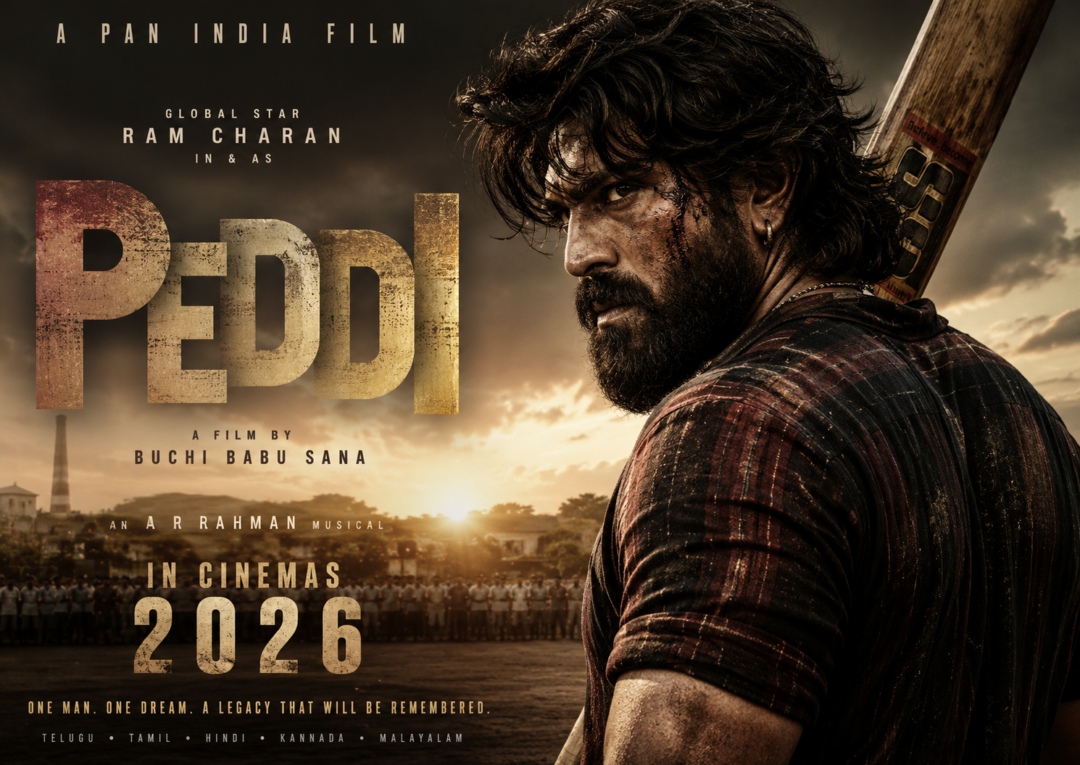
There’s a kind of film that arrives carrying enormous weight — years of waiting, sky-high expectations, and the reputation of everyone attached to it. Peddi is exactly that kind of film. And the honest answer is: it doesn’t fully deliver on all of it. But what it does deliver, particularly Ram Charan’s raw, unforgettable performance, makes it impossible to dismiss.
Directed by Buchi Babu Sana (of Uppena fame) and set in the dusty, sun-baked villages of 1990s Vizianagaram, Peddi is a story about a gifted athlete from a marginalized tribal community who fights — through sport — for something far bigger than a trophy. He fights for his people’s very existence on the map.
It released worldwide on June 4, 2026, in five languages, opened to a massive ₹112 crore globally on day one, and has already sparked a genuine debate about whether it’s a flawed masterpiece or a grand, overlong mess. Let’s break it down properly.
What Is Peddi Actually About?
The word “Peddi” in Telugu comes from “Pedda,” which means big, elder, or someone important in the community. That meaning isn’t accidental — the entire film is built around the idea of becoming someone who matters, not just personally, but for a whole people who’ve been invisible.
The story is set in a village in Vizianagaram, Andhra Pradesh, during the 1990s. Peddi (played by Ram Charan) is a cricketer-for-hire — someone who plays for any team willing to pay him. He’s gifted, he’s wild, and he belongs to a tribal community that literally doesn’t exist on government records. No railway station. No official recognition. When someone falls sick, they can’t even get to a hospital easily.
As the film progresses, Peddi transforms from a cricket mercenary into a wrestler, and then into a runner. Each sport represents a new layer of the fight — and each brings a new mentor, a new rival, and a new dimension to the community’s struggle for identity.
The Meaning Behind the Title
In Telugu, calling someone “Peddi” carries quiet respect. It’s not a boast — it’s a recognition of someone who holds the community together, who shows up when it counts. By the end of the film, you understand why the title was chosen. Ram Charan doesn’t just play a sporting hero. He plays someone his people need to believe in.
The Cast — Who Plays Who
This is universally agreed to be his career-best performance. He transforms completely — physically, emotionally, and in the way he carries silence on screen. Whether he’s playing cricket with reckless energy or wrestling with controlled fury, Charan disappears into the role. The commitment is total.
The film’s weakest link, through no great fault of her own. Her character is underdeveloped, and critics have pointed out she gets far less screen time and depth than the role demands. She’s not unconvincing — she simply isn’t given enough to work with.
The Kannada superstar brings genuine gravitas to his role as Peddi’s wrestling trainer. The scenes between him and Ram Charan are consistently the film’s highlights — layered, physical, and emotionally honest. A casting choice that pays off.
Plays a crucial figure from the community’s past whose unfulfilled dream becomes Peddi’s inherited mission. His arc is emotionally resonant in the first half but critics note his character exits the film without the closure his setup promises.
Divyenndu brings his trademark sharp energy to a pivotal supporting role. Boman Irani, in a smaller part, brings the kind of lived-in dignity that elevates any scene he appears in. Both are well-utilized given the film’s sprawling cast.
“Ram Charan plays his best match in a tiring but undeniably ambitious sports drama.”
Koimoi Review — June 2026
AR Rahman’s Music — Worth the Wait?
Short answer: yes. The longer answer is that Rahman’s score for Peddi does something specific — it doesn’t just accompany the action, it explains the interiority of people who don’t have words for what they feel.
The background score for the wrestling sequences in the second half has been singled out by critics across the board as exceptional. It builds the way tension actually builds — not in sudden bursts but in slow accumulation, until the moment it breaks and the release feels earned.
The songs themselves are a mixed bag in the context of the film’s narrative flow, but several stand out as standalone listening experiences. Rahman reportedly composed the final special number — filmed as recently as April 29, 2026, in Hyderabad — with a “surprise element” that early audiences have called one of the film’s most unexpectedly moving moments.
What Works — And What Doesn’t
The Highs
- Ram Charan’s performance: Every single review — even the harshest ones — agrees this is his finest work. He’s physically transformed and emotionally present in a way that his previous mass entertainers didn’t demand. He carries scenes alone, without dialogue, and it lands.
- The core premise: A community fighting for a railway station — for the simple right to exist on a map — is genuinely moving. The social justice backbone of the film is not superficial. It’s felt.
- Shiva Rajkumar–Ram Charan chemistry: Their scenes together are the film’s structural heart. The mentor-student dynamic is executed with real warmth and physicality.
- Technical craft: Cinematographer R. Rathnavelu’s work is consistently beautiful. The way he frames rural Vizianagaram — the dust, the fields, the low evening light — gives the film a visual poetry that holds even when the script wobbles.
- First half rhythm: The cricket portions of the first half flow well, with genuine momentum and crowd-pleasing energy balanced against emotional weight.
The Lows
- The runtime: At 3 hours and 9 minutes, Peddi is roughly 30–40 minutes too long. The second half in particular loses its rhythm as the film keeps introducing new sports, new rivals, and new subplots that compete for emotional space.
- Janhvi Kapoor’s underdeveloped role: The romantic subplot feels like an obligation rather than an organic part of the story. It interrupts the film’s more interesting threads without adding enough in return.
- The multiple sport pivots: Cricket to wrestling to running — each shift is narratively motivated, but the constant pivoting means none of the three sporting arcs gets the full depth it deserves. It’s three films in one, and not all three are equally strong.
- Jagapathi Babu’s exit: His character is set up with real weight and then resolved too quickly. It’s one of the film’s most discussed disappointments among early audiences.
Box Office — The Numbers So Far
Whatever critics say, the audience showed up. In a big way.
Peddi opened in Telugu, Tamil, Kannada, Malayalam, and Hindi — a genuine pan-India release. The Telugu-speaking states of Andhra Pradesh and Telangana led with massive occupancy, but the Hindi market also showed stronger-than-expected numbers, suggesting Ram Charan’s post-RRR stardom continues to hold nationally.
The film had strong IMAX and premium format bookings — overseas premieres were targeted for June 24 to maximize PLF allocation. Industry trackers put it among the biggest Indian film openings of 2026, and the early trajectory suggests it has a solid chance of being a commercial success even against its massive ₹350 crore budget.
Buchi Babu Sana — The Director’s Vision
After his debut Uppena (2021) — a critically acclaimed rural love story that announced him as a genuine filmmaker with a distinct voice — Buchi Babu Sana had a lot riding on Peddi. And his ambition here is evident in every frame.
He’s clearly trying to make a film that works on multiple levels simultaneously: as a commercial masala entertainer, as a social justice drama, as a sports epic, and as an intimate character study. The problem is that these four films don’t always want to coexist peacefully, and the screenplay struggles to referee between them.
But the instincts are correct. The community at the centre of the story — invisible people fighting for a railway station, using sport as their only available language of protest — is a concept worth building a film around. Where Buchi Babu falters is in trusting the concept enough to let it breathe rather than piling more on top of it.
🎬 Director’s Track Record
- Uppena (2021): Debut film — a rural love story that became a massive hit and announced Buchi Babu as a director who could handle both emotion and visual scale.
- Peddi (2026): His second film and a significant step up in budget and ambition. Shot across Hyderabad, Colombo, Kanyakumari, and Pune over roughly three years.
- Collaborative partners: Works closely with cinematographer Rathnavelu ISC and has now built a second successful creative relationship with AR Rahman — both collaborations visible in Peddi’s strongest moments.
- The style: His films favour rooted, rural settings with heightened emotional drama. He’s not a filmmaker interested in slick urban cool — he wants mud, sweat, and generational weight in his frames.
Should You Watch It?
Here’s the honest breakdown depending on what you’re looking for.
- Watch it if you love Ram Charan: This is his most complete performance to date. No question. Even fans who felt the film itself was flawed have come out talking exclusively about what he does in it.
- Watch it if you appreciate sports films with social weight: Think of films like Dangal or Sultan — Peddi is in that conversation, though less tightly edited than either. If you don’t mind the occasional pacing issue, the emotional core will reward you.
- Watch it if you love AR Rahman’s music: The score alone earns a theatre visit. It’s best experienced loud.
- Think twice if you have low tolerance for long runtimes: At over three hours, and with a second half that tests patience, you need to go in prepared. This is a marathon, not a sprint.
- Watch it on the big screen regardless: Rathnavelu’s cinematography and Rahman’s score are both experiences that shrink on a TV. This is a film built for the cinema hall.
Final Verdict:
Flawed. Ambitious. Unforgettable in Parts.
But Ram Charan’s performance is the kind that gets remembered. Not just in this film’s lifetime, but in the longer story of Telugu cinema. He commits fully, sacrifices the comfort of his star persona, and finds something real inside a character who could easily have been just a sporting superhero.
Buchi Babu Sana dreamed big. He got more right than wrong. And the story he chose to tell — of a people who don’t exist on paper, using sport to demand that someone finally write their name down — is worth sitting through three hours for, even when those three hours occasionally test you.
Buy the ticket. Go for Ram Charan. Stay for the story underneath the story. And let AR Rahman’s music do what it always does — find the emotion you didn’t know you were carrying into the theatre.
In Theatres Now — June 4, 2026