🌏 Market Intelligence | June 2025
India Drops to
7th Spot in
Global Market
Rankings.
Not long ago, we were celebrating. India had climbed to become the 4th largest stock market in the world — overtaking Hong Kong and sitting right behind the US, China, and Japan. It felt like a milestone moment. Something to put on the front page.
Then 2025 happened. And India quietly slipped back to 7th place. No dramatic crash. No single big event. Just a slow grind down — a mix of global money moving elsewhere, a stronger dollar pulling foreign investors out, and a domestic market that ran a little too hot a little too fast.
If you’re wondering what this actually means — for your portfolio, for India’s growth story, and for where things go from here — this piece is for you. Let’s break it down simply, without the jargon.
The Global Rankings — Where Everyone Stands
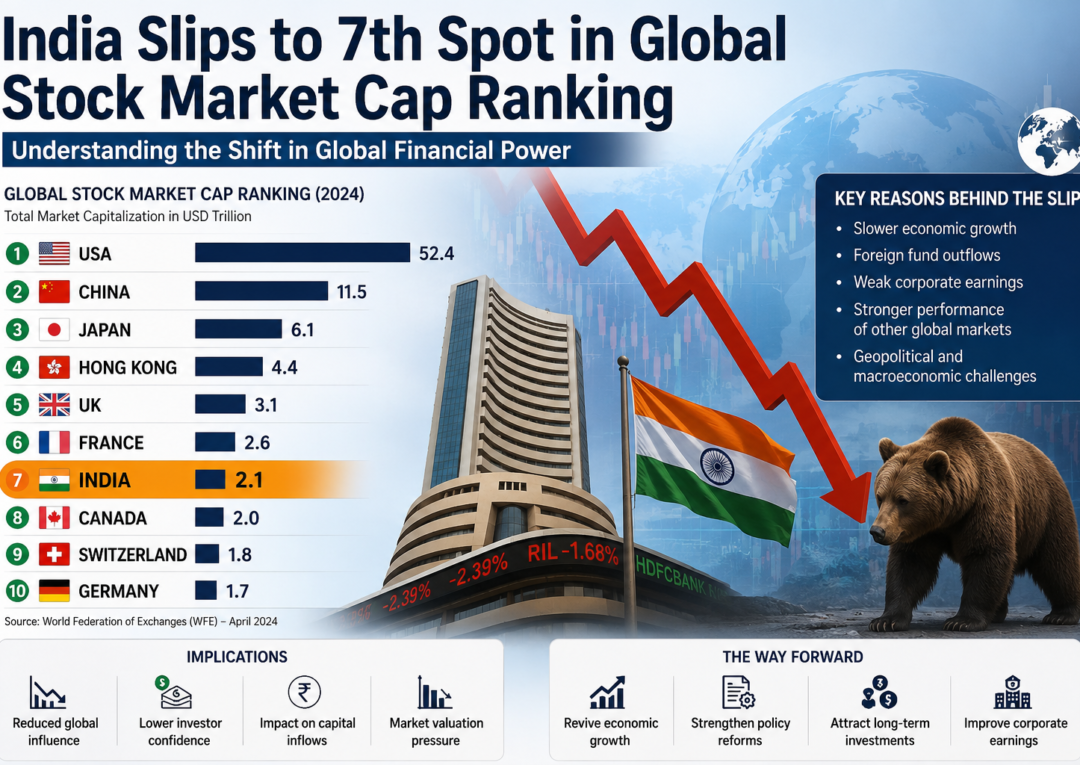
Before we dig into what happened to India, let’s just look at the actual leaderboard. Because context is everything here. The ranking is based on total stock market capitalisation — basically the combined market value of all listed companies in a country.
| Rank | Country | Market Cap (approx.) | Change |
|---|---|---|---|
| 1 | 🇺🇸 United States | ~$50 Trillion+ | ▲ Dominant |
| 2 | 🇨🇳 China | ~$10–11 Trillion | — Stable |
| 3 | 🇯🇵 Japan | ~$6.5 Trillion | ▲ Strong Yen rally |
| 4 | 🇬🇧 United Kingdom | ~$5.5 Trillion | ▲ Recovered |
| 5 | 🇫🇷 France | ~$5.0 Trillion | ▲ Europe re-rated |
| 6 | 🇭🇰 Hong Kong | ~$5.0 Trillion | ▲ China stimulus |
| 7 | 🇮🇳 India | ~$4.9 Trillion | ▼ Down from #4 |
| 8 | 🇨🇦 Canada | ~$3.6 Trillion | — Stable |
India didn’t lose money. What shifted is that other markets gained faster — and in some cases, the currencies of those countries strengthened against the dollar, making their market caps look bigger in USD terms. But there’s more to it than just currency math. Let’s get into the real reasons.
Why Did India Slip? The Real Story
This is the part most news articles skip. They say “India dropped to 7th” and leave it there. But the reasons behind this are actually quite interesting — and once you understand them, the picture looks a lot less scary.
1. The FII Exodus
Between October 2024 and early 2025, Foreign Institutional Investors (FIIs) pulled out somewhere in the range of ₹1.5–2 lakh crore from Indian equities. That’s not a typo. A massive outflow of foreign money happened in a relatively short window.
Why did they leave? Mostly because the US dollar got stronger and US bond yields were still attractive. When you can park money in US treasuries and earn a decent return with almost zero risk, why take the emerging market bet? A lot of global fund managers made that call in late 2024.
2. Valuations Had Run Ahead of Earnings
By mid-2024, Indian small and mid-cap stocks in particular were trading at valuations that were, frankly, stretched. A lot of companies had great stories but the stock prices had run up too fast, pricing in perfection.
When Q2 and Q3 FY25 earnings came in softer than expected — partly due to slowing urban consumption, muted government capex ahead of elections, and margin pressure — the market corrected. Not a crash. But a sustained grind down from those elevated levels.
3. Europe and Hong Kong Had a Moment
Here’s something most people miss. India didn’t just fall — it was overtaken. European markets, particularly France and the UK, saw a significant re-rating in 2025. European stocks had been cheap relative to the US for years, and global investors started rotating in.
Hong Kong had its own catalyst — China announced significant stimulus measures, and Hong Kong-listed Chinese stocks (which include some of the biggest companies in the world) surged. That pulled Hong Kong’s market cap well above India’s again, reversing the 2023 ranking where India had briefly overtaken Hong Kong.
4. The Rupee Effect
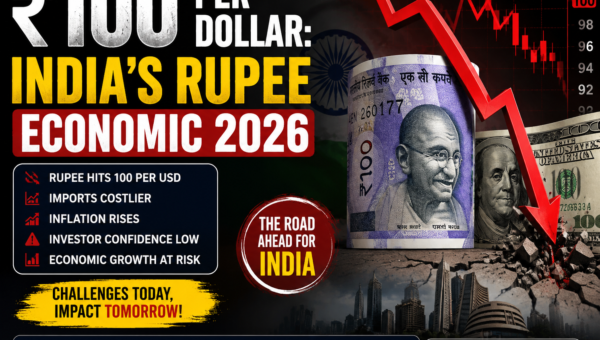
India’s market cap is calculated in US dollars for these global comparisons. When the rupee weakens — say from ₹83 to ₹87 against the dollar — the same Nifty value translates to fewer dollars. A weaker rupee directly reduces India’s apparent market cap on the global leaderboard, even if Indian stocks haven’t moved much in rupee terms.
How Markets Are Actually Responding
The ranking drop didn’t hit all sectors equally. Some parts of the Indian market held up well. Others bore the brunt. Here’s the breakdown that actually matters.
State Bank of India, Bank of Baroda, and other PSU banks held up reasonably well. Their valuations were never as stretched, dividend yields were attractive, and domestic institutional investors stepped in as FIIs stepped out. Not exciting, but resilient.
This is where the correction really hurt. The BSE SmallCap index fell significantly from its peak. Many stocks that had doubled or tripled in 2023–2024 gave back 30–50% of those gains. Retail investors who entered late in the cycle felt this most acutely.
Large-cap IT companies and pharmaceutical stocks acted as relative safe havens. Their revenues are dollar-denominated — so a weaker rupee actually helps their bottom lines. In a down market, these held their ground better than most domestic-focused sectors.
Infrastructure stocks had been on a massive rally on the back of government capex spending. When spending timelines stretched and order book conversion slowed, the sector hit a pause. Not a structural problem — but a timing one. Expectations just got too high.
Urban consumption softened more than expected through 2024–25. Two-wheelers, premium FMCG, and quick commerce businesses saw slower-than-expected growth. The rural-urban spending divide widened in ways that caught several companies off-guard in their earnings guidance.
HAL, BEL, Mazagon Dock continued their multi-year re-rating. Defence indigenisation, export orders, and a sustained government procurement pipeline make this a decade-long structural story. Even in a broadly weak market, quality defence names showed relative resilience.
“India didn’t lose its growth story. It lost the premium the market was paying for it — and that’s actually a healthier place to restart from.”
Market Structure Perspective — Mid 2025
What This Actually Means for You
Let’s be direct. If you’re an investor — whether you’re just starting out or you’ve been doing this for years — here’s the honest take on what this ranking shift means for your money.
🔑 Key Takeaways for Different Investors
- For beginners: A drop in global ranking isn’t a sign that India’s economy is broken. India is still one of the fastest-growing large economies in the world. The stock market and the economy move together over decades — but they can diverge significantly over months or even a couple of years. Don’t panic-sell because of a headline ranking number.
- For SIP investors: This is actually good news in disguise. Nifty at lower valuations means your monthly SIP buys more units. Rupee cost averaging works best when markets are choppy. The correction has brought valuations back to more reasonable territory, particularly in large caps.
- For equity portfolio managers: The FII outflow story will eventually reverse. India’s macro fundamentals — demographics, domestic consumption, digitisation, capex cycle — haven’t changed. When global risk appetite returns and the dollar weakens, India will see significant inflows. The question is just timing.
- For NRIs and dollar-based investors: A weaker rupee actually makes Indian assets cheaper in dollar terms right now. This is historically when smart offshore money starts looking harder at Indian equities — not when the rupee is strong and the market is at all-time highs.
- For traders: The high-beta small and mid-cap space that got hit hardest will also bounce the most when sentiment turns. But selectivity matters more than it did in 2023. Not everything will recover equally. Stocks with real earnings growth and reasonable valuations will separate from the ones that were just riding the wave.
The Path Back to the Top — What Needs to Happen
India reclaiming a top-5 spot isn’t a fantasy. But it’s not automatic either. Here’s what the path forward actually looks like — and what could accelerate or delay it.
Tailwinds Working in India’s Favour
- Earnings recovery: Corporate India’s earnings growth is expected to reaccelerate in FY26. When earnings catch up with valuations, the re-rating happens naturally. Analysts broadly expect Nifty EPS growth of 12–15% in FY26 — healthy but not frothy.
- Government capex kicking in: Post-election, government infrastructure spending is back on track. Roads, railways, defence manufacturing, semiconductor fabs — the pipeline is real. This has a multiplier effect on corporate earnings across sectors.
- FII flows can reverse quickly: The same global money that left India in Q4 2024 can come back faster than most people expect. If US rates start falling and the dollar weakens in 2025–26, emerging markets — and India specifically — become attractive again. India has deep, liquid markets. It’s an easy destination for large-scale inflows.
- Domestic investors are here to stay: One of the structural shifts of the last five years is that domestic mutual funds and retail SIP investors have become a genuine counterweight to FII selling. When FIIs sold in 2024, domestic institutions were there absorbing the supply. This didn’t exist in 2008 or even 2013.
- Rupee stabilisation: A stabilising rupee directly lifts India’s USD market cap. Even without any stock price movement, a rupee recovery from current levels would push India’s ranking higher on the global table.
What Could Keep India Lower for Longer
- Global risk-off continuation: If the dollar stays strong and US yields stay elevated, the “carry trade” that brought money into India stays unattractive. Capital will stay in safe havens rather than EM.
- Earnings disappointments: If FY26 earnings don’t deliver the expected recovery — due to consumption slowdown, margin pressure, or global demand weakness — the market will find it hard to re-rate upward.
- China keeps rallying: The more China’s stimulus drives its market higher, the more Hong Kong and mainland China indices pull global EM allocation away from India. The India-China allocation debate within EM funds is a real factor that doesn’t get enough attention.
The Bigger Global Shift — What It Tells Us
Zoom out for a second. The fact that rankings are shifting this frequently is itself a story about how dynamic global financial power has become. Ten years ago, the top-10 list barely moved. Now it’s reshuffling almost annually.
Japan coming back strong after decades of stagnation. Europe getting re-rated after years of underperformance. Hong Kong recovering on China stimulus. India correcting after a massive multi-year run. All of this is happening simultaneously.
The deeper takeaway for any serious investor — Indian or global — is that country-level rankings should inform your macro view, but not dominate your stock-picking. Great companies in a temporarily out-of-favour market often deliver the best long-term returns. The investors who bought Indian equities during the 2013 currency crisis or the COVID crash didn’t regret it.
Final Read:
The Rank Slipped. The Story Didn’t.
But the ranking is a snapshot in a movie, not the final scene. India’s demographic dividend, domestic consumption story, digital infrastructure build-out, and manufacturing push — none of that reversed in 2025. What reversed was the excess premium the market was charging for it.
Corrections are how markets reset to sustainable levels. And sustainable levels are where the next big rally starts from. The investors who understand this are positioning quietly right now, while headlines scream about India losing its place on the leaderboard.
The rank will move again. The question is — when it moves back up, will you already be positioned, or will you read about it after the fact?
Market Analysis — June 2025