🚀 Defence Technology | 2025
India’s Drone
Just Got
A Precision
Missile.
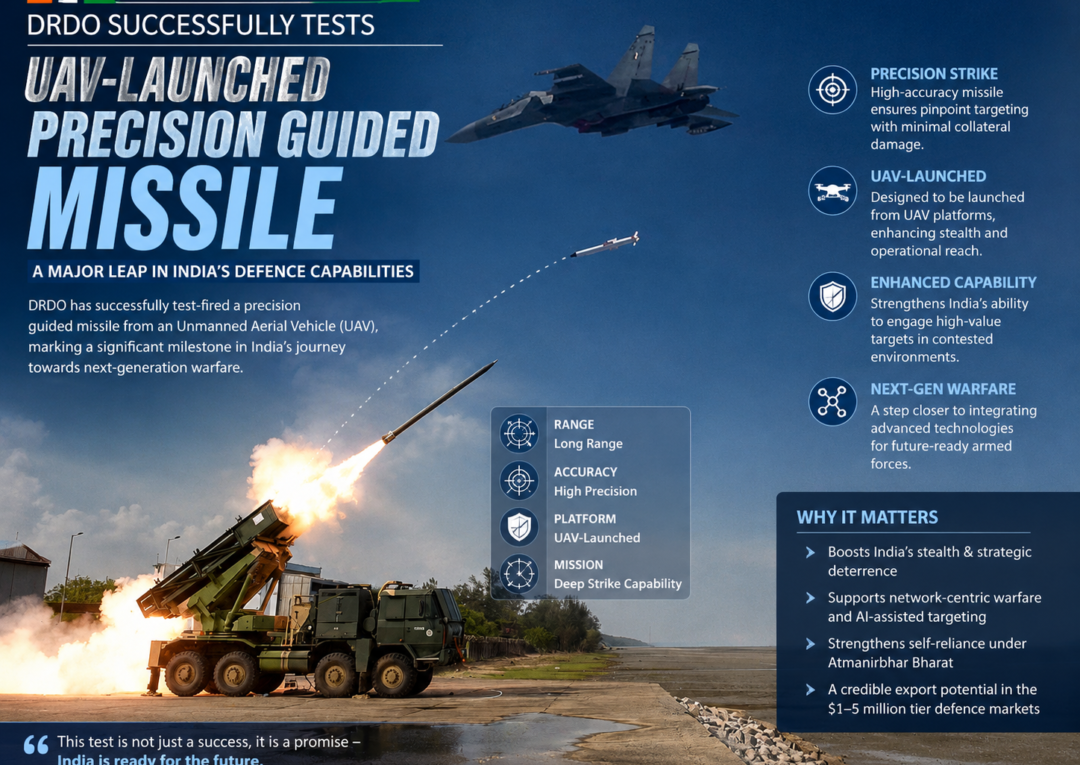
Most big defence news comes with a press release, a ceremony, and a minister holding a scale model. This one was different. DRDO’s successful test of a UAV-launched precision guided missile quietly cleared a milestone that India’s defence establishment had been working toward for years — and the implications reach far beyond a single test range in the desert.
What DRDO just demonstrated isn’t just a new weapon. It’s a new way of fighting — one that puts precision strike capability into unmanned platforms that can be deployed faster, cheaper, and with far less risk to human life than traditional attack aircraft. That changes a lot of equations, not just on the battlefield but in boardrooms, budget meetings, and foreign policy conversations across the region.
For the business reader, the defence enthusiast, or the DRDO scientist who wants to understand exactly why this test matters — this is the full picture.
What Actually Happened — Breaking It Down
Let’s start with what DRDO actually tested, because the terminology matters here and it’s easy to get lost in jargon.
A UAV (Unmanned Aerial Vehicle) — a drone — was used as the launch platform for a precision guided missile. The missile didn’t just fire and hope. It guided itself to the target with high accuracy. That guidance — the “precision” part — is what separates this from a dumb bomb dropped from altitude. It means the weapon can hit a specific target, not just a general area.
The test reportedly validated the complete weapon integration — meaning the UAV’s systems and the missile’s guidance worked together as designed. The missile separated cleanly from the airframe, activated its guidance, and hit its intended target. That sounds simple. In practice, getting every element of that chain to work the first time under real conditions is anything but.
What Kind of Missile — and What It Can Do
DRDO’s precision guided missile family designed for air launch uses a combination of guidance modes — typically inertial navigation combined with terminal seekers (electro-optical, laser, or radar) to acquire and hit targets in the final phase of flight. This multi-mode approach is what gives “precision” its meaning: the weapon can be updated, redirected, or locked to a moving target even after launch.
For the non-technical reader: think of it as the difference between throwing a ball and throwing a ball that can steer itself toward wherever you point the laser. One misses if your aim is off. The other corrects in flight.
Why This Test Changes the Picture — Strategically
India’s two primary security concerns sit on well-defined borders. And both those borders have, over the past few years, seen a specific shift: the proliferation of drones as military tools. The 2021 Jammu airbase attack — the first known drone-based strike on Indian military infrastructure — announced that unmanned platforms were no longer a distant threat. They were already here.
DRDO’s latest test is partly a direct answer to that shift. If adversaries can use drones offensively, India needs offensive drone capability of its own — and this test establishes that India now has precision strike from unmanned platforms. That’s not a small thing.
🎖 Strategic Implications — What Changes Now
- Standoff Strike Without Crew Risk: Precision guided missiles launched from UAVs can engage high-value targets — radar stations, artillery positions, logistics nodes — from a safe distance. The operator stays well behind the line of contact. This completely changes the risk calculus for certain mission types.
- Contested Airspace Penetration: Drones are smaller radar cross-sections than crewed aircraft. A UAV that can now carry and fire precision munitions can potentially operate in airspace that would be considered too dangerous for jets — opening mission sets that weren’t previously viable.
- Swarm + Strike Convergence: India is simultaneously developing drone swarm technologies. The ability to combine swarm tactics with armed UAVs — where some distract, some jam, and some strike — is now a realistic near-term combination. Today’s test is one piece of that larger puzzle.
- Mountain Warfare Relevance: In high-altitude terrain — where conventional logistics and air operations face real constraints — long-endurance armed UAVs provide a persistent overwatch and strike capability that crewed platforms struggle to match cost-effectively. This is directly relevant to India’s northern borders.
- Naval Integration Potential: Ship-launched or carrier-based UAVs with precision strike capability extend India’s naval reach without the expense of additional strike aircraft or the risk of forward basing crewed platforms in hostile maritime zones.
“You don’t need to send a pilot into danger when a drone can do the same job — and now India has proved it can hit precisely from one.”
IndiaThreads Defence Analysis Desk
The Business Angle — Who Actually Benefits
Defence breakthroughs don’t happen in a vacuum. Behind every successful test is an ecosystem of manufacturers, suppliers, system integrators, and policy decisions that determine whether the technology stays on a test range or actually enters service. And this is where the business reader’s attention should be sharp.
India’s defence budget in 2024–25 stood at approximately ₹6.21 lakh crore — and a growing share of that is being directed toward indigenous procurement. The government’s “negative import lists” — categories of equipment that must be bought from domestic manufacturers — have expanded steadily. Precision guided munitions and unmanned systems are both on that list.
The Beneficiary Landscape
Hindustan Aeronautics Limited is the natural integration partner for air-launched weapons systems. As DRDO’s UAV programme scales toward induction, HAL stands to benefit from production orders, integration contracts, and the broader Rustom and MALE UAV programme pipeline.
Bharat Electronics Limited provides the sensors, communication systems, ground control stations, and seeker technologies that precision guided systems depend on. Every guided munition that enters service has significant BEL content — and volume orders are how BEL’s margins improve.
The government’s push to develop defence MSMEs means hundreds of smaller component manufacturers — precision machining, propellants, airframe structures, optics — stand to benefit from increased domestic procurement. This is where genuine industrial deepening happens.
Countries in Southeast Asia, Africa, and the Gulf that are looking for cost-effective armed UAV solutions are potential buyers. India’s competitive pricing, growing diplomatic relationships, and now proven technology make this a credible export proposition — not immediately, but within the decade.
India’s private drone sector — which has grown rapidly on the back of PLI schemes and defence procurement reforms — gains significant credibility and contract pipeline visibility from DRDO’s demonstrated willingness to validate new UAV-based weapon concepts.
The Journey That Led Here
DRDO’s missile journey didn’t start with this test. It’s the result of decades of accumulated capability — some successful, some painfully slow, but always moving forward.
Where India Stands Globally Now
India’s position in the global armed drone landscape is characterized by a strategic pursuit of technological advancement and self-reliance. While the nation has made significant strides in developing indigenous drone capabilities, it faces formidable competition from established players in the field. The emphasis on enhancing domestic production and collaboration with international partners reflects India’s commitment to bolstering its defense capabilities. However, a comprehensive assessment of its current capabilities reveals both opportunities and challenges that require careful navigation to achieve a leading role in this evolving arena.
The United States, Israel, China, and Turkey are the established leaders in armed UAV development. The US Predator and Reaper, Israel’s Harop and Heron TP, China’s Wing Loong and CH-4, and Turkey’s Bayraktar TB2 have all seen real operational use. These aren’t test range successes — they’re combat-proven systems that have shaped conflicts in Libya, Yemen, Azerbaijan, and Ukraine.
- India is not yet at Bayraktar TB2 level operationally — but this test is meaningful because India is now building toward that capability indigenously, not importing it.
- The technology gap is closing: DRDO’s guidance technology, seeker development, and propulsion work have all matured significantly over the past decade. The test validates that integration — the hardest part — works.
- India’s timeline advantage: Countries building from scratch take 15–20 years to reach this point. India’s baseline from IGMDP means the marginal development cost and time for new platforms is far lower than it was for earlier generations.
- The export positioning is real: India is already selling BrahMos to Philippines and defence equipment to 85+ countries. An indigenous UAV-launched precision missile system — once mature — fits directly into India’s emerging tier of export-grade military hardware.
What Comes Next — The Roadmap
A successful test is step one. Getting from a validated prototype to an operational, battle-ready system is a completely different challenge — and one that India has historically taken longer to complete than the initial test milestones suggest.
Near-Term (1–3 Years)
- Multiple developmental trials across varied conditions — altitude, temperature, electronic countermeasure environments — to fully qualify the weapon system.
- Formal user trials by Indian Army and Air Force, which will generate requirements for modifications before production clearance.
- Integration testing with the specific UAV platforms India plans to deploy — whether Rustom-2, the MALE UCAV, or platforms yet to be selected.
Medium-Term (3–7 Years)
- Production order clearance and manufacturing line setup — either through HAL, a private defence company, or a joint venture structure.
- Initial operational capability with frontline units, likely starting with the Army’s high-altitude reconnaissance and strike requirements.
- Potential export qualification process beginning with friendly nations currently in conversation about India’s defence exports portfolio.
Long-Term (7–15 Years)
- Full operational integration of armed UAV squadrons into India’s three-service warfighting doctrine.
- Second-generation development — stealth airframes, AI-assisted targeting, network-enabled swarm operations — building on today’s validated baseline.
- A credible export product that competes with Turkish and Israeli systems in the $1–5 million per unit price bracket for mid-tier defence markets.
Final Read:
This Test Is a Promise — Now India Must Keep It.
The strategic value is real: unmanned precision strike changes how India can project force, deter adversaries, and protect its interests without escalating to crewed aircraft missions in contested airspace. The economic value is also real — every system that India produces and eventually exports is rupees that would otherwise have left the country.
But history suggests that celebrating test success is the easy part. Programmes that validated successfully in 2010 are still working through induction in 2025. The organisations and people involved in today’s test need the same institutional support, funding continuity, and procurement follow-through to turn this milestone into a deployed capability. That’s the harder challenge — and the one that ultimately determines whether this test is a turning point or just a headline.
The drone has fired its missile. The real test of India’s defence ambition is what happens in the decade that follows.
Defence Analysis — 2026