🚀 Space Exploration | Updated April 2026
Astronauts Can’t Be
Stopped at Earth
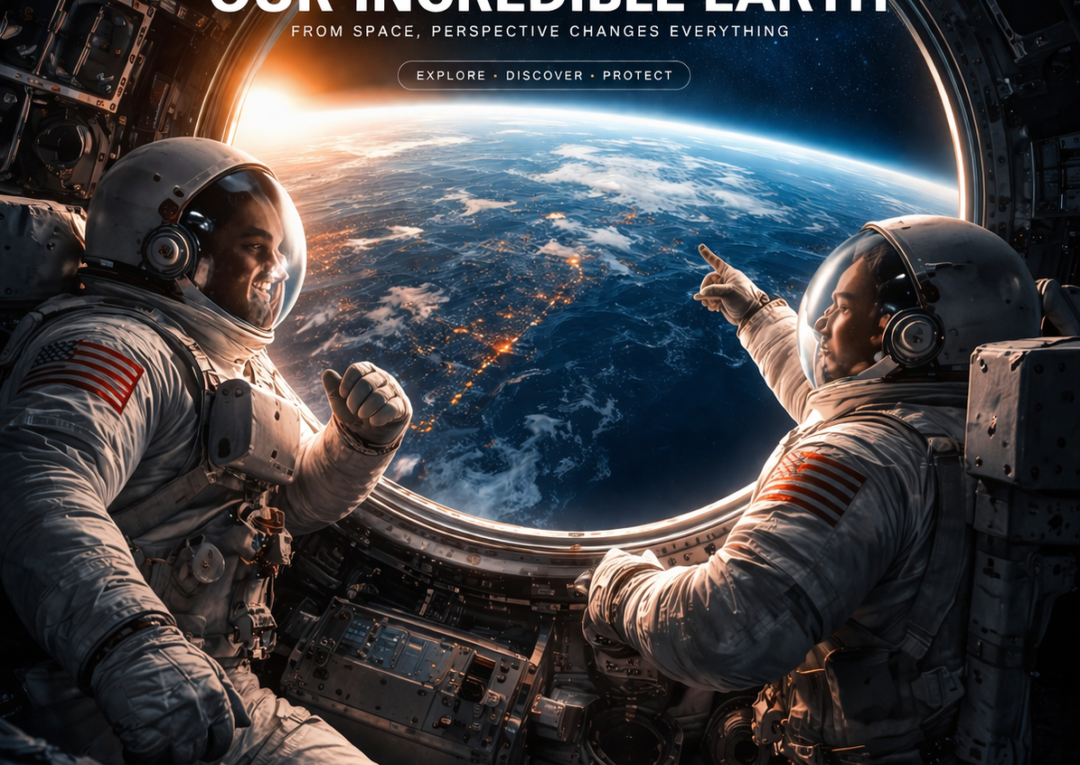
Imagine looking out of a window — and instead of your street, your city, your country, you see the entire planet Earth floating silently in black space. No borders. No noise. Just this brilliant, fragile blue marble hanging there like it’s the most precious thing in the universe.
That’s exactly what astronauts see every single day aboard the International Space Station (ISS). And almost every one of them says the same thing: nothing could have prepared them for it. They cry. They go silent. Some say it completely changes how they think about life. There’s even a name for what happens to them — the “Overview Effect.” Let’s talk about what’s really going on up there, and why it matters to all of us down here.
What Do They Actually See?
Let’s be real — most of us have seen photos of Earth from space. But photos don’t come close to capturing what astronauts describe seeing with their own eyes.
From the ISS, the view is massive. You can see entire continents at once. The Himalayas look like tiny wrinkles on a beach ball. The Amazon rainforest is a deep green smudge. City lights at night form glowing webs across the dark side of the planet — and during the day, the thin blue line of the atmosphere hugging the planet looks almost impossibly delicate.
The Atmosphere — That Thin Blue Line
One of the most striking things astronauts report is how thin Earth’s atmosphere looks from space. Scientists describe it as the equivalent of the skin on an apple — just a tiny, thin layer between us and the vacuum of space.
Astronaut Ron Garan once described it as humbling in the most visceral way — seeing that wafer-thin atmosphere protecting all of life as we know it. That’s the moment many astronauts realize just how vulnerable our planet actually is. Not in a textbook way. In a gut-punch, deeply personal way.
“The Earth is not just our home. From up there, it looks like all we’ve got — and it’s magnificent.”
Paraphrased from ISS astronaut accounts
The Overview Effect — Science Meets Emotion
A well-documented cognitive shift that happens to astronauts when they see Earth from space — a sudden, overwhelming sense of perspective, interconnectedness, and responsibility for our planet.
This isn’t just poetic language. The Overview Effect is a real, documented psychological experience first described by author Frank White in 1987, and since validated by hundreds of astronaut accounts and several scientific studies on cognitive shifts in space travelers.
What exactly triggers it? Scientists believe it’s a combination of things — the visual scale of the view, the complete absence of human-made borders (which exist on maps, not on Earth), and the cognitive dissonance of feeling both incredibly small and deeply connected to something massive at the same time.
What Happens Inside Your Brain?
Neuroscientists who’ve studied this say the Overview Effect likely activates the brain’s default mode network — the same system involved in self-reflection and perspective-taking. When you suddenly realize you can see your entire civilization from a window, the brain processes it as a profound shift in identity and belonging.
- Borders disappear: Astronauts universally report that seeing Earth without geopolitical lines makes nationalism feel strange and arbitrary.
- Scale resets everything: Wars, arguments, traffic jams — all of it shrinks to near-nothing when viewed from 400 km up.
- Urgency about climate becomes real: The thinness of the atmosphere and visible environmental damage (dust storms, deforestation) become shockingly apparent.
- Awe becomes overwhelming: Many astronauts report involuntary emotional responses — crying, laughing, going completely silent for long stretches.
In Their Own Words
Words from astronauts who’ve actually been there. These aren’t press-release quotes — these are real reflections from people whose worldview literally shifted the moment they looked out that window.
🌌
“I had an overwhelming sense that this planet we share is far too beautiful to be destroyed by human indifference. Seeing it from up there, you can’t stay passive.”
🪐
“There are no lines. No borders. Just one incredibly fragile, gorgeous planet. You don’t feel patriotic up there — you feel human.”
🔭
“When asked how India looks from space, I said — Saare jahan se achha. More beautiful than anything in the world. And I meant the whole world.”
Why This Matters — Especially for You
If you’re a student reading this — and let’s be honest, most people reading space content these days are — here’s why this isn’t just cool trivia.
🌱 Climate Change Gets Real
Every astronaut who sees Earth from space comes back more convinced than ever that climate change is the defining challenge of our time. The atmospheric thinning, the shrinking ice caps, the visible dust over continents — it’s all strikingly visible from orbit. This isn’t ideology. It’s optics. Literally.
That should matter to anyone studying science, engineering, policy, or literally anything else — because it shapes the world every future career will operate in.
🚀 Space Is Closer Than Ever
With SpaceX, ISRO, Blue Origin, and several new private space companies actively developing human spaceflight, the generation of students alive today may very well be the first to experience commercial space tourism as something ordinary — not a childhood dream, but a weekend trip.
India’s own space program (ISRO) is actively working on the Gaganyaan mission — India’s first crewed spaceflight. If all goes well, Indian astronauts will orbit the Earth in a spacecraft designed and built in India. That’s historic. And it’s happening soon.
🧬 The Science of Wonder Is Real Science
The Overview Effect is studied by psychologists, neuroscientists, and even philosophers. Awe — the emotion it produces — has been shown in research to improve creativity, reduce anxiety, and increase prosocial behavior. In plain words: feeling genuinely amazed makes you a better thinker and a better human.
Understanding this isn’t just feel-good fluff. It’s actively informing how space agencies prepare astronauts, how long-duration missions are structured, and how future Mars missions will handle crew mental health over multi-year journeys.
- Sunrises every 90 minutes: ISS astronauts technically experience 16 sunrises per day — each lasting just a few minutes. Imagine that as your alarm clock.
- No weather from up there: Cloud formations look elegant and calm from orbit. A hurricane looks like a beautiful white spiral. It’s terrifying and gorgeous at the same time.
- City lights tell human stories: At night, you can see the dramatic contrast between North and South Korea — one blazing with light, one almost entirely dark. Geography becomes sociology from up there.
- The Moon looks different too: From the ISS, the Moon appears as a pale grey disk against the blackness of space — no blue sky to soften it. It feels closer and colder than it does from Earth.
India’s Space Moment
It’s worth spending a moment on India’s role in all this — because it’s a genuinely exciting story right now.
ISRO’s Chandrayaan-3 mission in 2023 made India only the fourth country to successfully land a spacecraft near the Moon’s south pole. That was a global milestone. And the Gaganyaan program — India’s human spaceflight mission — is currently in advanced stages. Once it flies, India will join an extremely short list of countries that have independently sent humans to space.
For Indian students especially, this is the moment to pay attention. The scientists, engineers, and mission controllers making this happen are graduates of IITs, NITs, and regional engineering colleges across the country. The next generation of space professionals is sitting in classrooms right now.
“When Rakesh Sharma looked down and called India ‘Saare jahan se achha’ — he didn’t just mean India. He meant all of it.”
The Overview Effect, applied
Final Thought:
Look Up — And Keep Looking
The view of Earth from space is more than a pretty picture. It’s a perspective shift that has changed the thinking of every single human being who has ever experienced it. And through their words, their photos, and their stories — it can change yours too.
Astronauts don’t come back from space worried about the same small things. They come back worried about the big ones — and inspired to do something about them. That’s not a bad way to move through the world.
The planet is phenomenal. We just need to remember to act like it. 🌍
Science
Space
Recommended Read