🌏 Geopolitics & Tech | May 2026
Trump Flew to Beijing With
America’s
Tech Titans.
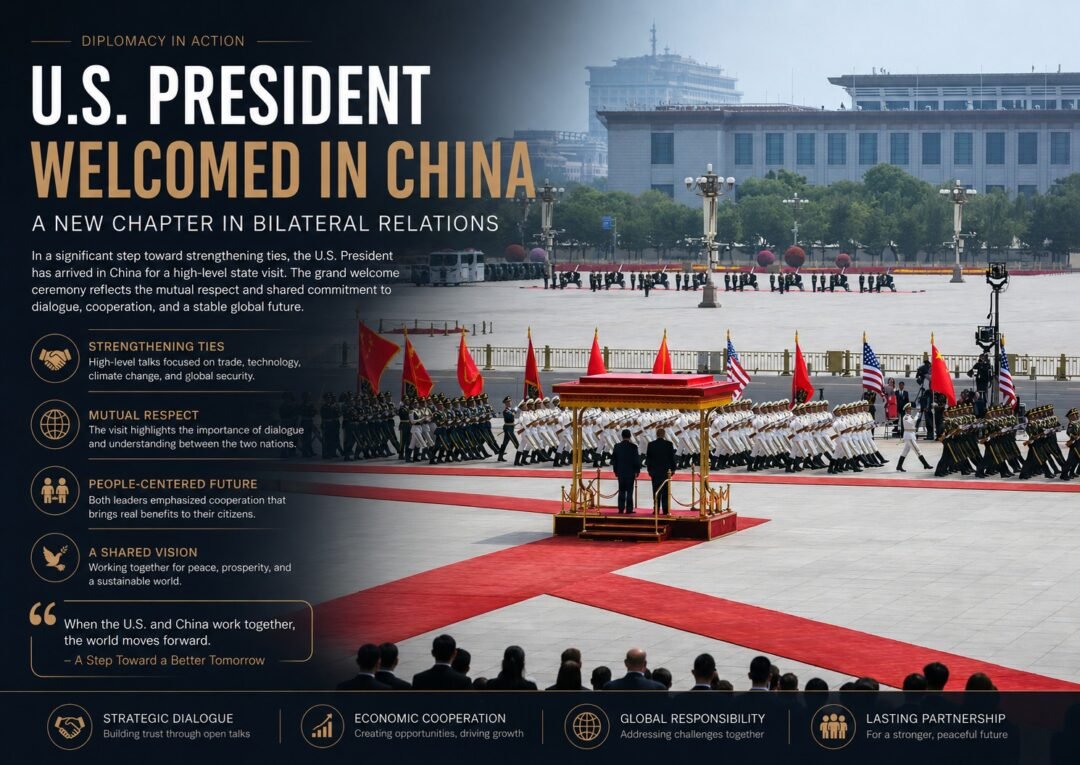
Picture this: the US President boards Air Force One — and sitting beside him are Elon Musk, Tim Cook, and Jensen Huang. The plane touches down in Beijing. The last time a sitting American president stepped foot on Chinese soil was nearly a decade ago.
This isn’t just a diplomatic visit. It’s a statement. Trump brought Silicon Valley’s most powerful names to the table with China’s President Xi Jinping — and the world watched to see what would happen next.
What came out of those two days in Beijing will shape global trade, the AI race, semiconductor supply chains, and the future of US-China relations for years. This is the full story — what happened, who was there, what each player wanted, and why it matters for everyone, including India.
Why Trump Went to Beijing — And Why Now
After a year of bruising tariff battles — where both sides slapped each other with levies north of 100% — something shifted. By late 2025, both Washington and Beijing quietly agreed to a trade truce on the sidelines of APEC. Tariffs came down. Rare-earth export restrictions were paused. A fragile peace was established.
But a truce isn’t a deal. And the world’s two largest economies — together accounting for over 40% of global GDP — needed more than a temporary ceasefire. They needed a conversation. A real one.
There’s also a broader geopolitical context here. The Iran war has been consuming US strategic bandwidth. China, watching carefully, has been calculating its own leverage. Trump needed to show China that America wants business — not just confrontation. And what better way to signal that than arriving with the CEOs of Apple, Tesla, Nvidia, Boeing, BlackRock, Meta, and a dozen others?
Who Was on The Plane — and What They Wanted
This wasn’t a random guest list. Every CEO on that plane had skin in the game with China. Here’s a breakdown of the key players and what they were really there for.
Musk’s Tesla generates enormous revenue from China — his Shanghai Gigafactory has produced over 4 million vehicles since 2019. But the big ask in Beijing? Full Self-Driving (FSD) approval in China. Tesla has been waiting for Chinese regulators to greenlight its autonomous driving features for years. Getting that clearance could be worth billions. Musk told reporters at the Great Hall of the People that he wanted to accomplish “many good things” — classic Musk understatement.
Apple is the largest smartphone brand in China — and also the most vulnerable. China is both Apple’s biggest factory floor and one of its biggest markets, with Foxconn assembling the bulk of iPhones there. Cook is a master of diplomatic navigation: he’s already gotten Apple exempted from tariffs twice. In Beijing, he wanted a stable operating environment — no sudden regulatory crackdowns, continued supply chain access, and a calmer backdrop for Apple’s $275 billion investment commitment to China.
Huang was a last-minute addition — boarding the plane at a stopover in Alaska. That detail alone tells you how urgent his situation is. Nvidia lost essentially its entire China market share after US chip export restrictions kicked in. The company went from dominating 95% of China’s AI chip market to near zero. Huang wants back in, specifically with Nvidia’s H200 chips. Shortly after Trump’s meeting with Xi, reports emerged that Washington had cleared H200 sales to several major Chinese tech firms. His meeting with Chinese officials, Huang said, went “excellently.”
Boeing needed this trip badly. Chinese airlines had been refusing to accept Boeing aircraft during the trade war — a brutal blow to America’s largest exporter. The payoff came fast: Trump told Fox News that China agreed to buy 200 Boeing 737 Max jets, up from an earlier deal for just 50 aircraft. That’s a headline breakthrough that no amount of lobbyist work could have delivered as quickly.
The supporting cast was just as powerful. BlackRock’s Fink and Citi’s Fraser have been pushing for China to ease restrictions on foreign financial services firms. Meta wants deeper supply chain partnerships. Qualcomm and Micron need chip market clarity. Cargill wants the agricultural boycotts — China had stopped buying US soybeans — to end. Xi reportedly agreed to resume soybean purchases, a big win for American farmers who’ve been suffering since 2025.
The Real Agenda: AI Chips vs Rare Earths
Here’s the most important thing to understand about this summit — it wasn’t really about tariffs anymore. Tariffs are so 2025. The real battleground in 2026 is something far more strategic.
As one economist put it: “Unlike the country Trump visited in 2017, China is no longer getting rich by stocking the shelves of Costco.” The trade war has evolved into a tech war. And the most powerful weapons on both sides aren’t import taxes — they’re export controls.
“The trade war is now a tech war — and the AI supply chain is its most critical battlefront.”
Fortune / CEO Daily — May 2026 Analysis
The US controls the world’s most advanced AI semiconductors. Nvidia’s chips — particularly the H100 and H200 — are what power modern AI models. Without them, Chinese AI companies like DeepSeek and Baidu are at a serious disadvantage. That’s why China’s biggest retaliation card is different: rare earth minerals.
China controls the production and processing of over 80% of the world’s rare earth minerals — the materials essential for everything from electric vehicles to fighter jets to smartphones. Beijing had already started curbing rare earth exports to the US as a retaliatory measure. That creates a genuine chokehold that the US can’t easily replicate or bypass.
This is why Jensen Huang’s presence mattered so much. Nvidia selling back into China isn’t just good for Nvidia’s revenue — it’s the central chip in a much larger diplomatic exchange.
How We Got Here — The Timeline
The Global Impact — What It Means for the World
The Beijing summit isn’t just a US-China story. When the world’s two largest economies sit down and decide to stabilize their relationship, the ripples reach every corner of the globe. Here’s how it plays out.
Markets globally were watching this summit like hawks. Any sign of de-escalation between the US and China reduces uncertainty across supply chains, commodity prices, and tech sector valuations. The early deal signals — Boeing jets, soybeans, Nvidia chip access — sent positive ripples through equity markets.
A more cooperative US-China relationship is a double-edged sword for India. On one hand, lower geopolitical tension is good for global trade and commodity prices — which helps India’s economy. On the other hand, if Apple stabilizes its China supply chain, the pressure to shift manufacturing to India eases. India’s moment as the alternative manufacturing hub may be less urgent than it looked a year ago.
If Nvidia gets to sell H200 chips back into China, the global AI race gets more complicated. Chinese companies could once again access cutting-edge US hardware — potentially accelerating their AI development. But the alternative — a totally closed Chinese AI ecosystem built on Huawei chips — might ultimately create a more dangerous long-term competitor. There’s no clean answer here.
200 Boeing 737 Max jets is a headline-grabbing deal. It breaks a yearslong drought in Chinese aviation orders for Boeing. The order backlog pressure eases. US manufacturing employment in aerospace gets a visible boost. And it gives Trump a clear “win” to show American voters — deals done, jobs secured.
American soybean farmers have been among the hardest hit by China’s retaliatory boycott since 2025. Xi’s reported agreement to resume soybean purchases offers real economic relief to US agricultural states — the ones that voted Trump in. Smart politics, real economic impact.
With the US distracted by Iran and now warming to China on trade, Taiwan is watching every word exchanged between Trump and Xi with extreme anxiety. Analysts warn that Trump might soften official US language on Taiwan — either as a trade chip or in a moment of unscripted warmth. That would send shock waves through Asia’s security architecture.
“We are the two largest economies on the planet — and how we interact largely determines how the global economy performs.”
Mark Zandi, Moody’s Analytics Chief Economist
The Geopolitical Subplots Nobody’s Talking About
Every summit has the headline agenda — and then the real agenda underneath. Here’s what’s quietly running in the background of the Beijing talks.
Iran: The Elephant in the Room
The ongoing Iran war has dominated US foreign policy bandwidth for the past year. China has maintained relationships with Iran throughout — economically and diplomatically. The Beijing summit discussions on Iran are significant: the US needs China’s cooperation (or at least non-interference) in managing the conflict. That’s a chip China can play. And it’s likely behind some of the flexibility being shown on trade.
Taiwan: The Landmine
Georgetown professor Arthur Dong put it bluntly: “If China were to contemplate an attack on Taiwan, this might be the opportune moment.” With US attention split between Iran and domestic politics, and with a summit emphasizing warmer relations, there’s concern that Trump might inadvertently signal reduced US commitment to Taiwan. China is, according to analysts, “super focused” on any language shifts from Trump on Taiwan. Every word matters.
The “Board of Trade” Framework
One of the structural outcomes being discussed is a bilateral Board of Trade — a formal mechanism to manage commerce between the two countries in non-sensitive sectors. Think of it as guardrails: a way to keep economic cooperation flowing without either side having to make politically explosive concessions on the sensitive stuff (semiconductors, military tech). It’s pragmatic, unglamorous, and probably the most durable outcome of the summit.
What This Means For India
India watches the US-China relationship like few countries on earth. Here’s the real-world impact.
- Manufacturing shift slows: If Apple stabilizes its China supply chain, the urgency to diversify manufacturing to India reduces. India needs to keep demonstrating operational excellence — cost, speed, infrastructure — to remain attractive regardless of US-China dynamics.
- Tech supply chains: Indian tech companies — especially in semiconductor assembly, electronics, and software — benefit from a world where US-China tech decoupling is partial, not total. Complete decoupling would force India to choose sides more explicitly.
- Diplomatic balancing: India’s “strategic autonomy” — maintaining relationships with both the US and Russia/China — gets tested when Washington and Beijing warm up. India needs to manage its own bilateral relationships carefully rather than relying on US-China tensions to do its strategic work.
- Rare earths: India has significant rare earth deposits — and this summit’s focus on the US-China rare earth-for-chips dynamic highlights India’s own potential as an alternative supplier. This is a medium-term strategic opportunity that the Indian government is starting to take seriously.
- Markets: A more stable US-China relationship generally reduces global volatility — good for Indian equity markets, good for the rupee, good for FII flows. Short term, the Beijing summit outcome is modestly positive for Indian financial markets.
What to Expect Next
This summit was billed as the first of four expected meetings between Trump and Xi in 2026 — including a likely reciprocal state visit to the US. That framing is important: it signals both sides want a sustained diplomatic rhythm, not a one-off photo op.
- Watch the Nvidia H200 deal closely: Reports suggest sales were cleared to major Chinese tech firms. But the political backlash from US China hawks in Congress could complicate implementation. This isn’t over until it’s formalized.
- Board of Trade formation: The bilateral trade management body, if formally established, could become a lasting institutional framework for US-China commerce — insulating business relations somewhat from political volatility.
- Taiwan language: Analysts will parse every word of the summit’s joint communiqué for any softening of US position on Taiwan. That’s the real read from the foreign policy community.
- Rare earth deal or no deal: If China fully reverses its rare earth export controls in exchange for chip access, that’s a major win for US industry. If it doesn’t — watch for continued pressure on the US to build domestic supply chains.
- Boeing deliveries: 200 jets is a lot of planes. Watch if Chinese airlines actually start accepting Boeing aircraft again — that’s the real-world indicator of whether the deal means what it sounds like.
Final Thought:
The World Just Changed — A Little.
The deals announced are real. Boeing jets, soybean purchases, Nvidia chip access — these aren’t symbolic gestures. They’re economic lifelines for specific industries that have been bleeding for a year. And the structural conversations — the Board of Trade, the AI chip-for-rare-earth swap, the Taiwan language calibration — will define the next chapter of this relationship.
But let’s be clear-eyed: this isn’t a reset. It’s a recalibration. The tech war between the US and China isn’t going away — it’s just being managed more intelligently now. The AI race, the semiconductor battle, the rare earth chokehold — these tensions are structural, not situational. One summit can’t fix them.
What the Beijing summit can do — and what it appears to have done — is buy everyone a bit more time. Time to negotiate. Time to build alternatives. Time to avoid the kind of catastrophic miscalculation that neither side can actually afford. In geopolitics, sometimes buying time is the win.
Geopolitics — May 2026