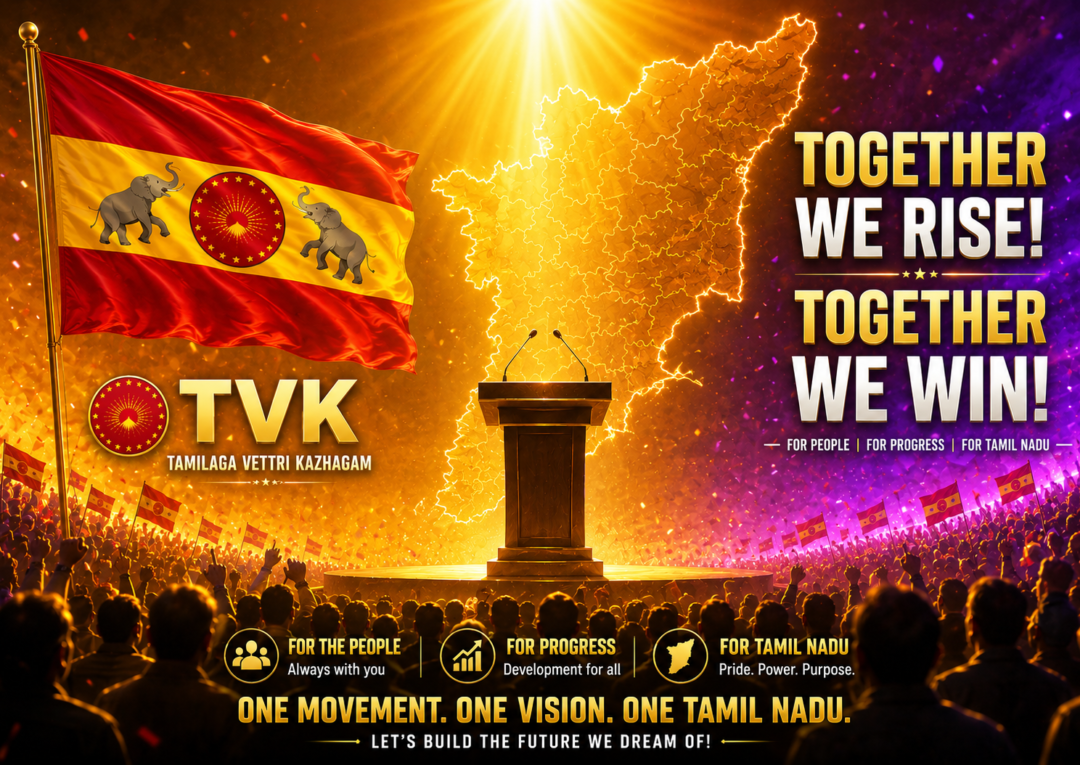
🏛 Tamil Nadu Politics | May 2026
TVK Storms
Tamil Nadu:
What Vijay’s
Move Means.
Tamil Nadu has seen a lot of things. Dravidian politics that rewrote the national playbook. Film stars who became chief ministers. Mass movements born from cinema halls. But what Thalapathy Vijay is attempting with Tamilaga Vettri Kazhagam (TVK) feels different — and political observers across the country are paying close attention.
This isn’t just another actor entering politics. This is the most famous Tamil star of his generation, with arguably the most passionate fanbase in the state, walking into a deeply entrenched political landscape — and trying to crack it open. Whether that’s ambition, conviction, or both, the effect on Tamil Nadu’s political arithmetic is already being felt.
Let’s break down what TVK actually is, where it stands today, what the challenges look like — and why this story matters well beyond the borders of Tamil Nadu.
So Who Is Vijay — And Why Does It Matter?
If you’re outside Tamil Nadu, you might know Vijay as the star of blockbusters like Mersal, Bigil, and Leo. But inside the state, he’s more than that. He’s a cultural force. His films routinely open to massive crowds and emotional scenes at theatres. Fan clubs that function like micro-organisations. Collectors’ editions, all-night queues, full-page newspaper ads on his birthday.
That kind of cultural capital doesn’t just disappear when someone announces a political party. It transfers — sometimes cleanly, sometimes messily — into political energy. And that’s exactly what Vijay is banking on.
What’s notable is how carefully scripted the party’s entry has been. Vijay stepped back from films. He’s been deliberately avoiding sensational controversies. The messaging has been measured, sometimes even cautious. This isn’t the noisy, chest-thumping entry you’d expect from a film star. It’s something more calculated — which itself tells you this isn’t a vanity project.
The Political Landscape TVK Is Walking Into
Tamil Nadu politics has been a duopoly for decades. DMK and AIADMK have traded power so consistently that political scientists use the state as a textbook case of two-party dominance. Anyone who’s tried to break that pattern — including major national parties — has mostly walked away humbled.
The BJP’s presence in Tamil Nadu remains limited despite aggressive attempts at expansion. The Congress operates largely as a junior partner. Smaller regional parties like DMDK, PMK, and MDMK exist, but they’re alliance pieces — not independent power centres. The last genuine political disruption from cinema was MGR founding AIADMK in 1972, and then Jayalalithaa consolidating it over decades.
“Tamil Nadu doesn’t give power to newcomers easily. But it has always had a soft spot for genuine outsiders who speak the language of ordinary people.”
Political Observer — May 2026 Perspective
So the question isn’t whether TVK can win in 2026 outright — most analysts say that’s unlikely in a first attempt. The real question is whether TVK can become the third force that pulls the political centre of gravity and forces alliances, trades, and concessions. That’s a more achievable — and in some ways more powerful — position to be in.
The Current Power Structure
- DMK (in power): M.K. Stalin’s government has been consolidating its base through welfare schemes, industrial investment drives, and Dravidian identity politics. Strong in urban Tamil Nadu, but facing anti-incumbency in pockets.
- AIADMK (in opposition): Edappadi Palaniswami leads a party that’s still rebuilding after the post-Jayalalithaa leadership crisis. A weakened opposition actually hurts the state — and opens space for a credible third option.
- BJP: Has national backing but faces a cultural headwind in Tamil Nadu. Its alliance politics are complicated, and its Dravidian identity gap hasn’t closed meaningfully.
- TVK (new entrant): No elected representatives yet. High visibility. Unclear vote-to-seat conversion potential. But capable of being a kingmaker if it crosses even 15–20 seats.
How TVK Is Actually Positioned — The Sector Analysis
Think of it like a market entry. TVK isn’t trying to win the whole market in year one. It’s trying to establish presence, find its core voter segment, and create optionality for 2031 and beyond. Here’s how the different political “segments” are being approached.
Tamil Nadu has a large, educated but underemployed youth population. Vijay’s messaging on job creation, startups, and skill development speaks directly to this segment. His film-era fan clubs are skewed young — and if even 40% of that convert to active voters, it’s a meaningful base.
Urban visibility is easy. Caste equations and rural community leaders in districts like Vellore, Salem, and Tirunelveli are where elections are won. TVK hasn’t yet demonstrated deep grassroots penetration here. This is the gap that most observers are watching most carefully.
Tamil Nadu’s industrial corridor — from Chennai to Hosur — runs on stable governance. A credible third party that speaks pro-investment language without the baggage of entrenched political patronage networks is something that business chambers are watching with interest, even if privately.
Tamil Nadu’s caste arithmetic is deeply complex. BC, MBC, and minority communities vote in blocs that parties spend years cultivating. TVK is attempting to build a pan-community appeal — anti-caste discrimination in its party constitution — but converting that into actual caste-community leadership will take time.
The global Tamil diaspora — particularly in Singapore, Malaysia, the UK, and North America — has emotional attachment to Tamil Nadu politics. Vijay has a massive international fanbase. Diaspora funding and narrative support could give TVK reach that purely ground-level parties can’t match.
TVK’s digital presence is formidable. The party’s launch events trended nationally. Vijay’s political statements get amplified far beyond Tamil Nadu. In the current media environment, this translates into genuine brand equity — and in close contests, brand equity can swing seats.
The TVK Timeline — From Star to Statesman
The Challenges Nobody Is Talking About
The TVK story gets a lot of excitement, especially in media. But the real political analysis has to be harder-eyed than that. There are genuine structural challenges Vijay’s party faces — and how it handles them will determine whether TVK is a long-term force or a cycle-one disruption.
⚡ The Real Challenges for TVK — 2026 and Beyond
- Organisation vs. Enthusiasm: Fan energy is real but it’s not the same as a party cadre. DMK’s ground-level organisation, built over decades, operates in every booth in every constituency. Building that kind of booth-level machinery in two years is genuinely hard. Enthusiasm doesn’t knock on doors at 6am on election day. Cadre does.
- The Caste Arithmetic Problem: Tamil Nadu’s elections are won and lost on caste mobilisation more than ideology. TVK’s anti-caste positioning is aspirationally right — but operationally, every party still has to negotiate with caste community leaders for votes. How TVK navigates this without compromising its stated values is the central tension.
- Alliance Trap: If TVK allies with DMK, it risks being absorbed and losing its “outsider” brand. If it allies with AIADMK, it alienates anti-establishment voters. If it goes alone, it may win the narrative battle but lose seats. This is the strategic dilemma that no amount of popular support resolves cleanly.
- Vijay as Sole Centre of Gravity: Right now, TVK is Vijay. There’s no second or third leader with independent political identity. That’s a vulnerability — in politics and in any organisation. What happens if Vijay steps back, takes a health break, or makes one badly received statement?
- First-Mover Tax: Every new party in Tamil Nadu has faced a credibility test in its first election — including MGR’s AIADMK in its early years. Voters often “waste” their vote tactically in a first cycle, waiting to see if a party can win before committing. TVK needs to clear that threshold.
What This Means Beyond Tamil Nadu
Here’s the part that national political watchers are paying attention to — and rightly so.
Tamil Nadu is not just any state. It’s the sixth largest economy in India, home to a significant chunk of India’s manufacturing and IT output, and a state with an unusually politically engaged electorate. What happens here sets patterns.
More importantly, the TVK model — a credible, non-traditional political entry that combines cultural capital with a structured policy agenda — is being watched as a potential template. Across India, regional politics is fragmenting. Voter trust in established parties is declining in survey after survey. The appetite for new options is real.
Three Scenarios Worth Modelling
- Breakout Performance (15–30 seats): TVK establishes itself as the credible third force. Alliance value becomes enormous. Vijay enters the national political conversation as a serious figure. DMK and AIADMK are forced to reckon with a permanent competitor. This is the scenario that transforms Tamil Nadu politics.
- Respectable First Round (5–14 seats): TVK wins enough to be relevant, loses enough to stay hungry. The party survives the first cycle, learns from it, and builds for 2031. This is probably the most likely scenario — and it’s still a good outcome for a two-year-old party.
- Below Expectations (0–4 seats): The fan base doesn’t convert to votes at scale. Structural caste arithmetic doesn’t break TVK’s way. The party faces an existential credibility question. Even here, Vijay’s political capital isn’t gone — but the rebuild becomes harder.
Final Read:
This Story Is Just Getting Started.
Tamil Nadu politics rarely rewards impatience. The state’s voters are sophisticated — they test new entrants carefully, give cautious first mandates, and reserve full trust for parties that prove themselves over time. That’s not a problem for TVK. That’s a road map.
Vijay has done something harder than winning an election in his first attempt. He’s made Tamil Nadu politics genuinely interesting again — and he’s forced the established parties to up their game. In a functioning democracy, that’s valuable regardless of seat counts.
The 2026 election will tell us whether TVK is a movement or a moment. But either way, the entry has already changed the conversation — and in politics, controlling the conversation is where everything begins.
Watch the candidate lists. Watch the alliance announcements. Watch the booth-level data. The real story of TVK won’t be written in press conferences — it’ll be written in election results, ward by ward, district by district.
Political Analysis — May 2026

[…] Vijay’s rise to Tamil Nadu’s Chief Minister chair is the kind of story that sounds like … […]