🕌 Geopolitics & Energy | May 2026
Modi Flew to
Abu Dhabi
While the
Gulf Burned.
Timing is everything in geopolitics. And the timing of Modi’s Abu Dhabi visit — May 15, 2026 — says everything about what India is up to.
The same day Trump was in Beijing reshaping the tech world, Modi touched down in the UAE capital with one urgent mission: lock in India’s energy lifeline before the Gulf crisis gets any worse. West Asia was on edge. Shipping routes through the Strait of Hormuz were under pressure. Oil markets were nervous. And India — which imports over 85% of its crude — had almost no room for error.
What Modi came back with wasn’t just a diplomatic photo-op. It was a set of agreements across energy, defence, maritime infrastructure, and investment that quietly repositioned India for the next decade. Short visit. Long consequences.
Why This Visit — and Why Now
Let’s set the scene properly. This wasn’t a routine diplomatic stopover. Modi landed in Abu Dhabi as the first leg of a five-nation tour — also including the Netherlands, Sweden, Norway, and Italy. But the UAE stop carried the most immediate strategic weight.
The Gulf region in May 2026 is not a calm place. Houthi attacks on Red Sea shipping routes have been rerouting global cargo for months. Tensions involving Iran — already elevated by the ongoing Iran conflict — have raised questions about the Strait of Hormuz, through which a massive chunk of the world’s oil moves every single day. Insurance premiums for tankers operating in Gulf corridors have surged.
There’s also a political dimension. The UAE has been directly targeted in recent regional tensions. Modi didn’t just come to sign deals — he came to stand beside a key ally. “The way the UAE has been targeted is not acceptable in any form,” Modi told Sheikh Mohamed bin Zayed Al Nahyan during their bilateral talks, praising the UAE’s “patience, courage and resolve.” India standing shoulder-to-shoulder with Abu Dhabi in this moment is a strategic signal, not just a diplomatic nicety.
Every Deal Modi Signed — and What It Means
Five agreements. Each one significant on its own. Together, they represent the most comprehensive single-visit upgrade to the India-UAE partnership in years.
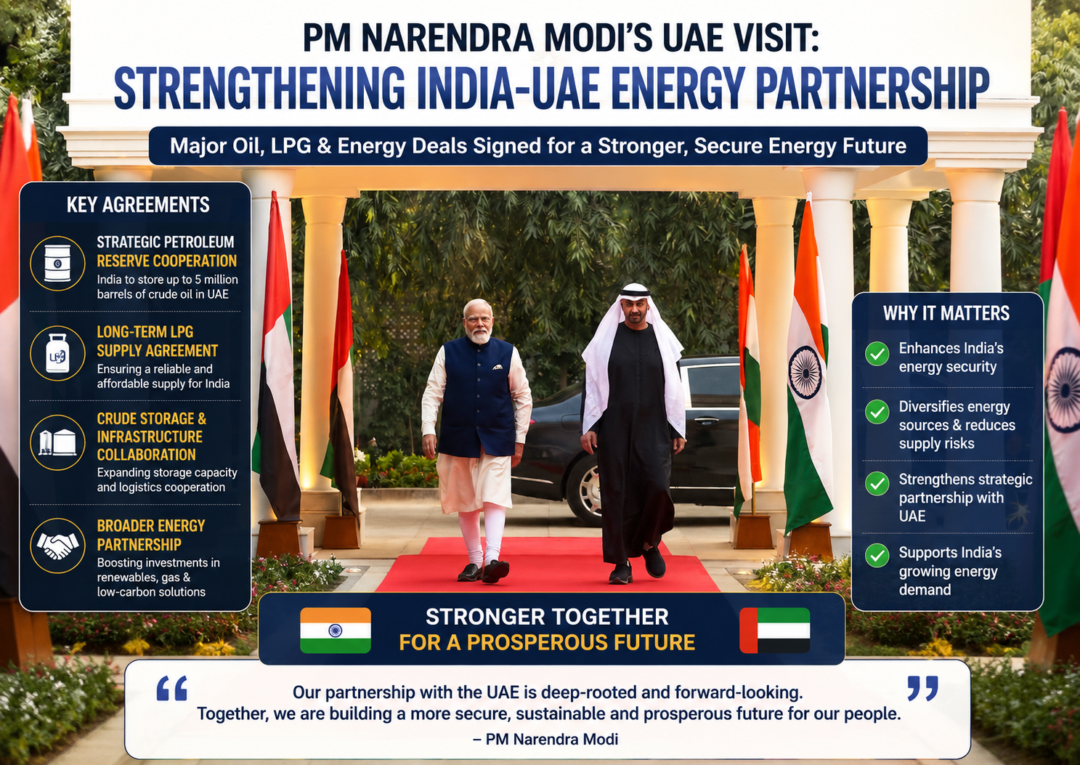
This is the headline deal — and for good reason. India’s strategic petroleum reserve system, run by Indian Strategic Petroleum Reserves Ltd (ISPRL), already had a unique arrangement with ADNOC: the Abu Dhabi national oil company was the only foreign entity storing crude oil in India’s underground reserves. This MoU deepens and expands that relationship. What it means in practice: ADNOC builds up more oil in India’s reserves, creating a shared stake in India’s energy security. A foreign oil company’s commercial interests become directly tied to India’s supply stability. That’s structural interdependence — not just a supply contract.
LPG doesn’t get the attention oil gets — but for 320+ million Indian households using cooking gas, it’s more immediately critical than crude. The UAE currently supplies roughly 40% of India’s domestic LPG requirements. This agreement between Indian Oil Corporation (IOCL) and ADNOC locks in long-term, prioritised supply — meaning when global LPG markets get tight (and they will), India gets preferential treatment. This directly protects household fuel prices from the full force of global volatility. It’s unglamorous. It’s essential.
This agreement is a genuine step-change. Previous India-UAE defence cooperation was limited to joint exercises and standard military-to-military exchanges. This framework goes further: joint development and co-production of advanced defence technologies, enhanced intelligence sharing, counter-terrorism coordination, cyber security cooperation, and interoperability standards. Effectively, India and the UAE are moving toward a relationship where their militaries can operate alongside each other in a crisis. In a region as volatile as the Gulf, that matters enormously. For India’s defence industry — which is trying to build an export base — getting a wealthy Gulf state as a co-development partner is a major opportunity.
This one is about the long game. India wants to become a major global shipping and logistics hub — and right now it doesn’t have the maritime repair infrastructure to back that ambition. The MoU to establish a Ship Repair Cluster at Vadinar in Gujarat (a deep-water port on India’s western coast, well-positioned for Gulf trade routes) is a direct investment in that vision. UAE investment in Indian maritime infrastructure also signals Abu Dhabi’s bet on India’s long-term economic trajectory. Vadinar servicing Gulf shipping traffic would create jobs, attract industrial capital, and build India’s presence in one of the world’s most strategically valuable trade corridors.
The UAE announced $5 billion in investments targeting Indian infrastructure, along with capital injections into RBL Bank and Samman Capital. This follows a pattern of Gulf sovereign wealth — UAE, Saudi Arabia, Qatar — moving significant capital into Indian financial markets and infrastructure. For India’s development story, Gulf investment is increasingly important: it’s patient, it’s large-scale, and it comes from partners with aligned interests in India’s stability and growth. The $5 billion commitment is the visible part; the relationship infrastructure being built around it matters even more.
The Oil Crisis Context — Why India Couldn’t Wait
To understand why this visit happened now — at this exact moment — you need to understand what’s happening in global oil markets and what it means for a country that imports 85% of its crude.
Brent crude has been trading above $90 for a sustained period in 2026. Houthi attacks on Red Sea shipping have pushed cargo rerouting costs higher across the board. The Strait of Hormuz — through which roughly 20% of the world’s oil passes — remains the single most important and vulnerable chokepoint in the global energy system. Any serious disruption there would send crude prices to levels that would be genuinely painful for India’s economy.
“India’s strategic reserve coverage stands at one-tenth of the IEA’s recommended benchmark. Closing that gap is a national security priority.”
Energy Security Analysis — May 2026
India already knows this vulnerability too well. In 2022, when Russia invaded Ukraine and global energy markets went haywire, India pivoted aggressively to discounted Russian crude — a smart short-term move that also drew significant Western criticism. The UAE deal represents a different kind of hedging: locking in a reliable, proximate, politically stable Gulf supplier for the long term, so that India doesn’t have to make improvised decisions under crisis pressure.
What ADNOC’s Role in India’s Reserves Actually Means
The ADNOC-ISPRL partnership is structurally novel in a way that deserves more attention. When ADNOC stores its oil in India’s underground strategic reserves, it doesn’t just become a supplier. It becomes a stakeholder. Its commercial interests — the value of that oil — are now directly tied to the security and accessibility of India’s reserve infrastructure. This creates a shared incentive: ADNOC has every reason to want India’s energy system to function smoothly, because disruptions would hurt ADNOC’s own stored assets.
That alignment of incentives — what strategists call “structural interdependence” — is far more durable than any contract. It’s the kind of architecture that makes a bilateral relationship genuinely hard to disrupt, even in periods of political tension.
The Bigger Picture: India-UAE — Not Just Oil Anymore
Here’s what often gets lost in the headline deal coverage: the India-UAE relationship has quietly become one of the most comprehensive bilateral partnerships in the entire Indo-Pacific — and it’s expanding faster than most people realize.
After the Comprehensive Economic Partnership Agreement (CEPA) came into force, bilateral trade crossed $100 billion. Both sides have now set a $200 billion target. That’s not just trade growth — it’s the transformation of a buyer-seller relationship into an integrated economic corridor. The UAE is India’s second-largest trading partner globally.
The UAE hosts roughly 3.5 million Indian nationals — the largest diaspora community in the country. They’re not just labourers anymore. India-origin professionals, entrepreneurs, and executives have become embedded in the UAE’s financial, medical, and technology sectors. This human bridge creates a resilience in the relationship that no single political crisis can easily break.
The India-UAE relationship is evolving beyond hydrocarbons. Both countries are investing in renewable energy cooperation, with UAE sovereign wealth backing Indian solar projects. There’s also growing dialogue on AI and technology co-investment — the UAE’s ambitions in AI (it has a dedicated minister for the subject) align naturally with India’s tech talent and software infrastructure.
India and the UAE have been working to settle bilateral trade in local currencies — rupees and dirhams — reducing dependence on the US dollar for bilateral commerce. This is part of India’s broader de-dollarisation effort and aligns with the UAE’s interest in diversifying away from dollar-denominated trade exposure. The RBL Bank and Samman Capital investments from this visit deepen that financial corridor further.
Both India and the UAE face threats from regional extremist networks. The intelligence-sharing and counter-terrorism components of the new Strategic Defence Framework aren’t abstract commitments — they address a real shared threat. The UAE has been a key intelligence partner for India in tracking financial flows to regional militant networks. That cooperation just got a formal upgrade.
India’s western coast and the UAE sit at either end of one of the world’s most commercially important maritime corridors. The Vadinar ship repair cluster investment positions India as a service hub for vessels transiting that route. Combined with India’s ambitions in the India-Middle East-Europe Economic Corridor (IMEEC), this maritime cooperation could eventually reshape the logistics of Gulf-to-Europe trade.
The Global Impact — What This Changes
Modi’s Abu Dhabi visit doesn’t exist in isolation. It’s happening alongside Trump’s Beijing summit, ongoing Iran tensions, and a West Asia region in the middle of serious geopolitical restructuring. Here’s how the India-UAE agreements ripple outward.
India’s Strategic Autonomy Gets a Real Foundation
India’s foreign policy has long talked about “strategic autonomy” — the ability to chart its own course without being a satellite of any great power. But strategic autonomy without energy security is an empty concept. If India’s fuel supply is vulnerable to a single disruption event, its policy choices get constrained fast. By locking in UAE reserves and LPG supply, India buys actual freedom to manoeuvre — whether that’s on Russia policy, US chip technology negotiations, or anything else.
A Signal to the Gulf: India Is a Serious Partner
Every Gulf state is watching who the big economies treat seriously. India showing up with concrete deals — not just diplomatic niceties — during a period of regional crisis sends a message: India is a partner worth investing in, worth standing beside, worth sharing intelligence with. That reputation, built visit by visit and deal by deal, is what shapes whether India gets preferential treatment the next time there’s a supply crunch.
The Oil Market Signal
The ADNOC-ISPRL strategic reserve expansion signals something important to global oil markets: India is moving from being a reactive oil buyer to a proactive energy manager. Countries that hold strategic reserves don’t panic-buy when prices spike — they draw down reserves and negotiate from strength. As India systematically closes the 90-day reserve gap, its ability to absorb oil price shocks without economic damage improves meaningfully.
What It Means for the Rupee and Inflation
For ordinary Indians, the LPG deal is the most direct line. Cooking gas prices — politically sensitive and economically significant — are directly tied to global LPG markets. A long-term supply agreement with preferential pricing from ADNOC acts as a buffer against the kind of fuel price spikes that can cascade into household budget pressure, food inflation, and political headaches for any government. This is energy diplomacy that reaches into every kitchen.
What India Got — Sector by Sector
- Energy security: Expanded ADNOC presence in India’s strategic reserves; long-term LPG supply locked in at preferential terms. India moves from 9-day coverage toward a more resilient stockpile position.
- Defence capability: Joint development access to UAE defence procurement and technology networks. Counter-terrorism intelligence upgrades. Interoperability frameworks that could matter in a real maritime crisis.
- Investment inflows: $5 billion in UAE capital targeting Indian infrastructure, banking, and capital markets. Patient Gulf money backing India’s development pipeline.
- Maritime infrastructure: Vadinar ship repair cluster positions India’s western coast as a service hub for Gulf-to-Asia trade routes. Long-term logistics play.
- Trade trajectory: Bilateral trade target raised to $200 billion — with the institutional frameworks (CEPA, financial integration, currency settlement) to support it.
- Diplomatic standing: India publicly backed the UAE during a period of regional targeting. That political capital will be returned in the form of preferential treatment in future supply negotiations, investment discussions, and multilateral forums.
Final Read:
Short Visit. Long Game.
None of these agreements fix the underlying volatility of West Asia. The Strait of Hormuz is still the world’s most consequential chokepoint. Oil prices are still elevated. Regional tensions are still simmering. India still imports 85% of its crude.
But what Modi accomplished was to make India more resilient to that volatility — not by avoiding it, but by building the institutional architecture to manage it. Strategic reserves. Long-term supply contracts. Defence frameworks. Investment channels. Maritime infrastructure. Piece by piece, India is assembling the energy security architecture that a $4 trillion economy needs.
The world was watching Beijing on May 15. Fewer people were watching Abu Dhabi. But for India’s 1.4 billion people — whose cooking gas, petrol prices, and economic trajectory depend on decisions made in rooms like the Great Hall in Abu Dhabi — Modi’s quiet, purposeful visit may turn out to matter just as much.
Geopolitics — May 2026