📉 Currency Watch | May 2026
The ₹100
Per Dollar:
India’s
Rupee Economic 2026.
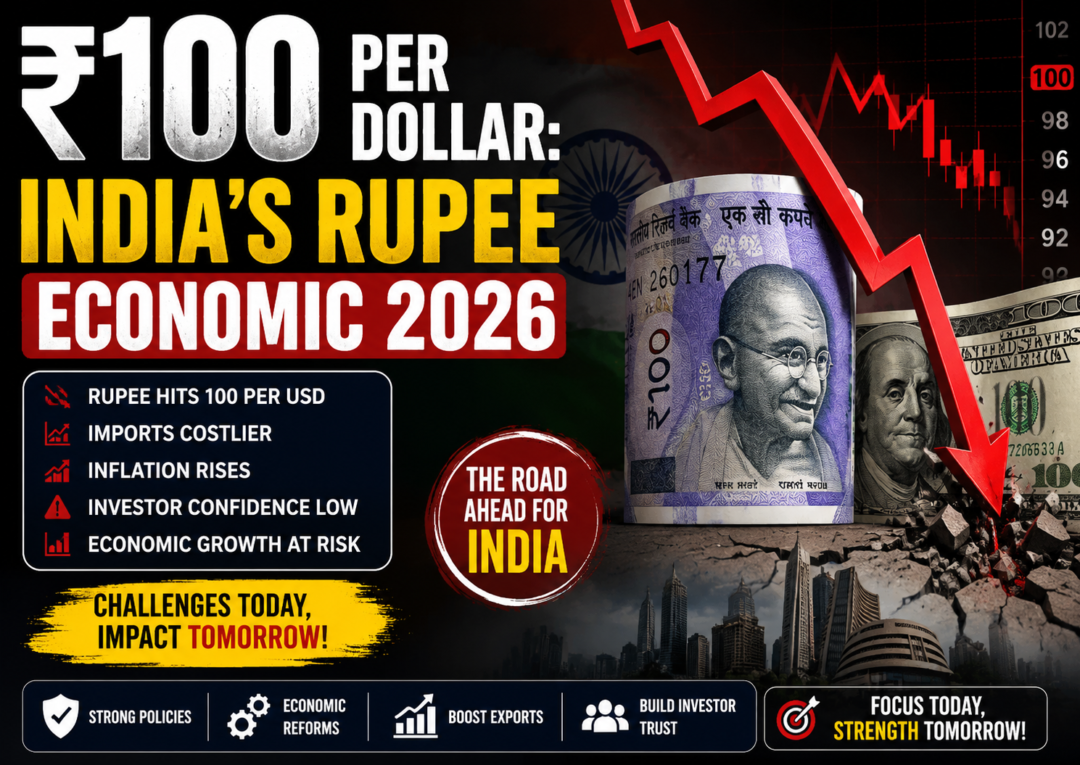
There’s a number that’s been quietly haunting Indian economic conversations for the past few months — ₹100 per dollar. That’s the psychological threshold nobody wants to talk about out loud, but everyone in treasury desks, import-dependent boardrooms, and policy corridors is watching nervously.
As of mid-2026, the rupee is trading in the ₹97–98 range. That’s not a crisis — yet. But it’s close enough to ₹100 that the question is no longer hypothetical. And it’s forcing India to revisit something it went through before: the stress-test of 2023, when the rupee last found itself under sustained, grinding depreciation pressure.
The question worth asking isn’t just “will the rupee hit ₹100?” It’s: what did 2023 teach India about managing a weak currency, and are those lessons actually being applied this time around?
First, Let’s Understand Why ₹100 Matters
Currency thresholds are partly psychological and partly structural. The rupee crossing ₹100 per dollar wouldn’t trigger an automatic economic catastrophe — the way, say, a banking system collapse would. But it would do several things simultaneously.
It would signal a loss of confidence in the RBI’s ability or willingness to defend the currency. It would feed directly into imported inflation — every dollar-denominated commodity, especially crude oil, becomes proportionally more expensive in rupee terms. And it would compress the already-thin margins of India’s import-heavy industries while expanding the cost base of the entire economy.
Beyond inflation, there’s the fiscal angle. India’s oil subsidy bill, even in its scaled-back form, becomes harder to manage when crude is both volumetrically expensive (from West Asia tensions) and currency-expensive (from a weak rupee). The two pressures compound each other — and that’s exactly the situation 2026 has handed the Indian government.
The ₹83 Rupee of 2023 — What Actually Happened
In 2023, the rupee spent most of the year between ₹81 and ₹84 per dollar. That sounds stable now, but at the time it was a source of real policy stress. The U.S. Federal Reserve was in the middle of its most aggressive rate-hiking cycle in four decades — and that alone was pulling capital out of emerging markets and into dollar-denominated assets.
India’s current account deficit in FY2023 widened to around 2% of GDP, partly because post-COVID import demand had recovered sharply while exports hadn’t kept pace. The RBI was spending foreign exchange reserves at a notable pace — reserves fell from around $640 billion in early 2022 to roughly $524 billion by October 2022 — to cushion the rupee’s fall rather than prevent it entirely.
The Five Lessons 2023 Taught India
Let’s be specific about what 2023 actually revealed — because these aren’t abstract policy lessons. They’re live, operational questions that India’s economic managers are wrestling with again right now.
📚 Five Lessons From the 2023 Rupee Stress Test
- Lesson 1 — Reserves Are a Buffer, Not a Shield: India’s forex reserves are large by historical standards, but spending them aggressively to defend a specific rupee level is a losing game. Markets will eventually test any fixed target. The 2023 experience showed that using reserves to smooth volatility — not to prevent movement — is the sustainable approach. The RBI lost significant reserves in 2022–23 and then spent the next 18 months rebuilding them. That cycle is expensive.
- Lesson 2 — The CAD Is the Real Pressure Point: A current account deficit means India is importing more in dollar terms than it’s earning. As long as the CAD is significantly negative, the structural demand for dollars exceeds supply — and the rupee faces downward pressure regardless of what the RBI does. Managing the CAD through export promotion, import substitution, and energy diversification is a more durable solution than currency intervention.
- Lesson 3 — Rupee Depreciation Isn’t Uniformly Bad: India’s IT sector earns in dollars and reports in rupees. A weaker rupee boosts their reported earnings — which is partly why IT stocks have held up despite the currency slide. The same logic applies to pharmaceutical exporters and gem & jewellery exporters. The pain is concentrated in import-dependent industries; the gain is dispersed across export-oriented ones. Policy has to hold both realities simultaneously.
- Lesson 4 — Inflation Management and Currency Management Are Not Independent: In 2023, high global commodity prices and a weak rupee created a dual inflation pressure. The RBI raised rates to fight inflation — but higher rates also attracted capital inflows, which partly supported the rupee. The two tools were working in the same direction. In 2026, the situation is more complex: rate cuts are expected, which could weaken the rupee further even as oil-driven inflation is already building.
- Lesson 5 — Psychological Thresholds Require Active Communication: When the rupee was approaching ₹84 in 2023, the RBI and Finance Ministry were unusually active in signalling confidence in India’s fundamentals. That communication wasn’t just PR — it helped stabilise sentiment among FII investors who might otherwise have accelerated outflows. The lesson: managing the narrative around a currency threshold is as important as managing the underlying economics.
The Rupee’s Journey — How We Got Here
2026 vs 2023: What’s Different This Time
It would be easy — and lazy — to say “this is just like 2023.” It’s not. The pressure on the rupee is real in both periods, but the causes and context are meaningfully different. Understanding what’s changed matters more than drawing a simple historical parallel.
What’s Worse in 2026
- Oil is both expensive and geopolitically uncertain: In 2023, high oil prices were mostly a demand and supply imbalance story. In 2026, there’s a genuine supply disruption risk layered on top — Strait of Hormuz anxiety, Red Sea rerouting, West Asia instability. That makes the oil price less predictable, which makes the import bill harder to plan around.
- The RBI has less rate flexibility: In 2023, the RBI had room to hike rates to support the currency and fight inflation simultaneously. In 2026, growth is slowing in some sectors and the pressure is to cut rates — which would worsen capital outflows and further pressure the rupee. The policy toolkit is more constrained.
- Global dollar strength is structural, not cyclical: The dollar in 2026 is strong for a different reason than 2023. U.S. fiscal expansion, continued AI-driven investment inflows into dollar assets, and geopolitical safe-haven demand are all keeping the dollar elevated. This isn’t a temporary Fed tightening cycle that will eventually reverse. It’s a more durable structural reality.
What’s Better in 2026
- India’s export base is broader: The goods export story has improved. Electronics exports have grown significantly, partly due to iPhone manufacturing expansion and broader PLI scheme success. That provides more dollar inflow than 2023’s export base did.
- Rupee trade settlement is more advanced: India has made genuine progress on settling trade in rupees with certain partners — UAE, Russia, some ASEAN economies. That doesn’t eliminate dollar dependence, but it reduces the marginal demand for dollars for those bilateral trade flows.
- Services exports remain a structural anchor: India’s IT and business process services exports continue generating substantial dollar inflows — roughly $250 billion annually. That’s a natural partial hedge against currency weakness that 2023 also relied on, and it hasn’t shrunk.
“The rupee crossing ₹100 would be a psychological event first and an economic event second — but psychology can drive economics.”
Currency Desk Analysis — May 2026
The Sectoral Fault Lines — Who Wins, Who Hurts
A weaker rupee isn’t a uniform experience. It moves money between sectors in predictable ways, and understanding those flows is where real portfolio and business decisions live.
The OMC story is worth dwelling on. IOCL, BPCL, and HPCL are caught in a classic double bind in 2026: crude oil is expensive in dollar terms, and the rupee buys fewer dollars than it did two years ago. Their input cost in rupee terms is being squeezed from both ends simultaneously. Add to this the political sensitivity around petrol prices ahead of any state election cycle, and you have a recipe for margin compression that equity analysts are tracking very closely.
What the RBI Is Actually Doing
The Reserve Bank of India doesn’t announce explicit exchange rate targets — and for good reason. If it did, currency traders would know exactly where to probe. But its actions reveal its thinking more clearly than its statements.
The RBI has been active in the forward and spot markets, selling dollars to prevent the kind of sharp, disorderly moves that rattle sentiment. This is the classic “leaning against the wind” approach — not stopping the depreciation, but smoothing its pace. That’s consistent with the 2023 playbook.
What’s also notable is the RBI’s shift in communication tone. Recent statements from the Monetary Policy Committee have been careful to acknowledge external risks — which is code for “we’re watching the rupee” — while signalling that domestic growth remains the primary mandate. That’s a delicate balancing act, and it’s being walked with some skill.
The Reserves Question
India’s foreign exchange reserves sit at approximately $640 billion as of mid-2026 — which sounds impressive. But a large share of that is in the forward book, meaning the RBI has committed those dollars for future delivery. The “net” reserve position, accounting for forward liabilities, is meaningfully lower than the headline number suggests.
This is a nuance that sophisticated analysts track carefully. It matters because the RBI’s actual capacity to intervene is smaller than the headline reserves number implies — and the market knows this.
What Professionals Should Do Now
For investors, CFOs, and business operators with rupee exposure, the ₹97–98 environment demands specific, not generic, thinking. Here’s the practical framework.
For Equity Investors
- Overweight IT and pharma exporters: These are natural beneficiaries of rupee weakness. TCS, Infosys, Sun Pharma — their dollar revenues translate to more rupees. This isn’t a speculative trade; it’s a mechanical hedge.
- Underweight import-dependent plays: OMCs, airlines with unhedged fuel costs, companies with large dollar-denominated capex pipelines — these face structural margin pressure that doesn’t resolve quickly.
- Watch for RBI rate cuts carefully: Any rate cut in this environment would likely weaken the rupee further. That’s good for IT, bad for OMCs and currency-sensitive bonds. Position accordingly before the MPC meeting.
For Corporate Finance Teams
- Hedge currency exposure aggressively — or lock in: Companies with dollar payables 6–12 months out should be using forward contracts or options. The cost of hedging has gone up, but the cost of not hedging has gone up more.
- Renegotiate dollar-linked contracts where possible: Longer-term supply agreements that were priced at ₹84–85 levels now have embedded losses at ₹97–98. Where renegotiation is contractually possible, it should be pursued.
- Review foreign currency borrowings: Any ECB (External Commercial Borrowing) in dollars becomes costlier in rupee repayment terms with every depreciation tick. Companies that levered up in dollars when they were cheap in rupee terms now face a compounding repayment burden.
Final Read:
₹100 Is a Number. The Policy Response Is What Matters.
The real risk isn’t the number itself. It’s if ₹100 becomes a psychological tipping point that accelerates FII outflows, triggers corporate panic-buying of dollars, and creates a self-fulfilling depreciation spiral. That’s what the RBI and Finance Ministry need to prevent — not the exchange rate level, but the feedback loop.
The lessons of 2023 are clear: manage pace, not level. Keep reserves for genuine stress, not to defend optics. Communicate confidently. Let exporters benefit. Support importers where fiscally possible. And don’t let the ₹100 narrative become bigger than the ₹100 reality.
India has been here before — not at ₹100, but at a psychological currency threshold that felt permanent and proved temporary. The professionals who navigated 2023 well weren’t the ones who called the turning point. They were the ones who positioned for multiple outcomes and didn’t let the number define their strategy. That’s the lesson. It still holds.
Currency Analysis — May 2026