💻 Tech & AI | June 2026
The Chip That
Rewires
Every
PC.
Let’s be honest — when most people hear “new Nvidia chip,” they picture gamers running the latest titles at insane frame rates. But what Nvidia announced with the RTX Spark isn’t really a gaming story. It’s something much bigger.
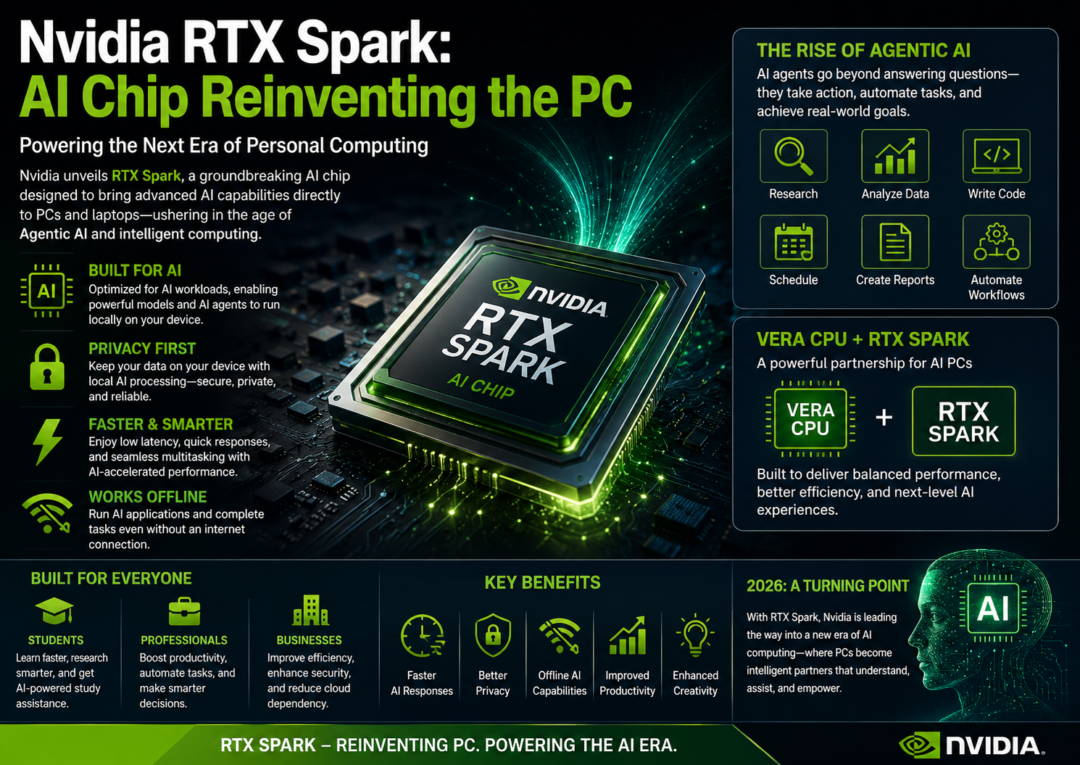
It’s the beginning of a new kind of personal computer. One that doesn’t just run your work — it actively assists with it. Thinks alongside you. Takes action without being asked twice. That’s what Nvidia means by “agentic AI” — and the RTX Spark is the hardware foundation that makes it possible locally, on your own device, without sending everything to a distant server.
For business professionals and AI learners, this shift matters enormously. Not because of specs or benchmarks — but because the entire relationship between users and computers is about to change. And understanding that change early is the difference between being ready and being left behind.
What Is RTX Spark — And Why Should You Care?
Nvidia’s RTX Spark is a next-generation PC chip architecture built from the ground up with one goal: making serious AI workloads run fast, privately, and efficiently on a regular laptop or desktop. Not a data center. Not a cloud server. Your machine.
Think of it this way. Current AI tools — ChatGPT, Gemini, Copilot — live in the cloud. When you type a prompt, your request flies out to a massive server farm, gets processed, and comes back to you. That’s fine for simple queries. But it creates real problems for anything sensitive, real-time, or deeply integrated into how you actually work.
RTX Spark changes the math. With a dedicated Neural Processing Unit (NPU) baked into the silicon alongside the GPU, the chip handles AI inference right on the device. No round-trip. No latency spike. No data leaving your machine.
For businesses, this is a significant unlock. Imagine a legal team running contract analysis entirely within their firewall. A finance analyst using an AI model trained on proprietary data without ever exposing that data to third-party APIs. A developer spinning up a coding assistant that knows the full codebase without pushing it to someone else’s cloud. That’s the actual value proposition — and it’s not theoretical anymore.
The “Agentic” Part — This Is New
The word Nvidia keeps using is agentic. It deserves some unpacking because it’s genuinely different from “AI assistant.”
An AI assistant waits for instructions. You ask, it answers. An AI agent takes initiative. It observes context, decides what to do next, executes multi-step tasks, and checks back in only when needed. It’s the difference between a calculator and an intern who actually gets things done.
RTX Spark is designed to enable agents that run persistently in the background — monitoring your workflows, drafting communications, managing schedules, generating summaries, flagging anomalies — all without constant prompting. The chip’s architecture supports the continuous, low-latency inference loops that agentic behaviour requires.
How the PC Industry Is Actually Responding
Nvidia doesn’t sell PCs. But it sells the chips that go into them — and the RTX Spark architecture is already driving a wave of product launches from every major OEM. Here’s the real picture across the industry.
Dell, HP, Lenovo, and Asus have all announced RTX Spark-class business laptops for the second half of 2026. IT procurement teams are being briefed now on the security architecture. The enterprise refresh cycle — already accelerated by Windows 11 — has a new hardware hook.
For developers building AI applications, running local models for testing and prototyping just became dramatically faster and cheaper. No API costs, no rate limits, no data egress fees. The full model development loop — prompt engineering, fine-tuning small models, RAG testing — can now happen on a workstation.
Healthcare, legal, and finance have been cautious about cloud AI specifically because of data compliance. Local inference on RTX Spark class hardware changes the compliance calculus completely. We’re already seeing pilots in radiology, contract law, and financial advisory where “no data leaves the device” is the headline selling point.
Video editors running local diffusion models for B-roll generation. Designers using local image AI that never touches Adobe or Getty servers. Writers using on-device LLMs for draft assistance without feeding manuscripts to third-party models. RTX Spark makes the creative workflow genuinely private for the first time.
RTX Spark class hardware will carry a premium at launch. The real access story comes in 18–24 months when the architecture filters down to mid-range hardware. But early education technology initiatives — particularly in higher ed and professional training — are already planning AI PC-native curriculum for 2027.
The future isn’t local OR cloud — it’s both, intelligently. Routine, sensitive, and real-time tasks run locally. Complex, large-scale, or collaborative tasks route to the cloud. RTX Spark includes the routing intelligence to manage that split automatically, which is what makes the “always-on AI” experience feel seamless.
“The GPU made computers visual. The NPU makes them intelligent. RTX Spark is where that shift becomes real.”
IndiaThreads Tech Analysis — June 2026
The Road That Led Here — A Timeline
To understand why RTX Spark is significant, you need to understand the path Nvidia took to get here — because this wasn’t an overnight announcement.
What Businesses Should Actually Do Now
If you’re leading a team, building software, or managing technology decisions, RTX Spark-class AI PCs aren’t a “wait and see” category anymore. Here’s the specific thinking that matters in mid-2026.
🔑 Strategic Moves for Business Leaders
- Identify your data-sensitive AI use cases first: Before buying hardware, map the workflows where you’d benefit most from AI assistance but can’t use cloud tools due to compliance or confidentiality. These are your first pilot targets for local AI on RTX Spark hardware.
- Talk to your IT procurement team now — not next year: The hardware refresh cycle for enterprise PCs typically runs 3–5 years. The decisions made in the next 12 months will define what your employees are running in 2028–2029. Getting AI-capable hardware into that refresh cycle requires conversations today.
- Start building AI literacy in your team: Agentic AI changes what “using a computer” means. Teams that understand how to structure tasks for AI agents, evaluate AI outputs critically, and iterate on prompts will have a genuine productivity edge. That’s a training investment with a fast payback.
- Watch the software ecosystem closely: The hardware is only half the story. Nvidia’s DIGITS platform, Microsoft’s Copilot+ stack, and the open-source local model ecosystem (Ollama, LM Studio, Jan) are all maturing fast. The software that makes RTX Spark genuinely useful for your specific workflow is being built right now.
- Think about agent governance before agents arrive: When AI agents can read your files, draft your emails, and execute tasks autonomously, you need clear policies about oversight, audit trails, and accountability. Sorting this out before deployment is dramatically easier than cleaning up after a governance incident.
For AI Learners — What This Means for Your Skills
- Local model development is now a viable career skill: Knowing how to run, fine-tune, and deploy models on local hardware — not just call APIs — is becoming genuinely differentiated. RTX Spark makes that skill more relevant, not less.
- Agent architecture is the next frontier: Learn how multi-step AI agents work. LangChain, AutoGen, and CrewAI are the current frameworks — but the underlying concepts (tool use, memory management, planning loops) are durable regardless of which framework wins.
- RAG on local data — practical and in-demand: Retrieval-Augmented Generation over private document sets is one of the most immediately useful enterprise AI patterns. With RTX Spark, that entire pipeline can run locally. Understanding how to build it is a job-ready skill right now.
- Privacy-first AI design: As local AI becomes more common, the ability to design systems that are powerful and private — not one or the other — will be a premium skill. Learn data minimisation principles, on-device inference patterns, and enterprise security frameworks.
The Bigger Picture — Three Scenarios
Any serious technology investment today should account for multiple paths, not just the optimistic one. Here’s how the RTX Spark era could unfold over the next two years.
- Rapid Mainstream Adoption (~40% probability): Microsoft deeply integrates agentic AI into Windows, OEMs ship RTX Spark machines at scale, enterprise refreshes accelerate, and local AI becomes the default by end of 2027. The cloud AI subscription model gets disrupted. Nvidia cements its position as the defining infrastructure company of the AI PC era.
- Parallel Ecosystem (Most Likely ~45%): Local AI and cloud AI coexist as genuinely complementary. RTX Spark class hardware becomes standard in professional and enterprise segments, while consumer hardware takes longer to hit the performance threshold. The hybrid routing model dominates. Nvidia, Microsoft, and Qualcomm all win in different segments.
- Slower-Than-Expected Adoption (~15%): Software ecosystem fragmentation, enterprise procurement inertia, and a lack of killer applications beyond the developer niche slow the rollout. The AI PC category remains a premium product without mass-market pull for 2–3 more years. Not a failure — just a longer cycle.
Final Read:
The PC Is Getting Smarter. The Question Is Whether You Are Too.
For businesses, that means real opportunities to build AI workflows around sensitive data that couldn’t exist in a cloud-only world. For AI learners, it means the skill set that’s valuable is shifting — from “how to call an API” to “how to design agents that run anywhere, on any data, within real constraints.”
The companies and individuals who understand this shift early won’t just be consumers of RTX Spark’s capabilities. They’ll be the ones defining what those capabilities are used for. And in technology, being one product cycle ahead of the mainstream isn’t a small advantage — it’s a compounding one.
The PC has been a window to the world for 40 years. RTX Spark and the agentic AI era it enables are turning it into something else entirely — a collaborator. Whether that’s exciting or unsettling probably depends on how prepared you are for the transition.
Tech Analysis — June 2026