🤖 AI Intelligence | June 2026
How Anthropic
Leapfrogged
OpenAI
to $1 Trillion.
Not too long ago, if you’d asked anyone in tech which AI company would be worth nearly a trillion dollars first — Anthropic or OpenAI — the answer would’ve been obvious. ChatGPT had the brand. OpenAI had the momentum. Sam Altman was on every magazine cover.
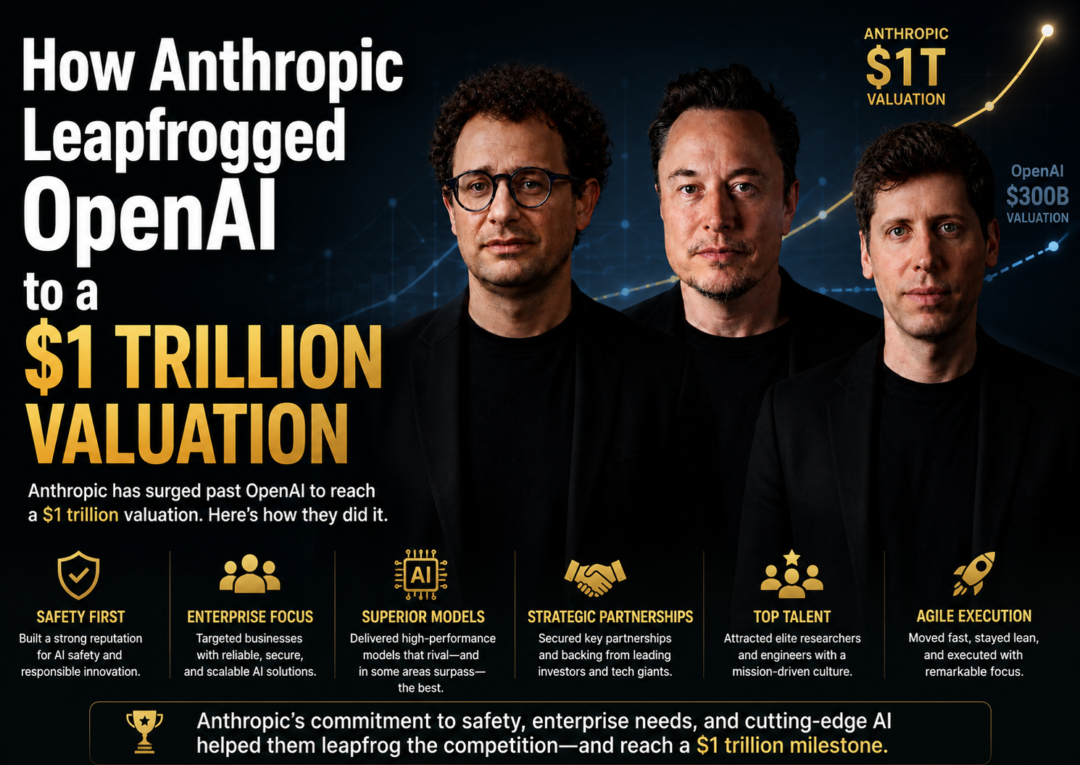
And yet, here we are in mid-2026 — and Anthropic, the quieter company with the safety-first philosophy and the AI assistant called Claude, has just raised $65 billion at a $965 billion valuation. It has overtaken OpenAI. Not just in valuation, but in revenue, enterprise market share, and developer adoption.
This is one of the most interesting business stories in recent tech history. And to understand how it happened, you need to go back to where it all started — a walkout, a disagreement about AI safety, and a sibling duo who decided to build something different.
The Origin Story:
Born from a Breakup
In 2021, Dario Amodei — then VP of Research at OpenAI — resigned. He wasn’t alone. His sister Daniela, along with several other senior researchers, left with him. Their concern? OpenAI was moving too fast, and not thinking carefully enough about what could go wrong.
That’s a bold reason to walk away from one of the hottest companies on the planet. But Dario and Daniela weren’t just making a philosophical statement. They were founding a company — Anthropic — built entirely around the idea that building powerful AI responsibly wasn’t a constraint on growth. It was the strategy.
Early on, the company was largely academic in its feel. It published safety research. It worked quietly on Constitutional AI — a method of training models to follow a set of ethical principles. It attracted enterprise customers rather than chasing viral consumer downloads. That restraint looked like a weakness at the time. It turned out to be a long game.
Who Are Dario and Daniela Amodei?
🔑 The Amodei Siblings — Anthropic’s Core
- Dario Amodei (CEO): Former VP of Research at OpenAI. Holds a PhD in computational neuroscience from Princeton. Self-described “accidental CEO.” Known for being unusually candid about AI risks — including the risks posed by his own company’s technology.
- Daniela Amodei (President): Spent seven years at Stripe building operational and financial infrastructure before joining OpenAI. She runs Anthropic’s day-to-day operations — and is widely credited as the commercial engine behind the company’s explosive enterprise growth.
- The other co-founders: Jared Kaplan (theoretical physicist, known for the “scaling laws” paper that predicted LLM capabilities), Chris Olah (pioneering mechanistic interpretability research), and several other OpenAI alums. This founding team had more combined AI research credibility than almost any startup in history.
The Valuation
Climb Was Vertical
The numbers here are genuinely hard to process without context. Anthropic’s valuation has moved faster than almost any private company in history.
The Real Reason
Claude Won the Enterprise
ChatGPT made AI famous. But Claude made it trustworthy enough for companies to actually deploy at scale. That distinction matters more than it sounds.
Think about it from a Fortune 500 company’s perspective. You want an AI that writes code reliably. Follows complex instructions. Doesn’t hallucinate in ways that create legal liability. Doesn’t leak sensitive data. Can be fine-tuned for your specific use case without behaving unpredictably. That’s not a consumer product — that’s an enterprise requirement. And it turns out Constitutional AI — Anthropic’s safety-focused training methodology — produces exactly those properties as side effects.
According to an HSBC research report published late 2025, Anthropic commands 40% of enterprise AI spending — ahead of OpenAI at 29% and Google at 22%. That’s not a coincidence. It reflects years of deliberate positioning in regulated industries: finance, healthcare, government.
The launch of Claude Opus 4.5 in late 2025 — and the explosion of Claude Code that followed — was the inflection point. Developers in Silicon Valley started calling it one of the most useful coding tools they’d ever used. Within months, Claude Code was doing $1 billion+ in ARR. That pulled the whole Anthropic ecosystem with it.
Business analytics firm Ramp reported a striking data point in 2026: Claude adoption among businesses rose to 34.4%, while OpenAI adoption fell to 32.3%. For the first time, Claude had more business users than ChatGPT. That’s the moment when “challenger” became “leader.”
Anthropic’s infrastructure partnerships with Amazon Web Services and Google give it compute access that would otherwise cost billions to acquire independently. This isn’t just capital — it’s deeply embedded go-to-market. AWS and Google both have strong incentives to push Claude to their enterprise customers.
Anthropic is opening its first Bengaluru, India office in 2026 and plans to triple its global workforce. For a company that was once entirely U.S.-centric, this is a significant signal. The enterprise AI opportunity outside the U.S. — particularly in Asia — is enormous, and Anthropic is now actively pursuing it.
Anthropic has selected a law firm to begin IPO preparation — a Wall Street debut that could happen as soon as late 2026. The company expects to turn profitable in 2028, two years ahead of OpenAI’s own profitability timeline. When it goes public, it will be one of the largest tech IPOs in history.
“We’re under incredible commercial pressure — and make it harder for ourselves because we do more safety work than other companies.”
Dario Amodei, CEO — Anthropic, February 2026
The Safety-First Play
That Actually Worked
Here’s something that seemed counterintuitive a few years ago: a company obsessed with AI safety — spending real resources on alignment research, publishing its findings publicly, building ethical guardrails into every model — would end up winning commercially.
But when you think about it, it makes complete sense. Safety-focused training produces models that are more reliable, more predictable, and better at following instructions. Those are exactly the properties that enterprise customers need. What looked like a values-based constraint turned out to be a product differentiation strategy with enormous commercial upside.
🔑 What “Constitutional AI” Actually Means
- The core idea: Instead of just training Claude on human feedback (like OpenAI does with RLHF), Anthropic trains it against a written “constitution” — a set of principles that guide how the model should behave. The model critiques its own outputs against those principles.
- Why enterprises care: Models trained this way are more consistent and predictable in edge cases. When a bank deploys Claude to summarise loan applications, it needs to know it won’t randomly go off-script. That reliability is what closes enterprise contracts.
- The alignment research edge: Anthropic publishes more mechanistic interpretability research than any lab. Understanding how the model works internally — not just what it outputs — lets the team make more targeted improvements. This compounding capability edge is hard for competitors to replicate quickly.
- The branding effect: In regulated industries, “safety-first AI” isn’t just reassuring — it’s a procurement checkbox. Government bodies, healthcare systems, and financial institutions have compliance obligations. Anthropic’s public commitment to safety makes those conversations dramatically easier.
What’s Still
Uncertain Ahead
Let’s not pretend this is a settled story. Anthropic’s $965 billion valuation is pricing in flawless execution over the next several years. And there are genuine open questions.
- Profitability is still years away: Despite $47 billion in annualised revenue, Anthropic isn’t profitable yet. Compute costs are enormous. The path to break-even is projected for 2028 — but AI infrastructure economics can shift quickly in either direction.
- OpenAI isn’t done: Sam Altman’s company is preparing its own IPO and still has $13 billion+ in annual revenue, deep Microsoft ties, and consumer brand recognition that Anthropic doesn’t match. The race isn’t over — it’s entered a new phase.
- New entrants keep coming: Google’s Gemini, Meta’s Llama models (open source and increasingly capable), and a dozen well-funded startups are all competing for the same enterprise contracts. Market share in AI shifts fast — history has shown that repeatedly.
- The IPO test: Private market investors and public market investors are different animals. When Anthropic goes public, the scrutiny on burn rate, path to profitability, and moat durability will be far more intense. The valuation will face real pressure from quarterly earnings cycles.
- Regulatory wildcards: AI regulation is evolving fast in the EU, U.S., and India. A company like Anthropic — deeply invested in safety research — is arguably better positioned than rivals to navigate this. But unpredictable policy shifts could still affect growth trajectories.
What This Means
for Indian Tech & AI Learners
If you’re in India — whether you’re a developer, a tech professional, a student, or someone just tracking the AI space — Anthropic’s rise matters to you directly.
- Bengaluru office opening in 2026: Anthropic’s first India office is coming this year. That means hiring — and likely significant hiring for engineering, applied AI, and operations roles. For developers who’ve been building with Claude’s API, this is a direct career opportunity.
- Claude Code for Indian developers: Claude’s strongest commercial product right now is a coding assistant. Indian software engineers — who make up a massive share of global tech talent — are already among the most active AI tool users globally. The tools are getting better and the competitive advantage of proficiency is compounding.
- The enterprise AI playbook: Indian IT companies (Infosys, TCS, Wipro) are all evaluating AI integration deeply. Understanding which model wins at enterprise and why — as this story explains — directly informs which AI tools will power the next decade of Indian IT services delivery.
- The safety angle matters here too: India’s own AI regulation framework is evolving. Companies with demonstrated safety credentials — like Anthropic — are likely to face fewer regulatory hurdles entering Indian enterprise markets. That matters for procurement timelines.
Final Read:
The Quiet Company Won.
Dario Amodei once joked that $30 billion in ARR with 80x growth was “insane and unmanageable.” That’s probably the most honest thing any AI CEO has said out loud. The growth is real. The challenge of sustaining it — while staying ahead on safety, talent, and compute economics — is just beginning.
But for anyone trying to understand where the AI industry is heading in the next two to three years, Anthropic’s story is the clearest signal available. Safety and capability aren’t opposites. Patience and ambition aren’t opposites. And being second out of the gate doesn’t mean finishing second.
The company that once quietly resigned from OpenAI is now, quietly, running it.
AI Analysis — June 2026