🎬 Tamil Nadu Politics | May 2026
Vijay’s
Rise to
Power:
The New CM 2026.
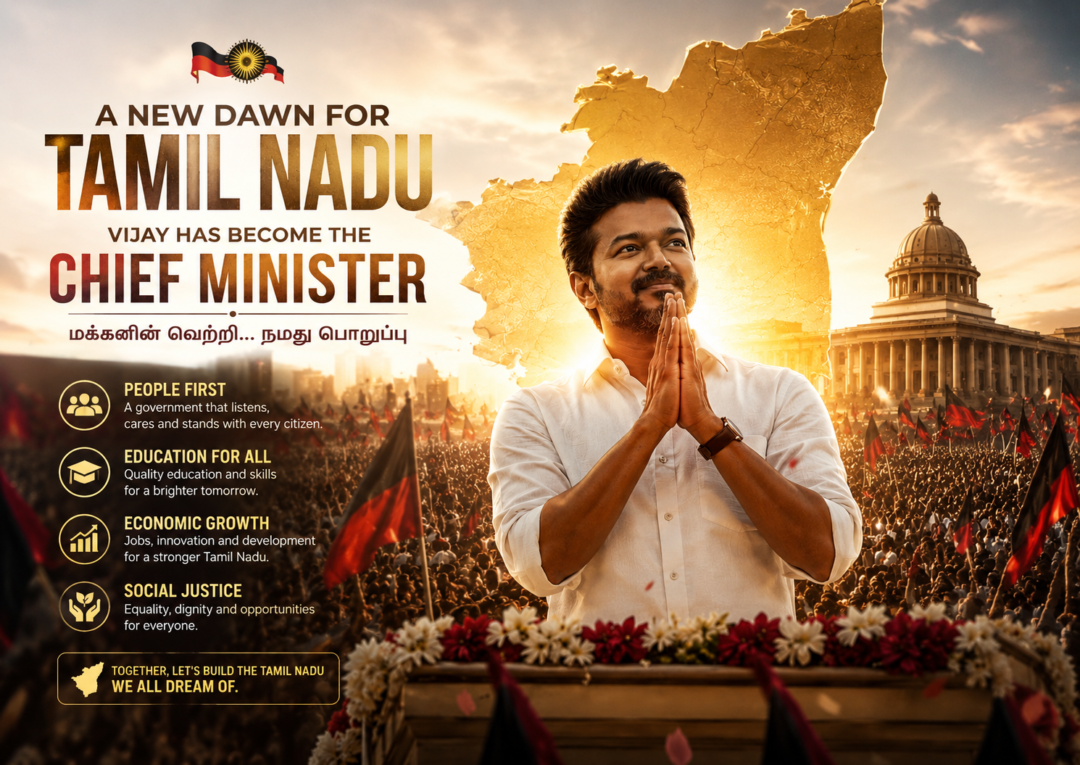
Tamil Nadu has seen many political stories. But none quite like this. A superstar who walked away from the biggest salary in Tamil cinema, built a party from scratch, navigated one of India’s most complex political landscapes — and landed in the Chief Minister’s chair.
Vijay’s rise to power in Tamil Nadu is not just a political event. It’s a seismic shift in how people in this state think about who deserves to lead, what politics can look like, and whether a completely new kind of politician can actually survive the machinery of Indian electoral democracy.
Whether you support TVK, DMK, or AIADMK — or none of them — this story demands your attention. Because what just happened in Tamil Nadu will shape the next decade of its politics. And understanding it properly means going all the way back to where it began.
From Silver Screen to Secretariat
For years, people asked the question half-joking: “Will Vijay actually do it?” Tamil cinema has a long, complicated relationship with politics. MGR did it. Jayalalithaa did it. Kamal Haasan tried and stumbled. Rajinikanth announced and retreated.
Vijay watched all of it. And then — quietly, methodically — he did something none of them did quite the same way. He didn’t just announce a party. He built one. District by district. Meeting by meeting. With a clarity of message that caught even seasoned political observers off guard.
The announcement of Tamilaga Vettri Kazhagam (TVK) in 2024 was met with every kind of reaction. Excitement from fans, deep scepticism from political veterans, and careful watchfulness from both DMK and AIADMK. Nobody dismissed it. That in itself was significant.
Why This Transition Was Different
Other actor-politicians entered the arena on the back of fan adoration and hoped it would convert into votes. Vijay’s team understood that fan love and political support are not the same thing. You have to build the second independently.
So TVK spent its early period doing something unglamorous: grassroots organisation. Booth-level committees. District presidents. Women’s wings. Youth wings. The boring infrastructure of a real party — not a personality cult with an election symbol.
The Tamil Nadu Political Maze He Had to Navigate
To understand what Vijay achieved, you have to understand how genuinely difficult Tamil Nadu’s political terrain is. This isn’t like walking into an open field. It’s more like trying to find a path through a forest where every tree has a name — and every name has decades of history attached to it.
Under M.K. Stalin, DMK came back to power in 2021 with a strong majority. It has deep organisational roots, a clear Dravidian ideological identity, and the advantage of incumbency. For any new party, aligning with DMK means access — but also subordination. Vijay had to negotiate that balance carefully.
Post-Jayalalithaa, AIADMK has been in a visible identity crisis. Edappadi Palaniswami leads a party that still commands significant vote share but has struggled to present a coherent opposition narrative. TVK’s rise directly competed for AIADMK’s disillusioned voters — and succeeded in peeling some away.
BJP’s presence in Tamil Nadu remains limited but strategically relevant — particularly in alliance mathematics. Vijay’s positioning as explicitly secular and socially progressive was partly a direct response to this. It helped him consolidate support from communities that are historically wary of BJP influence in state politics.
No honest political analysis of Tamil Nadu is complete without acknowledging caste. TVK worked to build a broad, cross-caste coalition — which is easier said than done. Vijay’s personal image as someone from a middle-class background, without obvious community affiliations, was an asset here. It allowed different groups to project their hopes onto him.
Tamil Nadu has a significant youth population — first-time voters, urban and semi-urban working class, college-educated aspirants who feel disconnected from traditional party structures. TVK built its initial energy on this base. Vijay’s connect with younger voters was real, not manufactured. The challenge was converting that energy into disciplined political action.
Makkal Needhi Maiam showed what happens when a star-politician enters without enough organisational depth. Kamal’s personal credibility was never in doubt — but the party structure wasn’t strong enough to carry votes in sufficient numbers. Vijay’s team studied this and deliberately invested more in ground-level organisation before going to the electorate.
“In Tamil Nadu, it’s not enough to be loved. You have to be organised. Vijay understood that — and built accordingly.”
Tamil Political Observer — 2026 Assembly Analysis
The Timeline — How It Actually Unfolded
Vijay’s political journey didn’t happen in a straight line. There were real moments of uncertainty, internal pressure, and public scepticism. Here’s how the sequence actually played out.
What Vijay’s Victory Actually Means
It’s easy to get caught up in the spectacle of it. But let’s think about what this actually signals for Tamil Nadu’s political landscape — and what it means for the three major forces: TVK, DMK, and AIADMK.
🔑 The Power Dynamics — Post-2026 Tamil Nadu
- TVK’s Test Begins Now: Winning an election is one thing. Governing is another. Vijay’s real credibility will be established — or challenged — by how his administration handles the immediate pressures of office: bureaucracy, coalition management, opposition attacks, and the gap between campaign promises and ground-level delivery. The clock starts from day one.
- DMK’s Calculation: DMK backed Vijay, but it wasn’t charity. The alliance made electoral sense. The question now is how the relationship evolves when governing decisions create friction — as they inevitably will. Stalin’s DMK has enough organisational depth to be a stabilising partner, but also enough political savvy to protect its own interests if TVK stumbles.
- AIADMK’s Crisis Deepens: For Edappadi Palaniswami’s AIADMK, this result is a serious blow. Not just in seats — but in the narrative. A new party, barely two years old, has claimed a prize that AIADMK was built to hold. The internal pressure to reinvent or reposition will be immense. Watch this space carefully — a wounded AIADMK is unpredictable.
- The Youth Political Awakening: Perhaps the most significant long-term outcome is what Vijay’s rise signals to Tamil Nadu’s young voters. That political participation is worth it. That new parties can break through. That the Dravidian duopoly is not permanent. This mobilisation — if it sustains — changes the structural assumptions of Tamil politics for a generation.
- Cinema and Politics — The Line is Gone: Post-2026, Tamil Nadu has definitively answered the question about whether film stars belong in politics. The answer is: it depends entirely on how seriously they take the work. Vijay took it seriously. That’s what made the difference.
- National Implications — A New Voice: Tamil Nadu’s Chief Minister has a role in national coalition dynamics. Vijay now becomes a player in conversations about federal politics, Centre-State relations, and the broader opposition alliance architecture. How he uses that platform will matter beyond Tamil Nadu’s borders.
The Challenges Ahead — What Nobody is Talking About
Every political honeymoon ends. Vijay’s administration will face real tests quickly. Here’s what the serious political conversations are actually focused on.
For the TVK Government
- Coalition management is the first and hardest task: Governing with DMK as a partner means constant negotiation over portfolios, policy priorities, and credit-sharing. Vijay’s team needs experienced political operators — not just loyalists — in key positions.
- Bureaucratic trust-building: IAS officers and the Tamil Nadu civil service have seen actors-turned-politicians before. Earning the administration’s genuine respect — not just compliance — requires competence signalling early. Wrong appointments in key departments will cost time that a first-term government can’t afford.
- Welfare vs. fiscal prudence: Tamil Nadu runs significant welfare expenditure. Campaign promises in this space are always popular and always expensive. The CM’s office will face pressure from both directions — deliver on promises, and don’t blow the fiscal numbers. That tension is real.
- NEET and education policy: Tamil Nadu’s opposition to NEET has been a consistent political issue cutting across party lines. How Vijay’s government handles Centre-State friction on this issue will define his relationship with student communities and define his federalism credentials nationally.
For AIADMK — The Opposition’s Crisis
- Identity crisis without power: AIADMK has lost two consecutive assembly cycles. The party needs a compelling reason to exist for voters who are now choosing between DMK-TVK and alternatives. Simply waiting for the government to fail is not a strategy.
- Leadership consolidation vs. internal friction: Edappadi’s control of AIADMK has been contested. Defeat makes internal challenges worse, not better. The next two years will be critical for whether the party emerges more unified or fractures further.
For Political Watchers Following DMK
- Is DMK the power behind the chair, or a genuine partner? This is the question the media will obsess over, and the one that Vijay’s team needs to answer through action. If TVK’s CM is seen as a DMK proxy, the entire value proposition of a new party collapses.
- Succession and succession optics: DMK’s own succession dynamics — with Stalin’s son Udhayanidhi Stalin rising rapidly — create an interesting parallel narrative. Two young leaders from different generations of Tamil political culture, now governing together. How that relationship evolves is one of Tamil Nadu’s most interesting political subplots.
The Scenarios Worth Watching
Tamil politics moves fast. Here are the three trajectories that serious observers are tracking for Vijay’s tenure.
- Strong First Term (~40% probability): TVK governs competently, delivers on 2–3 flagship welfare and employment promises, manages DMK alliance without visible friction, and builds a credible administrative record. By 2028–29, Vijay is seen as a genuine political figure in his own right — not just a superstar who got lucky. Re-election becomes a real possibility.
- Turbulent but Surviving (~40% probability): Coalition friction, fiscal pressures, and opposition attacks create a difficult first term. TVK makes mistakes — some visible, some costly. But the government survives through alliance solidarity and Vijay’s personal connect with voters. He completes the term, learns on the job, and exits with a mixed but honest record.
- Early Crisis (~20% probability): Governance proves harder than expected, a major scandal or policy failure damages credibility early, alliance dynamics break down, or the Centre-State relationship deteriorates badly enough to create a political crisis. This is the tail risk — unlikely but not impossible in Tamil Nadu’s volatile political environment.
Final Read:
The Script Wasn’t Written in Hollywood.
What he has done is undeniable: built a party, navigated an alliance, won an election, and assumed the most demanding administrative role in one of India’s most consequential states. That’s not nothing. That’s everything.
For followers of Tamil politics — whether your loyalty is to TVK, DMK, AIADMK, or simply to Tamil Nadu — the next five years are worth watching closely. Not because it’s entertaining, though it will be. But because genuine political transitions — when they happen — rewrite the rules for everyone who comes after.
The question is no longer whether Vijay belongs in politics. He’s already answered that. The question now is simpler — and harder: Can he govern? Tamil Nadu is watching. And so is the rest of India.
Political Analysis — May 2026